Agentic Storefronts: Sell Inside ChatGPT

Shopify just flipped a switch. Your products can now appear inside ChatGPT, Google Gemini, and Microsoft Copilot — not as ads, not as links, but as purchasable items inside AI conversations. Shopify calls it Agentic Storefronts. Orders placed through AI agents show up in your Shopify admin like any other sale.
Here’s the problem nobody’s talking about: in a production audit of a U.S. Shopify catalog, AI shopping assistants ignored over 40% of the inventory because the product data lacked structured attributes. You can toggle on every AI channel Shopify offers. If your catalog isn’t agent-ready, those channels see an empty shelf.
And that’s before we get to the 4% fee, the real-time sync requirements, and the fact that your Amazon and WooCommerce catalogs are completely left out.
What Are Shopify Agentic Storefronts?
Agentic Storefronts let customers discover, evaluate, and purchase your products directly inside AI conversations. No more "click this link and visit the store." The AI agent handles the entire journey — from product recommendation to checkout — inside ChatGPT, Google AI Mode, or Microsoft Copilot.
Here’s how it works:
- Shopify Catalog syndicates your product data to participating AI platforms
- AI agents surface your products when users ask relevant shopping questions
- Customers checkout directly inside the AI conversation (or via your store, depending on the channel)
- Orders appear in your Shopify admin with channel attribution
Shopify reports a 15x increase in orders from AI platforms since January 2025. AI-driven traffic is up 7x. Early benchmarks show agentic traffic converting at 15-30% — compared to the 1.65% global e-commerce average. This is not a beta feature to ignore.
Which is exactly why getting the setup wrong costs you real revenue.
The Setup: 5 Minutes in Shopify Admin
Setting up Agentic Storefronts takes less than five minutes. Optimizing your catalog so AI agents actually find your products — that’s the real work.
Basic setup steps:
- In your Shopify admin, go to Settings > Apps and sales channels
- Find the Agentic storefronts section
- Click the AI channel you want to enable (ChatGPT, Gemini, Copilot)
- Toggle the channel on and accept the Agentic Storefronts Terms
- Install Shopify’s Knowledge Base app to feed AI agents your brand and policy data
Agentic storefronts are active by default on eligible stores, but you control which channels are on. Orders display in your admin with full channel attribution.
Current requirements:
- U.S.-based store selling to U.S. customers (early access)
- No additional fees from Shopify for Agentic Storefronts at this time
- ChatGPT checkout carries an additional 4% OpenAI fee (more on this below)
The 4% Fee Problem (And Why It Changes the Math)
OpenAI charges a 4% service fee on all completed transactions through ChatGPT checkout. This sits on top of your existing Shopify subscription and payment processing fees.
| Fee Layer | Amount |
|---|---|
| Shopify subscription | $39-399/mo |
| Payment processing (Shopify Payments) | 2.6-2.9% + $0.30 |
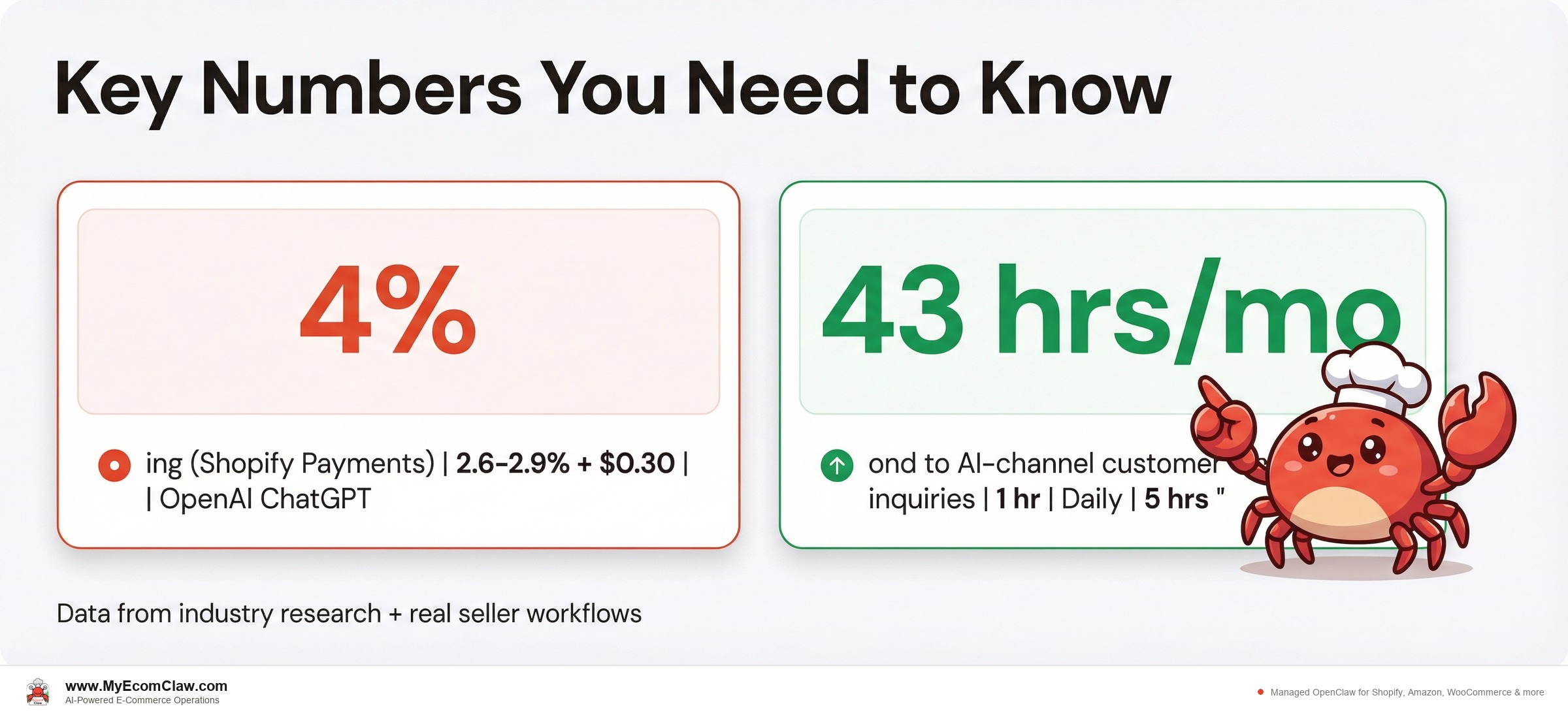
| OpenAI ChatGPT checkout fee | 4% |
| Total on a $100 ChatGPT order | ~$7.20 in fees |
That’s a 7%+ fee stack on ChatGPT orders. On a $50 product with a 40% margin, you’re handing over $3.60 just in processing — before shipping and COGS.
The part nobody mentions: Google AI Mode and Copilot charge zero. Same discoverability, zero additional fee. If you’re only optimizing for ChatGPT, you’re leaving money on the table and paying more for the privilege.
How OpenClaw handles this: Your Inventory Agent tracks which products perform on which AI channel. Your Orchestration Agent routes your catalog optimization effort toward the highest-margin channels first — whether that’s zero-fee Google AI Mode or high-converting ChatGPT. You see the real ROI per channel, not just the order count.
Built on OpenClaw — your agents run on your own server, analyzing channel performance with your actual margin data. No shared analytics platform. No comingled data. Your competitive intelligence stays yours. See plans →
Why AI Agents Ignore 40% of Your Catalog
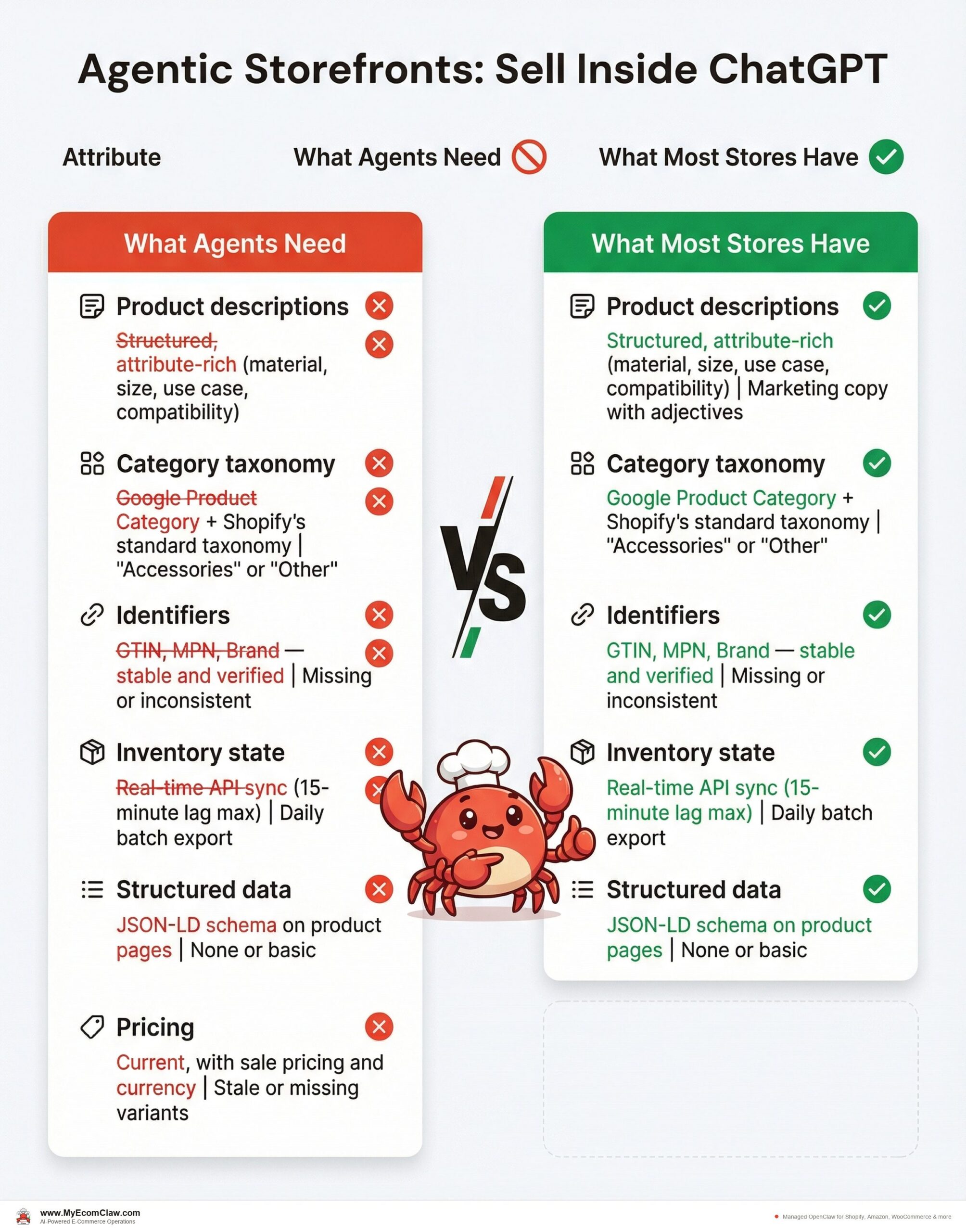
AI shopping agents don’t browse your store like a human. They parse structured product feeds. If your data is sparse, inconsistent, or missing key attributes, the agent skips your product entirely — even if you have the best price and fastest shipping.
What AI agents need but most Shopify catalogs lack:
| Attribute | What Agents Need | What Most Stores Have |
|---|---|---|
| Product descriptions | Structured, attribute-rich (material, size, use case, compatibility) | Marketing copy with adjectives |
| Category taxonomy | Google Product Category + Shopify’s standard taxonomy | "Accessories" or "Other" |
| Identifiers | GTIN, MPN, Brand — stable and verified | Missing or inconsistent |
| Inventory state | Real-time API sync (15-minute lag max) | Daily batch export |
| Structured data | JSON-LD schema on product pages | None or basic |
| Pricing | Current, with sale pricing and currency | Stale or missing variants |
A Shopify store with 2,000 SKUs and 60% attribute completeness is invisible for 800+ products across every AI channel. If your average order value is $75, that’s potentially $60,000+/month in undiscoverable revenue — across ChatGPT, Gemini, and Copilot combined.
And here’s the kicker — this isn’t a Shopify problem. Your Amazon listings might be perfectly optimized for A9 search but completely unreadable by shopping agents using the Universal Commerce Protocol.
The Universal Commerce Protocol: Why This Goes Beyond Shopify
Google, Shopify, and 20+ partners (including Walmart, Target, Mastercard, Visa, and Stripe) co-developed the Universal Commerce Protocol (UCP) — an open-source standard that lets AI agents handle the entire shopping journey across any merchant, any platform.
What UCP means for multi-channel sellers:
- AI agents can discover, compare, and complete purchases across Shopify, Amazon, WooCommerce, and Walmart — using one protocol
- Product data must be structured to UCP specs, not just platform-specific formats
- Merchants who optimize for UCP get discovered across every AI surface that adopts it
- It works with Agent2Agent (A2A) protocol and Model Context Protocol (MCP) for direct agent-to-agent communication
How OpenClaw handles this: OpenClaw natively supports MCP — the same protocol UCP builds on. Your five agents already speak the language that AI shopping agents use to discover and transact with merchants. MyEcomClaw configures your Inventory Agent to maintain UCP-compatible product feeds across Shopify, Amazon, and WooCommerce simultaneously.
Most sellers will spend months figuring out UCP. Your OpenClaw agents are already built on the same foundation.
The WhatsApp Conversation: Getting Agent-Ready
Here’s what it looks like when a merchant talks to their OpenClaw agent about Agentic Storefronts:
“I just turned on Agentic Storefronts in Shopify. Am I getting any AI orders?”
“You enabled ChatGPT and Google AI Mode yesterday. So far: 3 orders from Google AI Mode ($247 total), 0 from ChatGPT. I flagged an issue — 412 of your 1,100 SKUs have incomplete structured attributes. AI agents are skipping them. Want me to generate an enrichment report?”
“Yes. Which products are getting ignored?”
“Your top 50 revenue SKUs are fine — I prioritized those during onboarding. The gaps are in your accessories category: 238 SKUs missing GTIN, 174 missing material attributes, and 89 with generic category tags. I’ve drafted enrichment suggestions for the top 100 by revenue potential. Sending the report now.”
“What about my Amazon listings? Are those showing up in AI search too?”
“Your Amazon SP-API feed is synced. 847 of 920 Amazon SKUs have complete structured data — Amazon’s listing requirements actually helped here. I’m cross-referencing your Amazon attribute data to fill gaps in your Shopify catalog. Should save you manual work on ~150 SKUs.”
“Do it. And tell me if any ChatGPT orders come through — I want to track that 4% fee.”
“On it. I’ll tag ChatGPT orders separately in your daily briefing and calculate the net margin after the 4% OpenAI fee. You’ll see a per-channel ROI breakdown every morning.”
Before & After: Manual vs. Agent-Managed Agentic Commerce
Before: Manual Agentic Storefront Management
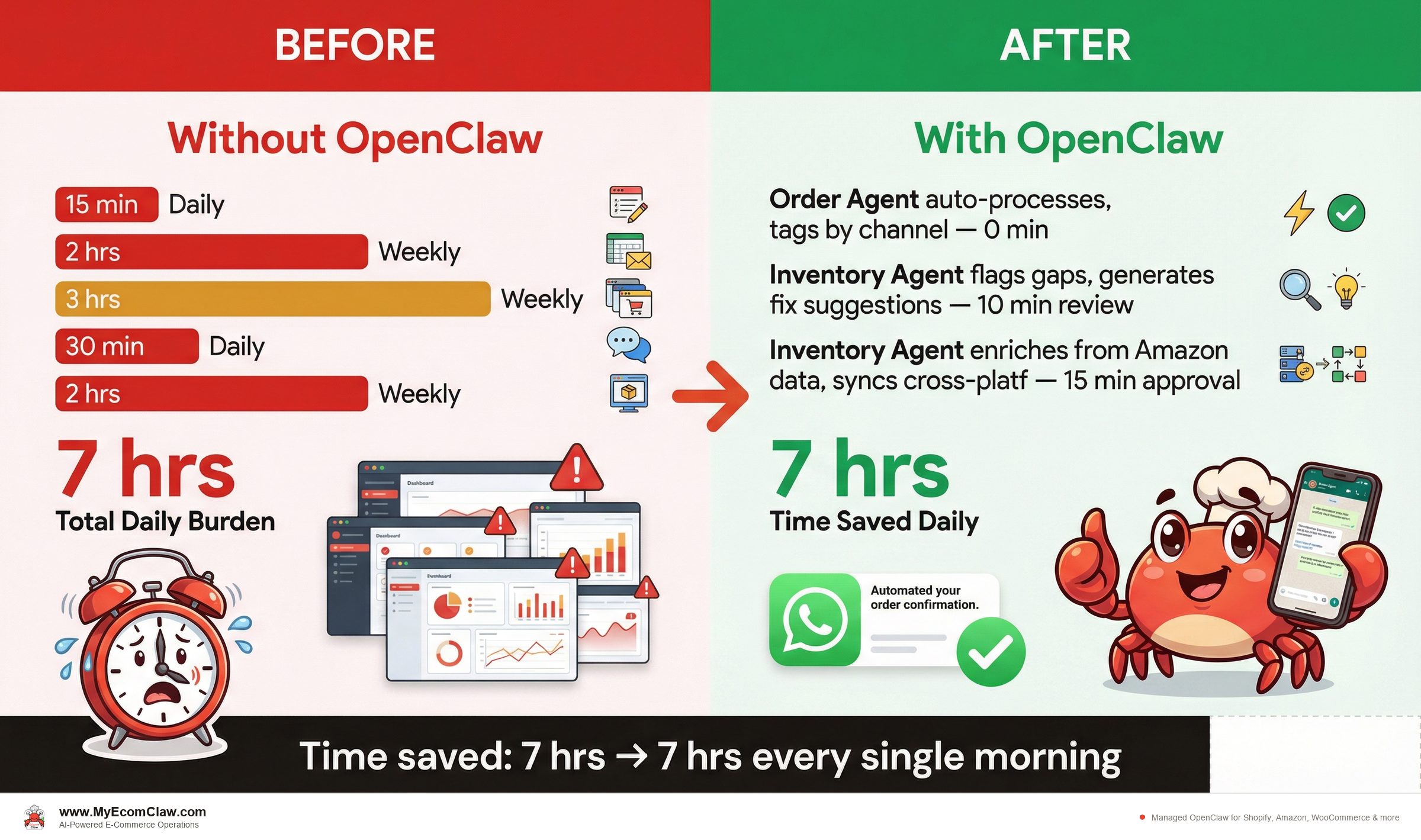
| Task | Time | Frequency | Monthly Hours |
|---|---|---|---|
| Check each AI channel for orders manually | 15 min | Daily | 7.5 hrs |
| Audit product data for AI readiness | 2 hrs | Weekly | 8 hrs |
| Update structured attributes per channel | 3 hrs | Weekly | 12 hrs |
| Monitor ChatGPT fee impact on margins | 30 min | Daily | 2.5 hrs |
| Cross-reference Amazon/Shopify catalog gaps | 2 hrs | Weekly | 8 hrs |
| Respond to AI-channel customer inquiries | 1 hr | Daily | 5 hrs |
| Total | 43 hrs/mo |
After: OpenClaw Agents Handle It
| Task | How Your Agent Handles It | Your Time |
|---|---|---|
| AI channel order monitoring | Order Agent auto-processes, tags by channel | 0 min |
| Product data audit | Inventory Agent flags gaps, generates fix suggestions | 10 min review |
| Structured attribute updates | Inventory Agent enriches from Amazon data, syncs cross-platform | 15 min approval |
| ChatGPT fee tracking | Orchestration Agent calculates net margin per channel daily | 0 min (in briefing) |
| Cross-platform catalog sync | Inventory Agent maps SKUs across Shopify + Amazon + WooCommerce | 0 min |
| AI-channel support tickets | Support Agent handles WISMO, returns, FAQ — escalates edge cases | 10 min/day |
| Total | ~7 hrs/mo |
43 hours/month manually vs. ~7 hours/month with OpenClaw agents. At a founder’s rate of $100/hour, that’s $3,600/month in recovered time. MyEcomClaw starts at $299/month. The ROI is 12:1 before you count the revenue from products that are now actually discoverable. See plans →
Multi-Platform Proof: Shopify + Amazon + WooCommerce
Agentic Storefronts is Shopify-first. But AI shopping agents don’t care which platform you sell on — they care about structured data. If you sell on multiple channels, you need agent-ready data everywhere.
Shopify: Agentic Storefronts + Shopify Catalog handles syndication to ChatGPT, Gemini, and Copilot. Your Inventory Agent ensures attribute completeness and real-time sync.
Amazon: Amazon’s SP-API already enforces structured data standards. Your Inventory Agent cross-references Amazon’s richer attribute data to fill Shopify catalog gaps — turning Amazon’s strict listing requirements into an asset.
WooCommerce: No native agentic storefront feature yet. But UCP is platform-agnostic. Your Inventory Agent structures WooCommerce product data to UCP specs so AI agents can discover your WooCommerce catalog alongside Shopify and Amazon.
Built on OpenClaw — deployed on your own server with pre-built skills for Shopify, Amazon, and WooCommerce. Five agents manage your catalog across every channel. Your data stays on your infrastructure. Starting at $299/month. Talk to us →
What Reddit Is Saying
Real merchants are navigating this shift right now:
"Turned on agentic storefronts last week. Got 2 orders from Gemini, zero from ChatGPT. My product descriptions are basically marketing fluff — I think the AI can’t parse them." — r/shopify
"The 4% ChatGPT fee is wild. I’m already paying 2.9% + Shopify’s cut. Google AI Mode is free. Why would I prioritize ChatGPT?" — r/shopify
"My Amazon listings have way better structured data than my Shopify catalog. If there was a way to pull that attribute data over to Shopify automatically, I’d pay for it." — r/ecommerce
Every one of these problems — unstructured data, fee tracking, cross-platform catalog sync — is exactly what OpenClaw agents handle on autopilot.
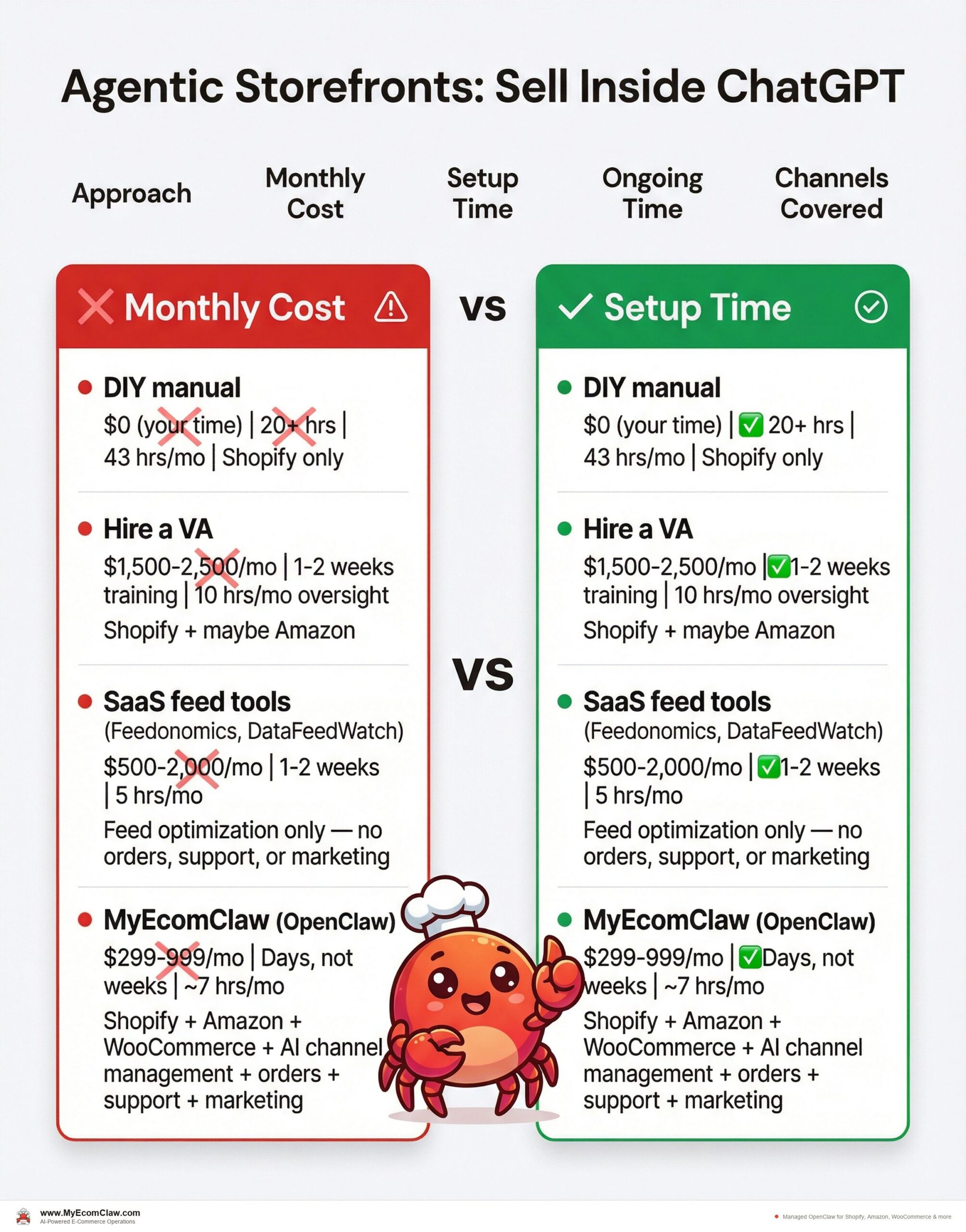
Cost & Time Savings: Manual Optimization vs. MyEcomClaw
| Approach | Monthly Cost | Setup Time | Ongoing Time | Channels Covered |
|---|---|---|---|---|
| DIY manual | $0 (your time) | 20+ hrs | 43 hrs/mo | Shopify only |
| Hire a VA | $1,500-2,500/mo | 1-2 weeks training | 10 hrs/mo oversight | Shopify + maybe Amazon |
| SaaS feed tools (Feedonomics, DataFeedWatch) | $500-2,000/mo | 1-2 weeks | 5 hrs/mo | Feed optimization only — no orders, support, or marketing |
| MyEcomClaw (OpenClaw) | $299-999/mo | Days, not weeks | ~7 hrs/mo | Shopify + Amazon + WooCommerce + AI channel management + orders + support + marketing |
Feed management tools cost $500-2,000/month and only handle product data. MyEcomClaw starts at $299/month and covers catalog optimization, order processing, inventory sync, customer support, and marketing — across Shopify, Amazon, and WooCommerce. Five agents, one server, all channels.
Why This Matters
If you’re a Shopify seller doing 1,000+ orders per month, Agentic Storefronts is the biggest distribution shift since marketplace selling. AI-driven orders are up 15x. Conversion rates from agentic traffic hit 15-30%. But only if AI agents can actually parse your product data — and right now, 40%+ of most catalogs are invisible.
This isn’t optional. Every day your catalog isn’t agent-ready is a day your competitors are capturing AI-driven orders you’ll never see.
Our take: The five-minute setup is the easy part. The hard part — structured data, real-time sync, cross-platform catalog consistency, fee optimization — is exactly the kind of operational work that AI agents were built to handle. OpenClaw agents do this on autopilot, on your server, across Shopify, Amazon, and WooCommerce. MyEcomClaw deploys and manages the whole thing for you, starting at $299/month.
You could spend 43 hours a month doing this manually. Or you could let your agents do it while you sleep.
Get your agent running → | Talk to us →
FAQ
How do I enable Shopify Agentic Storefronts?
Go to Settings > Apps and sales channels in your Shopify admin. Find the Agentic storefronts section, select the AI channel (ChatGPT, Google AI Mode, or Copilot), and toggle it on. Install Shopify’s Knowledge Base app to feed AI agents your brand and policy data. The whole process takes under five minutes — but optimizing your catalog for AI discoverability is the real work.
Does the 4% ChatGPT fee apply to all agentic storefront orders?
No. The 4% fee is OpenAI-specific, charged on completed transactions through ChatGPT checkout. Google AI Mode and Microsoft Copilot currently charge zero additional fees. Your OpenClaw Orchestration Agent tracks per-channel margins so you can prioritize the highest-ROI channels.
Do Agentic Storefronts work for non-U.S. stores?
Currently, Shopify’s Agentic Storefronts are in early access for U.S.-based stores selling to U.S. customers. Expansion is expected. MyEcomClaw supports merchants globally — when agentic storefronts open to your region, your catalog will already be optimized and agent-ready.
How do I make my products visible to AI shopping agents?
AI agents need structured product data: complete attributes (material, dimensions, use case), stable identifiers (GTIN, MPN), proper category taxonomy, real-time inventory sync, and JSON-LD schema markup. Your OpenClaw Inventory Agent audits your catalog, flags gaps, and generates enrichment suggestions automatically.
What about my Amazon and WooCommerce products — do they show up in AI search?
Shopify Agentic Storefronts only syndicate Shopify catalog data. But the Universal Commerce Protocol (UCP) is platform-agnostic. Your OpenClaw agents structure product data across Shopify, Amazon, and WooCommerce to UCP specs — so AI agents can discover your entire catalog, regardless of which platform hosts it. See plans →
Can I track which AI channel drives the most revenue?
Yes. Shopify shows channel attribution for agentic storefront orders. Your OpenClaw Orchestration Agent goes further — calculating net margin per channel after fees (including the 4% ChatGPT fee), comparing conversion rates across AI surfaces, and delivering a daily ROI breakdown via WhatsApp or Slack. Talk to us →