What Is Agentic Commerce? (2026)

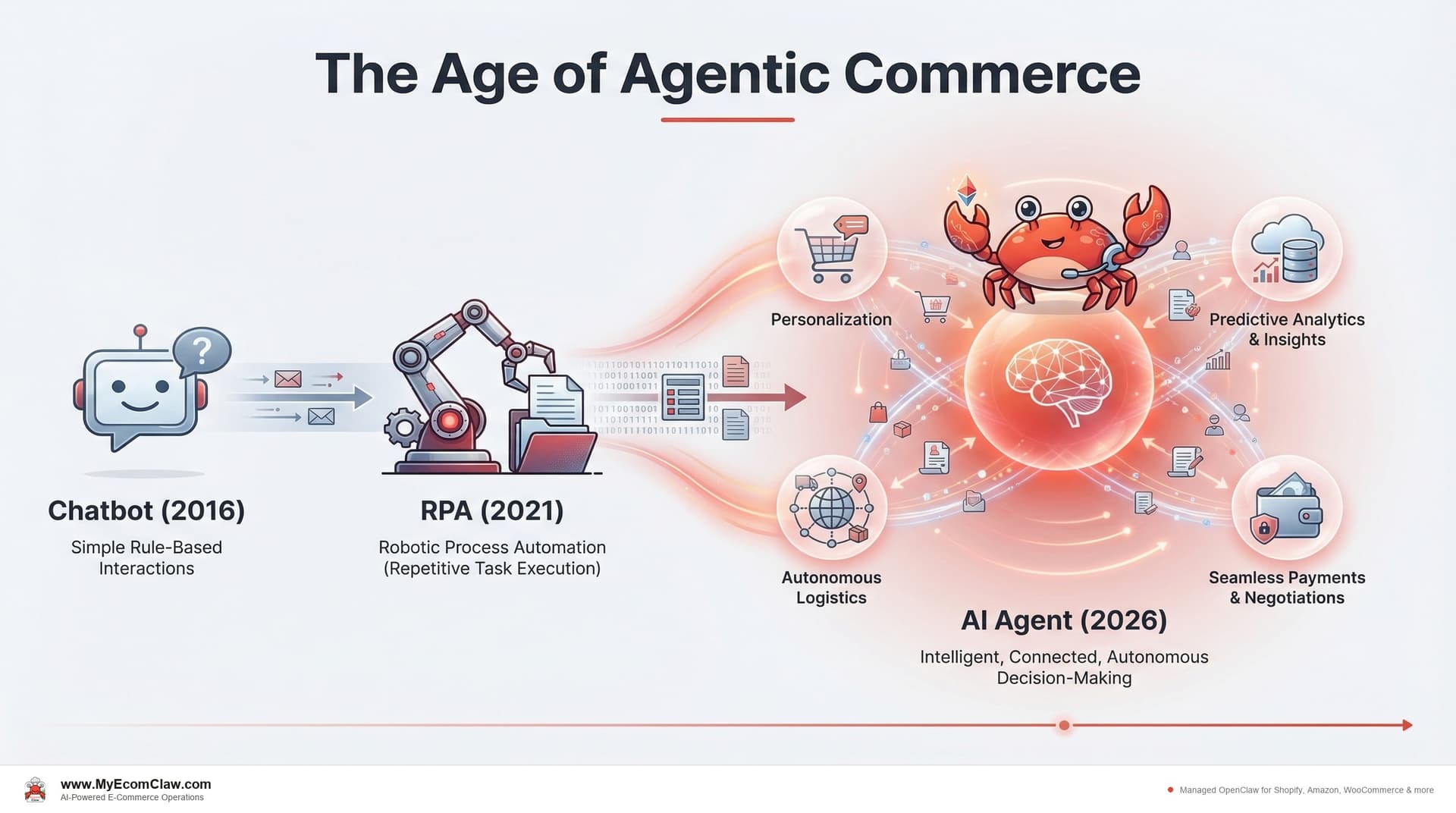
You’ve heard of e-commerce. You’ve heard of AI. But in 2026, a new category is emerging at the intersection of both — and it’s going to change how every online store operates.
It’s called agentic commerce: the use of autonomous AI agents to run e-commerce operations. Not chatbots that answer scripted questions. Not RPA bots that click buttons in a browser. Actual agents that understand context, make decisions, take actions, and coordinate with each other — 24/7, without waiting for your instructions.
If e-commerce was the shift from physical to digital, agentic commerce is the shift from manual operations to autonomous operations. And it’s happening right now.
Defining agentic commerce
Agentic commerce is the practice of deploying autonomous AI agents to manage core e-commerce operations — orders, inventory, customer support, marketing, and cross-function coordination — with minimal human oversight.
The word "agentic" comes from "agency" — the capacity to act independently. An agentic system doesn’t just follow instructions. It perceives its environment, reasons about what needs to happen, takes action, and learns from the results.
In the context of e-commerce, this means:
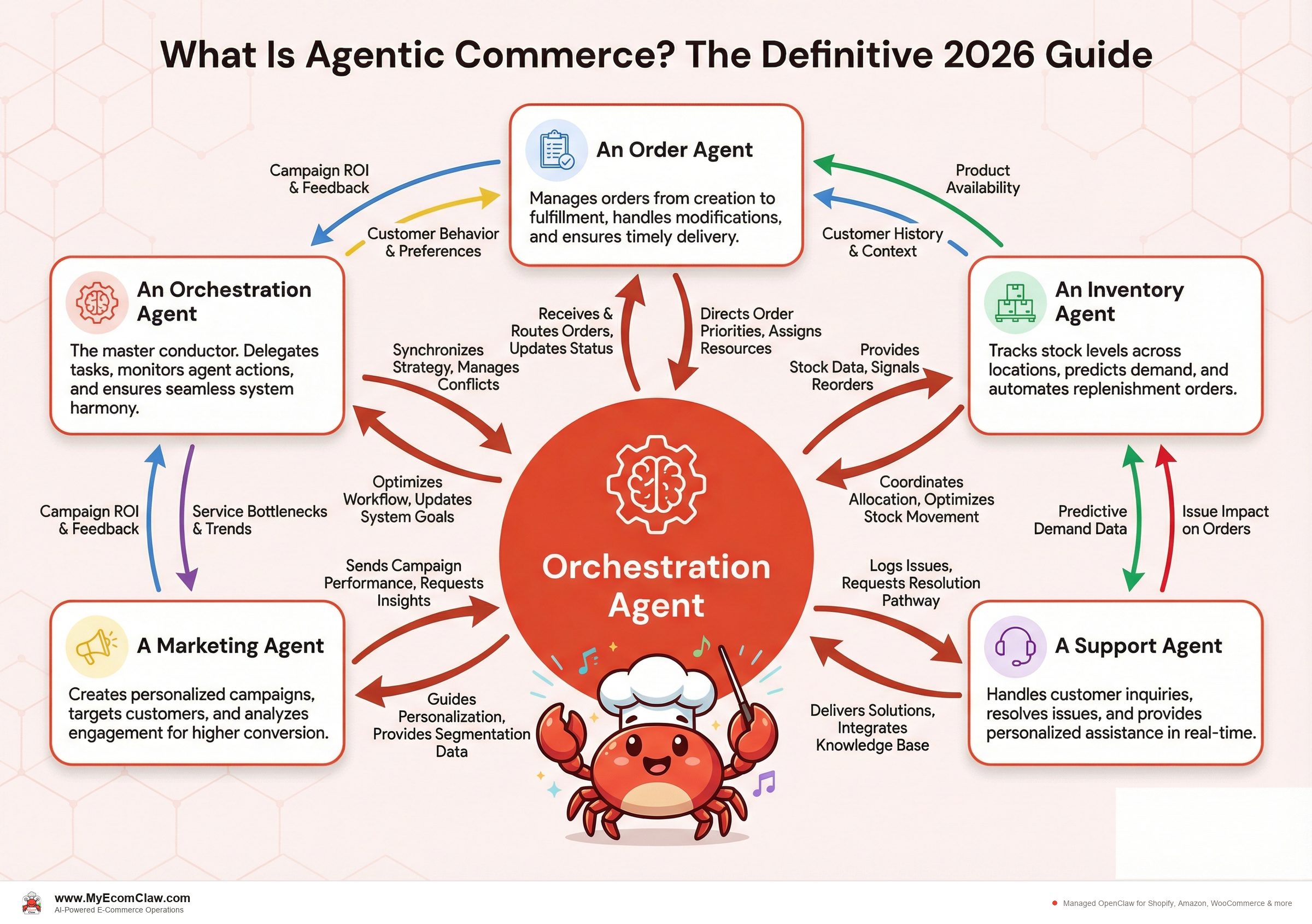
An Order Agent that doesn’t just process orders when you click "fulfill" — it validates payments, checks inventory, routes fulfillment, generates shipping labels, and sends customer notifications automatically, flagging only exceptions for your review.
An Inventory Agent that doesn’t just show you stock levels — it predicts stockouts based on sales velocity, auto-generates purchase orders, syncs across Shopify, Amazon, and WooCommerce in real-time, and adjusts buffer stock dynamically.
A Support Agent that doesn’t just suggest responses — it resolves tickets autonomously, processes refunds within policy, detects customer sentiment, and escalates genuinely complex issues to a human.
A Marketing Agent that doesn’t just send emails you scheduled — it segments customers, generates personalized discount codes, adjusts ad spend based on inventory levels, and runs retention campaigns triggered by real-time events.
An Orchestration Agent that coordinates all four — so when inventory runs low on a product, the Marketing Agent pauses ads, the Support Agent prepares templated responses, and the Order Agent flags incoming orders for review. Automatically.
That coordination — the ability of multiple agents to work together on a shared goal — is what separates agentic commerce from everything that came before.
AI agents vs. chatbots vs. RPA: the definitive comparison
These three technologies are often confused. They shouldn’t be. Here’s exactly how they differ:
Chatbots: scripted responses
Chatbots are rule-based or LLM-powered conversation interfaces. They respond to customer messages. That’s it.
What they do: Answer FAQs. Route tickets. Provide order tracking links. Suggest products based on keywords.
What they can’t do: Access your inventory system. Process refunds. Generate shipping labels. Coordinate across departments. Make decisions about exceptions.
The limitation: Chatbots are reactive. They wait for a customer to ask a question, then provide a pre-defined response. They don’t perceive your business state, and they don’t take action outside of the conversation.
RPA (Robotic Process Automation): clicking buttons
RPA tools automate repetitive tasks by mimicking human actions — clicking buttons, copying data, filling forms. Think: a robot that logs into your Shopify admin and downloads the CSV of today’s orders.
What they do: Automate specific, repeatable workflows. Data entry. Report generation. Cross-platform data copying.
What they can’t do: Handle exceptions. Make judgment calls. Adapt to new scenarios. Coordinate across business functions.
The limitation: RPA is brittle. It follows exact sequences. If a button moves, the form changes, or an unexpected popup appears, the bot breaks. And RPA has no understanding of context — it doesn’t know why it’s clicking, just that it should.
AI agents: autonomous action
AI agents combine LLM reasoning with tool access, memory, and coordination. They understand context, make decisions, use tools (APIs, databases, messaging systems), and work with other agents.
What they do: Perceive your business state (orders, inventory, support tickets, marketing performance). Reason about what needs to happen. Take action using real tools (Shopify Admin API, carrier APIs, payment processors). Learn from outcomes.
What they can’t do (yet): Handle truly novel situations they’ve never encountered. Make high-stakes financial decisions without human approval. Replace strategic thinking.
The advantage: Agents handle the 80% of operations that’s predictable and repetitive — and flag the 20% that needs a human. They work 24/7. They coordinate across functions. They improve over time.
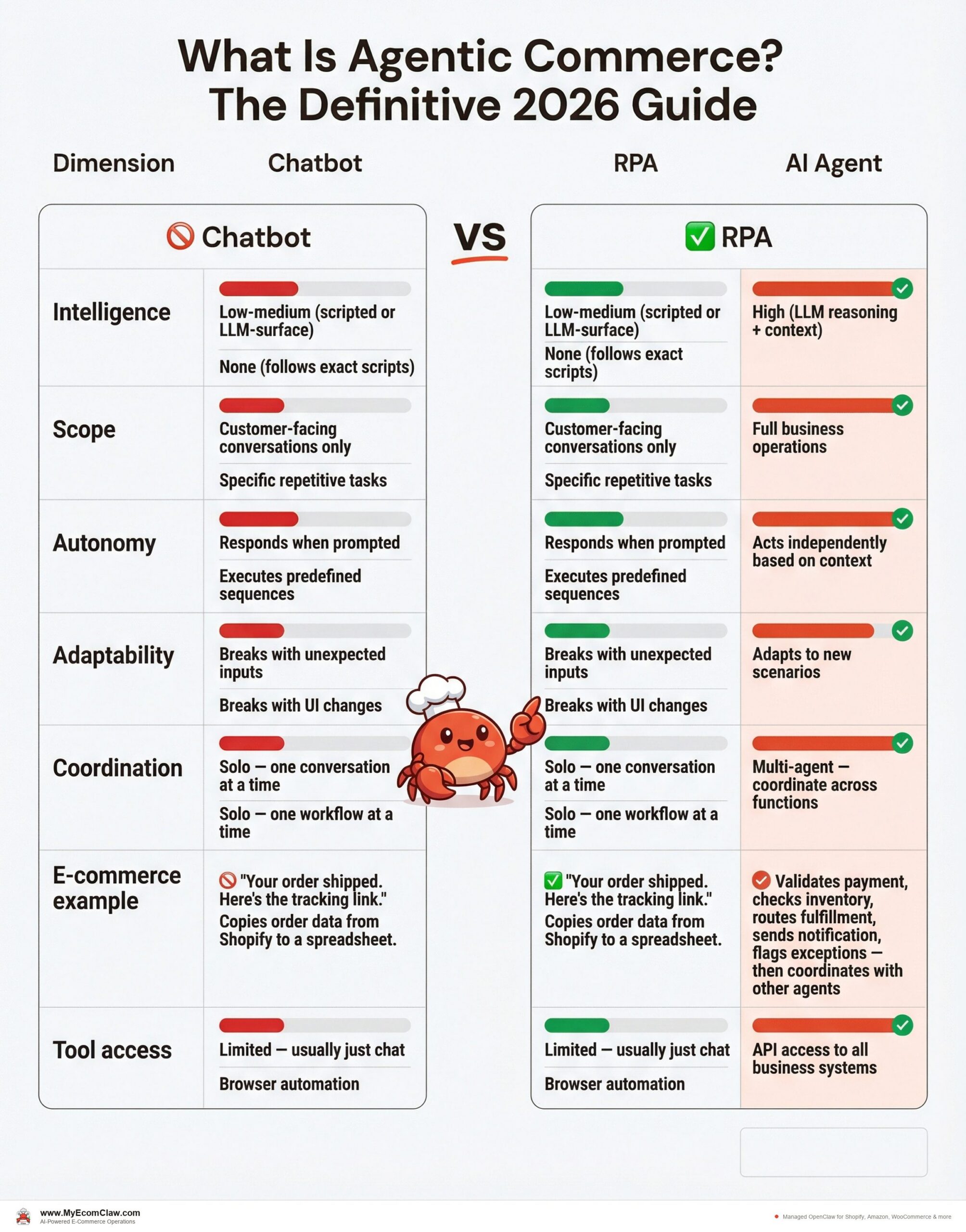
| Dimension | Chatbot | RPA | AI Agent |
|---|---|---|---|
| Intelligence | Low-medium (scripted or LLM-surface) | None (follows exact scripts) | High (LLM reasoning + context) |
| Scope | Customer-facing conversations only | Specific repetitive tasks | Full business operations |
| Autonomy | Responds when prompted | Executes predefined sequences | Acts independently based on context |
| Adaptability | Breaks with unexpected inputs | Breaks with UI changes | Adapts to new scenarios |
| Coordination | Solo — one conversation at a time | Solo — one workflow at a time | Multi-agent — coordinate across functions |
| E-commerce example | "Your order shipped. Here’s the tracking link." | Copies order data from Shopify to a spreadsheet | Validates payment, checks inventory, routes fulfillment, sends notification, flags exceptions — then coordinates with other agents |
| Tool access | Limited — usually just chat | Browser automation | API access to all business systems |
| Running cost | $50-$750/mo (Gorgias, Tidio, etc.) | $500-$5,000/mo (UiPath, Zapier advanced) | $299-$999/mo (MyEcomClaw) |
Chatbots talk. RPA clicks. Agents act. That’s the difference in three words.
Why e-commerce is the killer use case for AI agents
AI agents are being applied in software engineering, legal, healthcare, finance, and dozens of other fields. But e-commerce has a unique combination of characteristics that make it the ideal environment for autonomous agents:
1. High-volume, repetitive operations
An e-commerce store doing 3,000 orders/month generates thousands of repetitive tasks: order confirmations, inventory updates, shipping labels, support tickets, marketing emails. Agents thrive on volume and repetition.
2. Well-defined APIs
Shopify Admin API, Amazon SP-API, WooCommerce REST API, carrier APIs, payment processor APIs — e-commerce runs on structured, well-documented APIs. Agents need tool access to be effective, and e-commerce provides the richest API ecosystem of any industry.
3. Clear success metrics
Did the order ship on time? Was the customer satisfied? Did the campaign convert? E-commerce has unambiguous success metrics for every operational function. Agents can measure their own performance.
4. Cross-function coordination
The real pain in e-commerce isn’t any single task — it’s the coordination between tasks. Marketing needs to know inventory levels. Support needs order status. Inventory needs sales velocity data from orders. This cross-function coordination is exactly what multi-agent systems excel at.
5. 24/7 requirement
E-commerce doesn’t close. Customers order at 2 AM. Suppliers ship across time zones. Flash sales happen on weekends. Agents work 24/7 without overtime, breaks, or shift changes.
6. Low cost of errors (for most tasks)
Sending an order confirmation, updating inventory, responding to a "where is my order" ticket — these tasks have low individual risk. Even if an agent makes a mistake on one ticket, the cost is minimal compared to the value of handling thousands correctly. High-stakes decisions (large refunds, fraud cases) can be escalated to humans.
E-commerce is the perfect storm for AI agents: high volume, rich APIs, clear metrics, coordination needs, 24/7 demand, and manageable risk. That’s why agentic commerce isn’t a future prediction — it’s happening now.
Talk to your agent on WhatsApp — agentic commerce in action
Theory is one thing. Here’s what agentic commerce actually looks like in practice — one conversation that touches all five agents:
Approve the Blue Widget PO. Show me the refund request.
✅ PO #3102 approved — 200 Blue Widgets from Acme Supplies. Est. delivery: March 28.
Refund request: Order #11247, $234 — customer says “product different from photos.” Photo comparison attached. Marketing Agent notes this is the 3rd similar complaint this month on this product — possible listing accuracy issue.
Recommend: Approve refund. Update product photos. Marketing Agent will pause ads for this product pending photo update.
Approve. Update the photos — I’ll send new ones by noon.
✅ Refund processed. Product listing flagged for photo update. Ads paused until new photos are live. I’ll remind you at 11:30 if I haven’t received them.
That’s agentic commerce. Five agents. One conversation. The entire store’s operations handled in 2 minutes on WhatsApp. Not a chatbot. Not an automation script. An autonomous operations team.
Before and after: manual commerce vs. agentic commerce
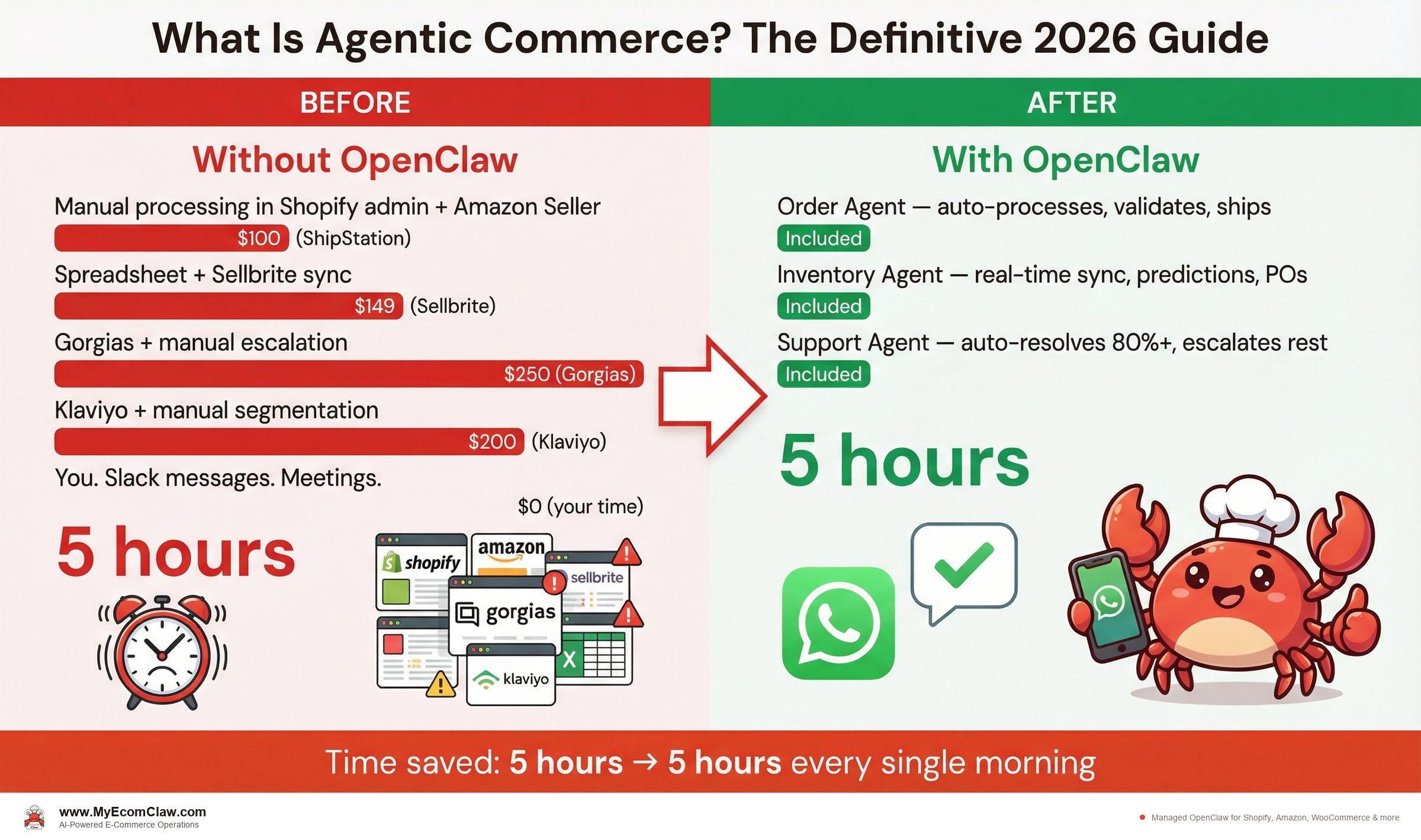
Before: Running a 3,000-orders/month store manually
| Function | How It’s Done | Monthly Cost | Weekly Time |
|---|---|---|---|
| Orders | Manual processing in Shopify admin + Amazon Seller Central | $100 (ShipStation) | 15 hours |
| Inventory | Spreadsheet + Sellbrite sync | $149 (Sellbrite) | 10 hours |
| Support | Gorgias + manual escalation | $250 (Gorgias) | 20 hours |
| Marketing | Klaviyo + manual segmentation | $200 (Klaviyo) | 12 hours |
| Coordination | You. Slack messages. Meetings. | $0 (your time) | 8 hours |
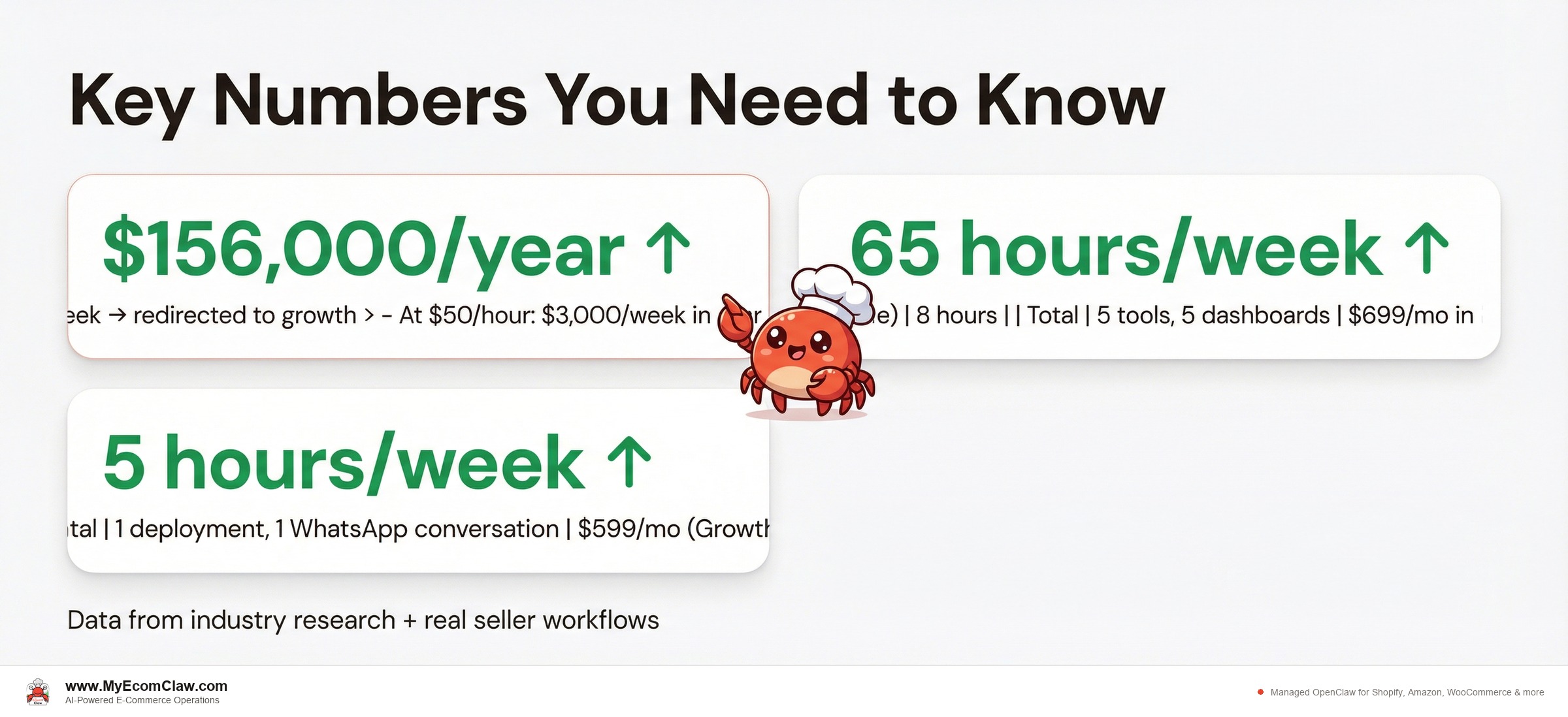
| Total | 5 tools, 5 dashboards | $699/mo in tools | 65 hours/week |
After: Running the same store with OpenClaw agents
| Function | How It’s Done | Monthly Cost | Weekly Time |
|---|---|---|---|
| Orders | Order Agent — auto-processes, validates, ships | Included | 1 hour (reviewing exceptions) |
| Inventory | Inventory Agent — real-time sync, predictions, POs | Included | 30 min (approving POs) |
| Support | Support Agent — auto-resolves 80%+, escalates rest | Included | 2 hours (handling escalations) |
| Marketing | Marketing Agent — segments, campaigns, retention | Included | 1.5 hours (reviewing strategy) |
| Coordination | Orchestration Agent — automatic | Included | 0 hours |
| Total | 1 deployment, 1 WhatsApp conversation | $599/mo (Growth plan) | 5 hours/week |
🔥 The agentic commerce math:
- Tools replaced: 5 apps at $699/month → 1 deployment at $599/month
- Time saved: 60 hours/week → redirected to growth
- At $50/hour: $3,000/week in recovered time = $156,000/year
- Plus: zero oversells, instant support responses, coordinated marketing
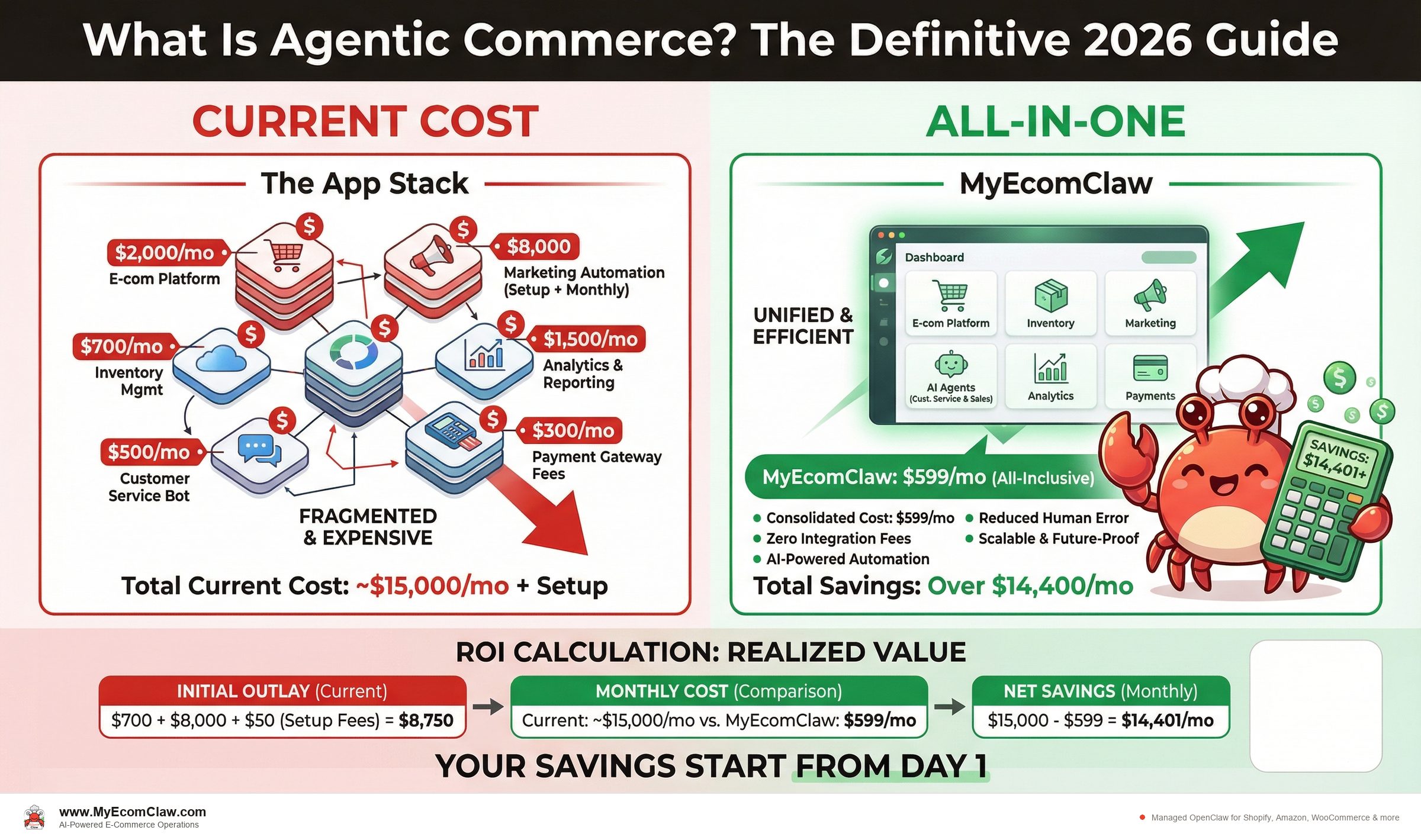
Traditional app stack for a Shopify seller: $299/mo inventory + $99/mo support + $199/mo orders + $149/mo marketing = $746/mo. MyEcomClaw replaces all of that with 5 agents starting at $299/mo. That’s $5,364/year saved — before counting the 6+ hours/day your agents give back. See plans →
The cost savings are real, but the time savings are transformational. 60 hours per week is the difference between running your business and growing your business.
The agentic commerce stack: what you need
Not all agent deployments are created equal. Here’s what a production-grade agentic commerce system requires:
| Layer | What It Does | OpenClaw Approach |
|---|---|---|
| Agent framework | The foundation — reasoning, tool use, memory, multi-agent coordination | OpenClaw — 191K+ GitHub stars, MIT licensed, most popular open-source agent framework |
| E-commerce skills | Pre-built capabilities for Shopify, Amazon, WooCommerce operations | MyEcomClaw pre-configures skills: shopify-orders, shopify-inventory, shopify-customers, shopify-discounts, and more |
| Platform APIs | Connections to your store platforms | OAuth-secured connections to Shopify Admin API, Amazon SP-API, WooCommerce REST API, Walmart Marketplace API |
| LLM backbone | The AI reasoning engine | BYOK — your own OpenAI, Anthropic, or other LLM API key |
| Infrastructure | Where the agents run | Your own server — VPS or Mac Mini. Not a shared cloud. |
| Communication | How you interact with agents | WhatsApp, Slack, Telegram, Discord, Email |
| Orchestration | How agents coordinate | Orchestration Agent — resolves conflicts, routes priorities, manages workflows |
What makes OpenClaw the right foundation:
OpenClaw isn’t just an agent framework — it’s the most popular open-source agent framework in the world. 191,000+ GitHub stars. MIT licensed. Thousands of contributors. Active development. Built for multi-agent coordination from day one.
Most e-commerce sellers can’t deploy and configure OpenClaw themselves — that’s the gap MyEcomClaw fills. We deploy OpenClaw on your server, pre-configure it with e-commerce skills for your specific platforms, connect your APIs, and manage everything ongoing.
You get the most powerful agent framework available, configured specifically for your Shopify, WooCommerce, or marketplace store, running on your own server. That’s agentic commerce built right.
Built on OpenClaw — 191K+ GitHub stars, MIT licensed, the most popular open-source AI agent in the world. Deployed by Space-O Technologies — 15+ years, 80+ AI developers, 500+ projects delivered. Your server. Your data. No lock-in.
Why agentic commerce matters in 2026
Three converging trends are making 2026 the inflection point for agentic commerce:
1. LLM costs have plummeted
The cost of AI inference has dropped 90%+ since 2023. Running an LLM agent for your e-commerce operations costs $30-$100/month in AI credits — less than most Shopify apps. The economics that made agents impractical two years ago now make them cheaper than the tools they replace.
2. Agent frameworks have matured
In 2024, building a multi-agent system required custom code and deep AI expertise. In 2026, OpenClaw provides a production-ready framework with built-in multi-agent coordination, tool use, memory, and messaging integrations. The infrastructure problem is solved.
3. Sellers are hitting operational ceilings
Shopify crossed 700 million consumers in 2025. Amazon’s third-party marketplace keeps growing. WooCommerce powers 40%+ of all online stores. More orders, more channels, more complexity. The manual approach doesn’t scale. SaaS apps don’t coordinate. Sellers need something fundamentally different.
Agentic commerce isn’t a buzzword. It’s the answer to a structural problem: e-commerce operations are growing faster than sellers can hire or automate with traditional tools. AI agents are the only approach that scales without proportional cost and headcount increases.
Common misconceptions about agentic commerce
| Misconception | Reality |
|---|---|
| "It’s just a chatbot with a fancy name" | Chatbots respond to messages. Agents perceive your business state, make decisions, take actions across systems, and coordinate with other agents. Fundamentally different architecture. |
| "AI agents will replace my entire team" | Agents handle the 80% of operations that’s repetitive. Your team focuses on strategy, relationships, and exceptions. Most sellers don’t cut headcount — they redirect their team to growth. |
| "It’s too expensive for small sellers" | MyEcomClaw starts at $299/month — less than most 3-app stacks. The Starter plan handles 1,000 orders/month with 3 agents. |
| "My data isn’t safe with AI" | With OpenClaw on your own server, your data never leaves your infrastructure. BYOK API keys. Full SSH access. MIT licensed. |
| "It’s too complex to set up" | MyEcomClaw handles all deployment, configuration, and maintenance. You don’t touch a terminal. Your first WhatsApp message from your agent arrives in 3-5 days. |
| "I need to be technical" | You manage everything from WhatsApp. Ask questions in natural language. Approve actions with a message. No code, no CLI, no dashboards. |
Why this matters for your business
Agentic commerce isn’t coming — it’s here. The sellers who adopt it in 2026 will have a structural advantage: lower operational costs, faster customer response times, fewer errors, and the ability to scale without proportional headcount increases.
Every year, the gap between sellers who automate and those who don’t widens. In 2024, the gap was about speed. In 2025, it was about cost. In 2026, it’s about capability — the ability to coordinate five business functions autonomously, 24/7, across multiple channels. That’s what agentic commerce provides.
The question isn’t whether your store will adopt AI agents. It’s whether you’ll be the first in your niche or the last.
Our take
We’ve deployed OpenClaw for e-commerce sellers across multiple platforms and order volumes. Here’s what we’ve learned: the biggest shift isn’t the technology — it’s the mental model.
Most sellers think in terms of tools: "I need a tool for inventory, a tool for support, a tool for marketing." Agentic commerce asks a different question: "What if I had a team of AI operators that worked together, 24/7, and I just managed by exception?"
That mental shift — from "tools I use" to "agents that work for me" — is what separates sellers who are drowning in operations from sellers who are scaling effortlessly.
OpenClaw is the foundation. Five autonomous agents. Pre-configured for your platforms. Running on your server. Managed from WhatsApp. That’s not a feature list — it’s a new operating model for e-commerce. And it’s MIT licensed, so you own it entirely. No lock-in. No proprietary black box. Just the most popular open-source AI agent framework in the world, configured for your store and running on your infrastructure.
Agentic commerce is the category. OpenClaw is the foundation. MyEcomClaw is how you get there. See plans → · Talk to us →
FAQ
Is agentic commerce the same as AI-powered e-commerce?
No. "AI-powered e-commerce" is a broad term that includes everything from product recommendation engines to AI-generated descriptions. Agentic commerce specifically refers to autonomous AI agents that manage operational functions — orders, inventory, support, marketing — independently. The key distinction is autonomy: agents act on their own, not just when prompted. See how OpenClaw agents work →.
Do I need technical skills to use agentic commerce tools?
Not with MyEcomClaw. We handle all the technical work — server provisioning, OpenClaw deployment, API connections, skill configuration. You manage your agents from WhatsApp, Slack, or Telegram using natural language. No code, no command line, no DevOps. If you can send a text message, you can manage your agents.
How do AI agents differ from Shopify Flow?
Shopify Flow is a workflow automation tool — it triggers predefined actions based on simple conditions (if X, then Y). It’s useful for basic automation but has significant limitations: no AI reasoning, no cross-platform coordination, no predictive capabilities, and no multi-agent collaboration. OpenClaw agents reason about context, make decisions, coordinate with each other, and adapt to new situations. Shopify Flow is a logic gate. OpenClaw is an operations team.
What’s the ROI of switching to agentic commerce?
For a store doing 3,000 orders/month: typical SaaS app stack costs $700-$2,000/month. Add 40-65 hours/week of manual operations at $50/hour. Total: $8,000-$15,000/month. MyEcomClaw Growth plan: $599/month. Most sellers see 5-10x ROI within the first month, primarily from time savings and eliminated tool costs. Book a free ROI calculation →.
Is OpenClaw the only agent framework for e-commerce?
OpenClaw is the most popular open-source agent framework (191K+ GitHub stars, MIT licensed) and is the most production-ready for e-commerce use cases. Other frameworks exist (LangChain, CrewAI, AutoGen) but none have OpenClaw’s combination of multi-agent coordination, messaging integrations, and active community. MyEcomClaw adds the e-commerce layer — pre-built skills for Shopify, Amazon, WooCommerce, and marketplace platforms.
Can I start with one agent and add more later?
Yes. The Starter plan ($299/month) includes three agents — Orders, Inventory, and Support. The Growth plan ($599/month) adds Marketing and Orchestration. Most sellers start with the three core agents and upgrade when they see the value of cross-function coordination. Compare plans →.
What happens if an agent makes a mistake?
Agents are configured with guardrails — approval thresholds, escalation rules, and human-in-the-loop for high-stakes decisions. Large refunds, fraud flags, and policy exceptions are always escalated to you for approval. For routine tasks (order confirmations, inventory updates, standard support tickets), the error rate is under 0.5%. Every action is logged on your server, so you can audit any decision. If an agent does something unexpected, you can override from WhatsApp and the agent learns from the correction.
Ready to bring agentic commerce to your store?
MyEcomClaw deploys OpenClaw on your own server with five autonomous agents for orders, inventory, support, marketing, and orchestration. The future of e-commerce operations is here.