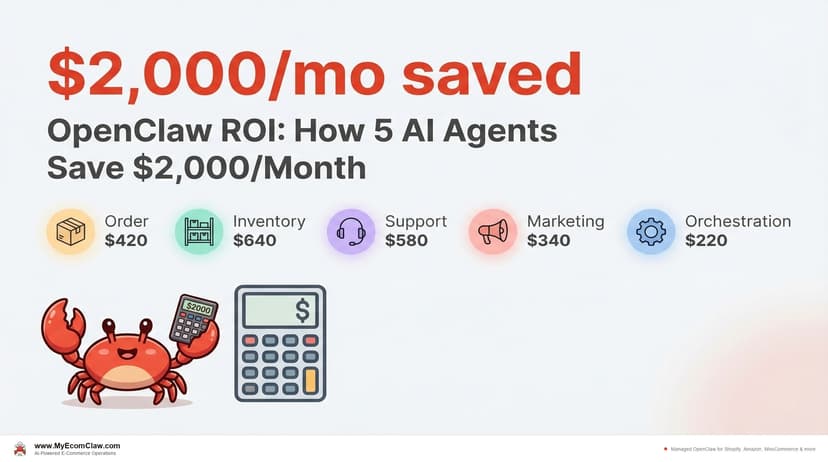
Why 12 Apps Cost More Than AI Agents

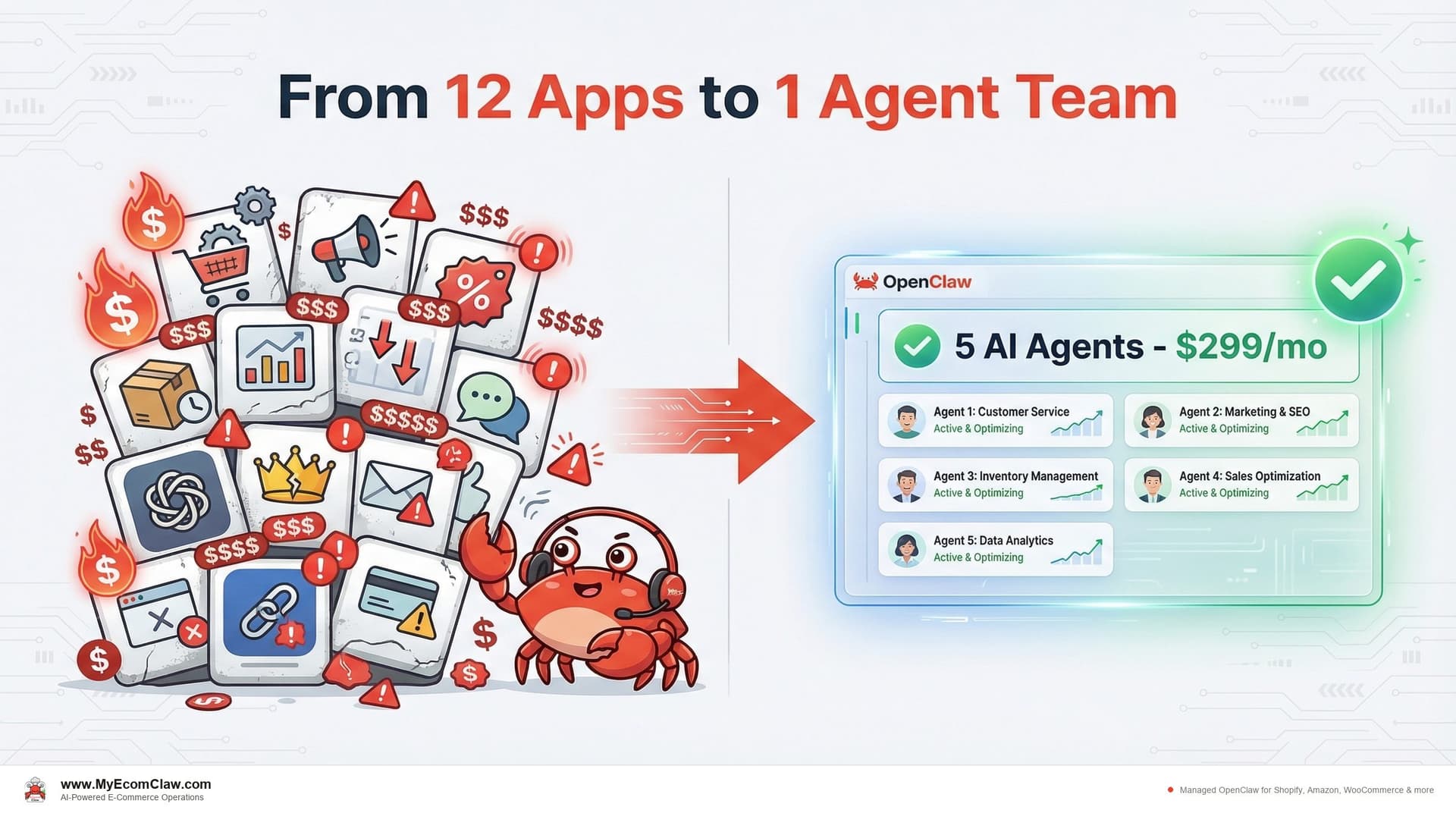
Open your Shopify admin. Click Settings. Click Apps and sales channels. Count them.
If you’re like the average Shopify store, you have somewhere between 6 and 12 apps installed. Each one solved a specific problem the day you installed it. A review collector here. An inventory sync there. A support helpdesk. An email tool. A shipping app. An analytics dashboard. An upsell popup. A returns portal.
Each one bills you monthly. Each one has its own dashboard. Each one stores a slice of your data on a different vendor’s cloud. And none of them know about each other.
Your inventory sync app doesn’t know you’re running ads on a product you’re about to stock out on. Your support app doesn’t know about the shipping delay that’s about to trigger 40 WISMO tickets. Your email tool doesn’t know that the customer it just sent a "buy again" email to left a 1-star review yesterday.
You’re paying $500+ per month for 12 apps that operate like 12 strangers sitting in the same room, none of them talking.
That’s tool fatigue. And it’s costing you more than the subscription fees.
The tool fatigue problem is real — and Reddit knows it
This isn’t just a theory. Sellers talk about it constantly.
On r/shopify, one seller posted: "I have 14 apps installed and my store loads like it’s 2005. Every app wants $30-$100/month and I’m not even sure half of them are doing anything."
Another on r/ecommerce: "Spent an hour this morning trying to figure out why my inventory counts were off. Turns out two apps were both trying to sync stock and conflicting with each other."
And this one from r/smallbusiness: "My Shopify app bill is higher than my rent. $640/month across 11 apps. I just wanted to sell candles."
The pattern is always the same: you start with 2 apps, add another every time you hit a new problem, and wake up 18 months later with a $600/month stack of tools you can barely manage.
A 2025 Shopify ecosystem report found that the average active Shopify store has 6+ apps installed. Stores doing 1,000+ orders per month typically run 10-15 apps. And each app adds not just cost, but complexity — conflicting scripts, slower page loads, multiple logins, scattered data, and zero coordination.
The real cost of 12 Shopify apps (it’s not just the subscription)
Let’s do the math for a real multi-channel Shopify seller running a typical app stack:
The visible cost: subscription fees
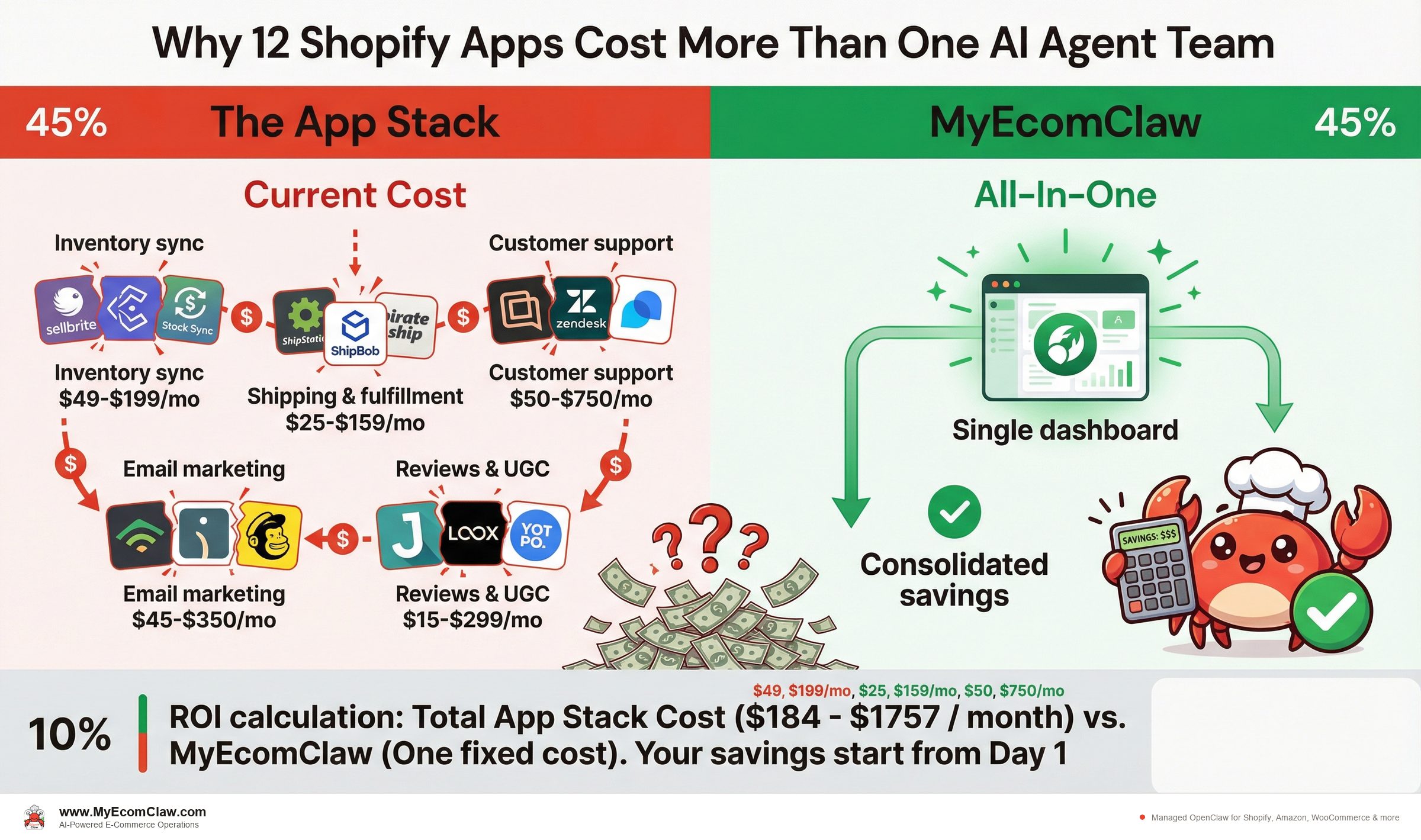
| App Category | Common Apps | Monthly Cost |
|---|---|---|
| Inventory sync | Sellbrite, CedCommerce, Stock Sync | $49-$199/mo |
| Shipping & fulfillment | ShipStation, ShipBob, Pirate Ship | $25-$159/mo |
| Customer support | Gorgias, Zendesk, Tidio | $50-$750/mo |
| Email marketing | Klaviyo, Omnisend, Mailchimp | $45-$350/mo |
| Reviews & UGC | Judge.me, Loox, Yotpo | $15-$299/mo |
| Analytics & reporting | Triple Whale, Lifetimely, Google Analytics | $0-$400/mo |
| Upsell & cross-sell | Bold Upsell, ReConvert, Zipify | $10-$100/mo |
| Returns management | Loop, Returnly, AfterShip Returns | $29-$199/mo |
| SEO & optimization | SEO Manager, Plug In SEO | $20-$80/mo |
| Subscriptions | Recharge, Skio, Bold Subscriptions | $99-$499/mo |
| Popups & conversion | Privy, Justuno, OptiMonk | $15-$100/mo |
| Loyalty & rewards | Smile.io, LoyaltyLion, Yotpo Loyalty | $49-$399/mo |
| Total (mid-range) | 12 apps | $406-$3,534/mo |
Even at the conservative mid-range, that’s $500-$800/month for most growth-stage stores. At the high end, stores doing 5,000+ orders per month easily spend $1,500-$3,000/month on apps alone.
🔥 $500-$800/month. That’s $6,000-$9,600/year on tools that don’t coordinate with each other.
The hidden costs nobody calculates
The subscription fee is the visible cost. The real costs are invisible:
1. Your time as the coordination layer — $15,600/year
None of your apps share data natively. You’re the human middleware. Every morning, you check Shopify, cross-reference Amazon, verify inventory counts match your sync app, check if support tickets align with shipping delays, and make sure your marketing isn’t promoting out-of-stock products. That’s 6+ hours per week of coordination — just making your apps work together.
At $50/hour, that’s $300/week or $15,600/year in lost productive time.
2. App conflicts — unpredictable but expensive
Two inventory apps writing to the same SKU at the same time. A review app and a popup app both triggering on the same page, slowing load time by 3 seconds. A shipping app that conflicts with your checkout flow. App conflicts don’t show up on your invoice, but they show up in lost conversions, incorrect stock counts, and frustrated debugging sessions.
3. Page speed degradation — measurable revenue loss
Every app adds JavaScript to your storefront. A 2024 Deloitte study found that a 0.1-second improvement in page speed leads to an 8.4% increase in conversions. If 12 apps are adding 2-3 seconds to your load time, the conversion impact is real — and it compounds with every visitor.
4. Data fragmentation — decisions based on incomplete information
Your support app knows about customer complaints. Your inventory app knows about stock levels. Your analytics app knows about margins. But no single view shows you the full picture. You make decisions based on whichever dashboard you happened to check last.
The 5-agent alternative: what replaces what
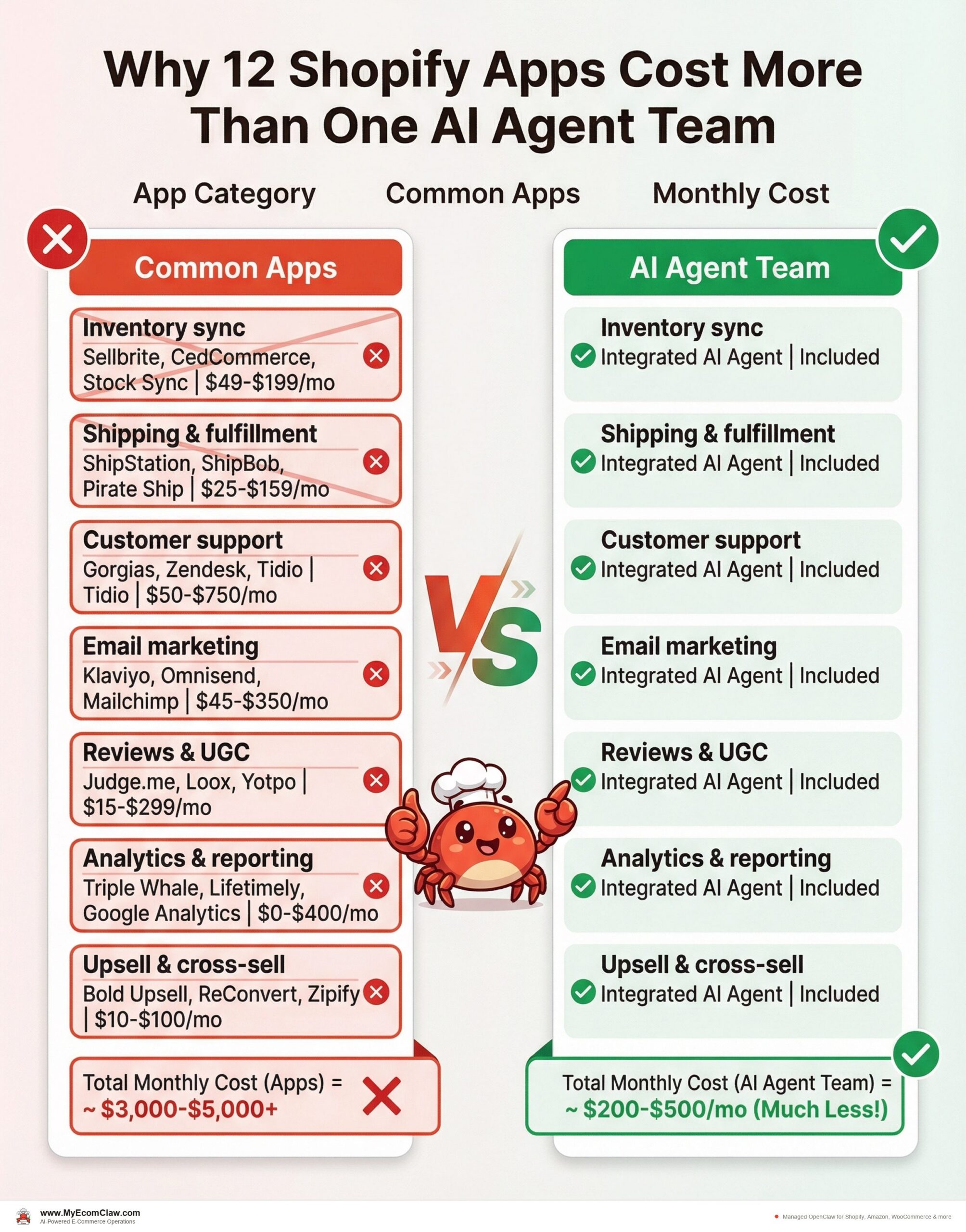
OpenClaw’s five agents replace the operational core of your app stack — the apps that handle orders, inventory, support, marketing, and analytics. Here’s the direct mapping:
| App Category (Your Current Stack) | Apps Being Replaced | OpenClaw Agent | What Changes |
|---|---|---|---|
| Inventory sync | Sellbrite, Stock Sync | Inventory Agent | Real-time sync + predictive stockouts + auto-POs |
| Shipping & order management | ShipStation | Order Agent | Order validation + fulfillment tracking + exception handling |
| Customer support | Gorgias, Zendesk | Support Agent | 24/7 auto-resolution + multilingual + zero per-ticket fees |
| Email marketing | Klaviyo, Omnisend | Marketing Agent | Customer segmentation + discount codes + campaign scheduling |
| Analytics & reporting | Triple Whale, Lifetimely | Orchestration Agent | Cross-agent coordination + audit trail + morning reports |
| Returns management | Loop, AfterShip Returns | Support Agent | Return processing + policy verification + label generation |
| Coordination layer | You, every morning | Orchestration Agent | Automated cross-agent coordination — you approve, it executes |
That’s 7-8 apps replaced by 5 coordinated agents. The remaining apps — reviews, loyalty, subscriptions, SEO — stay where they are. OpenClaw handles the operational backbone. Niche tools handle the niche features.
Talk to your agent on WhatsApp — no more 12 dashboards
Here’s what a Monday morning looks like when OpenClaw replaces your operational app stack:
What happened over the weekend?
Good morning! Here’s your weekend summary:
📊 Weekend Operations (Sat + Sun combined):
– Orders: 127 processed across Shopify (68), Amazon (41), WooCommerce (18). 0 payment issues. 3 flagged — all address corrections needed.
– Inventory: All 312 SKUs synced. 2 POs auto-generated and sent (Blue Widget restock + Red Hoodie XL). 0 oversells.
– Support: 38 tickets received. 34 auto-resolved (22 WISMO, 7 returns, 5 order questions). 4 escalated — details below.
– Marketing: Saturday flash sale campaign: 2,847 emails sent, 31% open rate, 89 conversions, $6,230 revenue. Sunday winback to 41 lapsed customers: 4 conversions.
– Coordination: Inventory Agent flagged Green Tee low stock → Marketing Agent reduced Green Tee ad spend by 40%. Saved $120 in wasted weekend ads.
⚠️ Needs your attention (4 items):
1. VIP customer (22 orders) wants exchange, not return — needs your approval
2. Amazon A-to-Z claim filed — details and recommended response attached
3. WooCommerce customer: wrong item received. Replacement recommendation ready.
4. 3 orders need address corrections — customer responses pending
Approve the VIP exchange. Use your recommended response on the A-to-Z claim. Ship replacement for WooCommerce customer. Correct addresses when customers reply.
✅ VIP exchange processed. New item shipping today.
✅ A-to-Z response submitted to Amazon.
✅ Replacement order created for WooCommerce customer.
✅ Address correction requests queued — will process on customer reply.
One message. 127 orders. 38 support tickets. 2 marketing campaigns. Real-time inventory sync. Cross-agent coordination. Total time: 90 seconds.
That same weekend, without OpenClaw, you would have logged into Shopify, Amazon Seller Central, WooCommerce, ShipStation, Gorgias, Klaviyo, and Triple Whale — 7 different dashboards — to piece together the same picture. Assuming you worked on the weekend at all.
A day in the life: before and after consolidation
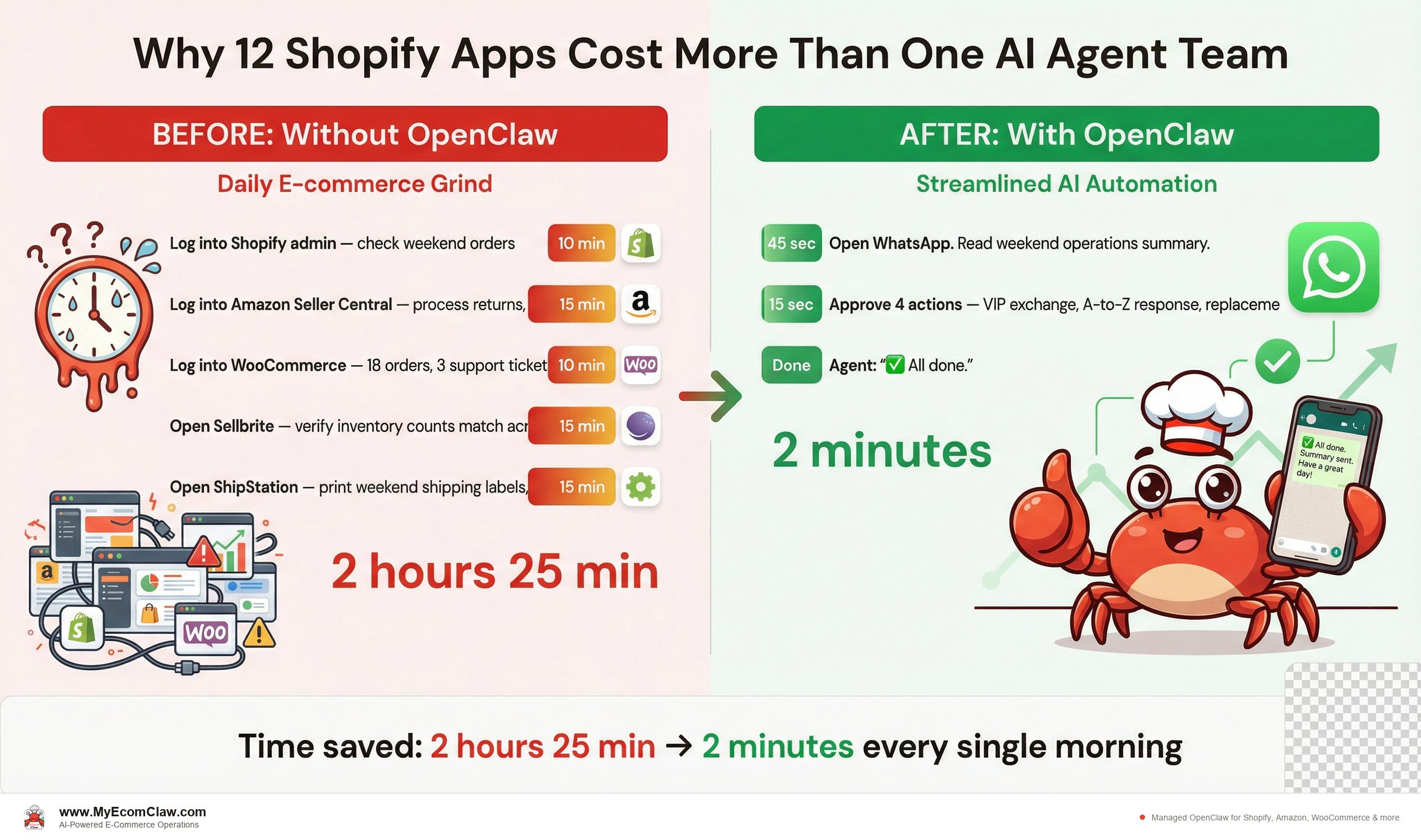
Before: Monday with 12 apps
| Time | What You’re Doing | Time Spent |
|---|---|---|
| 7:00 AM | Log into Shopify admin — check weekend orders | 10 min |
| 7:10 AM | Log into Amazon Seller Central — process returns, check claims | 15 min |
| 7:25 AM | Log into WooCommerce — 18 orders, 3 support tickets | 10 min |
| 7:35 AM | Open Sellbrite — verify inventory counts match across channels | 15 min |
| 7:50 AM | Open ShipStation — print weekend shipping labels, fix errors | 15 min |
| 8:05 AM | Open Gorgias — 38 tickets. Start answering WISMO one by one | 30 min |
| 8:35 AM | Open Klaviyo — check Saturday campaign results | 10 min |
| 8:45 AM | Open Triple Whale — look at weekend revenue vs. ad spend | 10 min |
| 8:55 AM | Realize you advertised a product that’s almost out of stock | 5 min |
| 9:00 AM | Manually pause ads, email supplier | 10 min |
| 9:10 AM | Reconcile refunds between Shopify, Amazon, and your accounting | 15 min |
| 9:25 AM | Finally start thinking about product strategy | — |
| Total | App-stack management | 2 hours 25 min |
After: Monday with 5 OpenClaw agents
| Time | What You’re Doing | Time Spent |
|---|---|---|
| 6:58 AM | Open WhatsApp. Read weekend operations summary. | 45 sec |
| 6:59 AM | Approve 4 actions — VIP exchange, A-to-Z response, replacement, address queue. | 15 sec |
| 6:59 AM | Agent: “✅ All done.” | Done |
| 7:00 AM | Start your week with strategy, not spreadsheets. | — |
| Total | Operations review | 2 minutes |
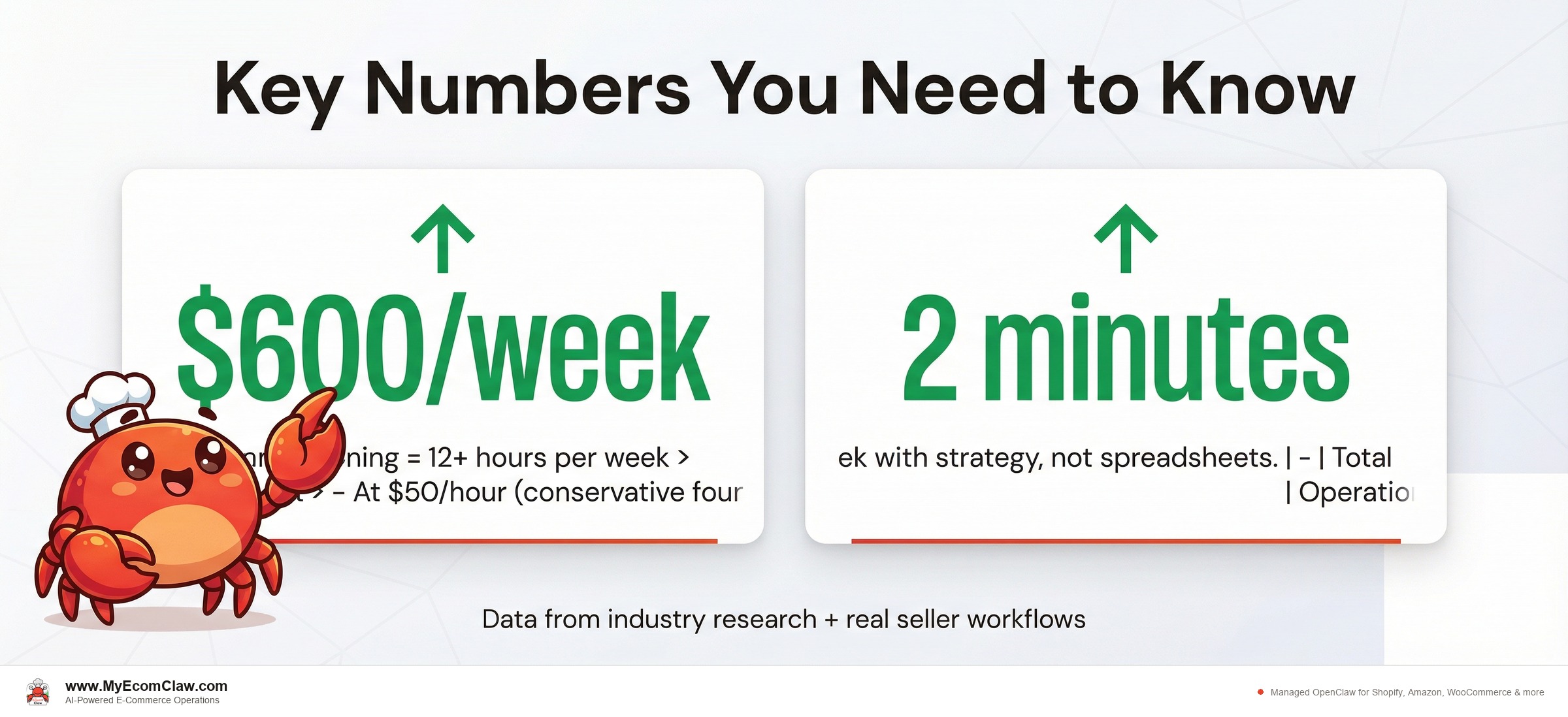
- Time saved:2 hours 23 minutes every Monday morning = 12+ hours per week
- At $50/hour(conservative founder rate) = $600/week
- Annual value of recovered time: $31,200/year
- App subscriptions saved:$300-$1,200/mo by replacing 7-8 operational apps
- Annual app savings:$3,600-$14,400/year
- Combined first-year value: $34,800-$45,600
The cost comparison: 12-app stack vs. five OpenClaw agents
| 12-App Stack (Typical) | MyEcomClaw (Growth) | |
|---|---|---|
| Monthly subscription | $500-$800/mo (mid-range) | $599/mo |
| Annual subscription | $6,000-$9,600/yr | $7,188/yr |
| Per-resolution / per-ticket fees | $300-$600/mo (Gorgias AI) | $0 — unlimited |
| Dashboards to check | 7-12 every morning | 1 (WhatsApp) |
| Coordination | You. Every morning. 6+ hrs/week. | Orchestration Agent — automated |
| Cross-tool data sharing | None. Manual export/import. | Native — all agents share data on your server |
| Page speed impact | 12 app scripts on your storefront | 0 — agents run server-side, not on storefront |
| Data ownership | Scattered across 12 vendor clouds | Your server. Your data. Full SSH access. |
| Lock-in | 12 separate contracts, 12 data exports | MIT licensed. Take everything if you leave. |
| Platforms | Mostly Shopify. Partial Amazon. Limited WooCommerce. | Shopify + Amazon + WooCommerce + Magento + Walmart |
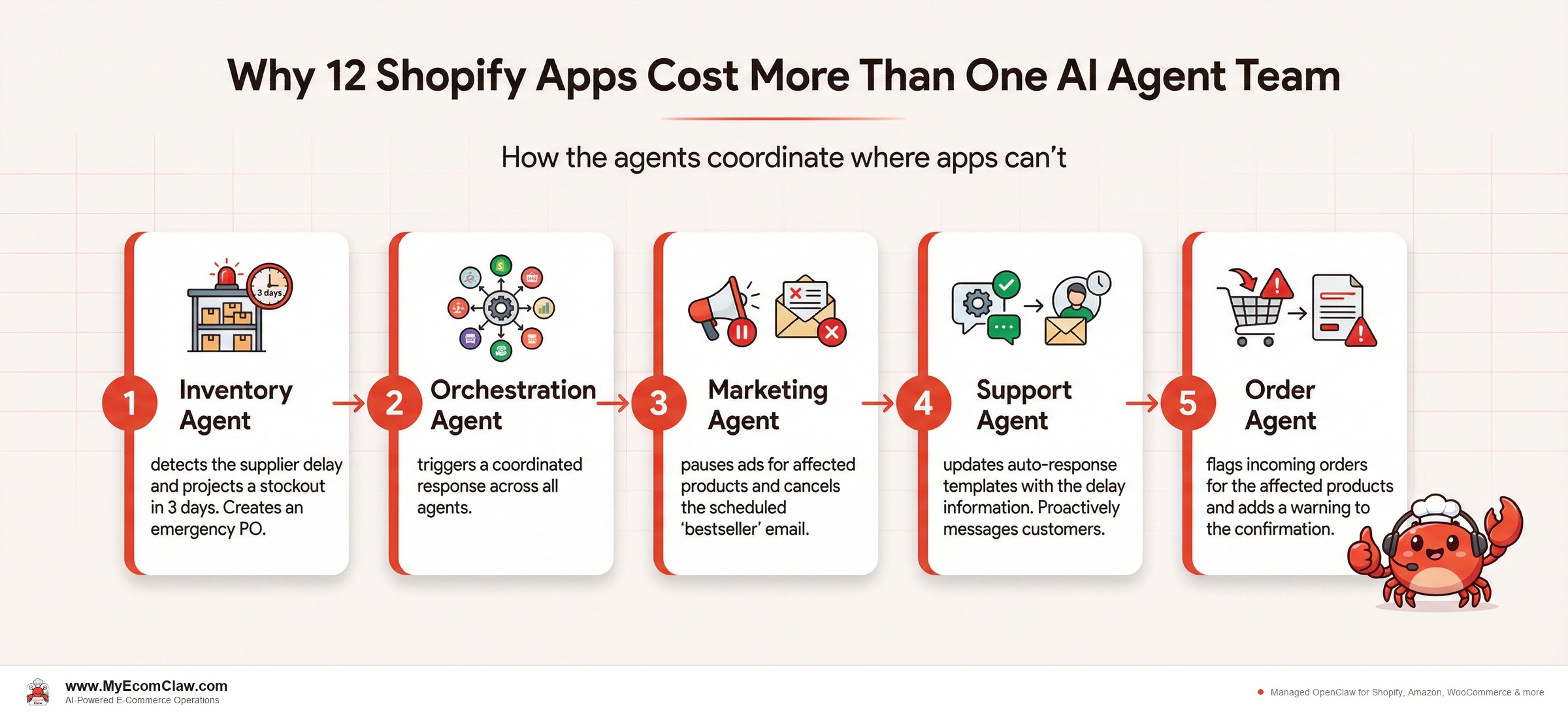
How the agents coordinate where apps can’t
Here’s the scenario that makes the difference clear:
Scenario: Your supplier is late, your ads are running, and support tickets are about to spike.
With a 12-app stack, here’s what happens:
- Sellbrite shows inventory dropping but doesn’t know about the supplier delay
- Klaviyo sends a "bestseller back in stock" email because it doesn’t know you’re about to run out
- Gorgias starts getting WISMO tickets but doesn’t know about the carrier delay
- Triple Whale shows ad spend is high but doesn’t connect it to the inventory problem
- You spend an hour figuring out the connection, manually pausing ads, updating email campaigns, and prepping support responses
With five OpenClaw agents:
Inventory Agent detects the supplier delay and projects a stockout in 3 days. Creates an emergency PO to an alternate supplier.
Orchestration Agent triggers a coordinated response across all agents.
Marketing Agent pauses ads for affected products and cancels the scheduled "bestseller" email. Messages you: "Supplier delay detected. Paused Blue Widget ads and cancelled Thursday’s email blast. Saved $340 in wasted spend."
Support Agent updates auto-response templates with the delay information. Proactively messages customers with pending orders: "Your order may arrive 1-2 days later than expected. Here’s your updated tracking link." — preventing 40+ WISMO tickets from ever being created.
Order Agent flags incoming orders for the affected products and adds a warning to the confirmation email about potential delays.
Total time for you: zero. The Orchestration Agent handled everything. You got a WhatsApp summary after the fact.
Built on OpenClaw — 191K+ GitHub stars, MIT licensed, the most popular open-source AI agent in the world. Built by Space-O Technologies — 15+ years in software, 80+ AI developers, 500+ projects delivered. Your server. Your data. No lock-in.
What your first week without app fatigue looks like
Tell us your current apps. We map which ones OpenClaw replaces and which niche ones stay. You pick a plan — Starter ($299/mo) or Growth ($599/mo). We start provisioning your server.
We connect your Shopify Admin API, Amazon SP-API, and WooCommerce REST API. We migrate your support policies, inventory thresholds, and campaign templates. You cancel your first batch of redundant apps.
You wake up. Check WhatsApp. Full operations summary — orders, inventory, support, marketing — in one message. You make 3 decisions and start your day. No Sellbrite. No ShipStation dashboard. No Gorgias inbox.
Agent sends you a weekly summary: “This week: 412 orders processed, 0 oversells, 147 support tickets resolved (138 automatically), 2 campaigns sent, 3 POs generated. Time you spent: approximately 14 minutes total.”
Total setup: 5-7 business days on Growth. We handle the migration. You handle the app cancellations.
Why this matters for your business
Tool fatigue isn’t a minor inconvenience. It’s an operational tax that compounds over time. Every new app you add increases your monthly cost, fragments your data further, adds another dashboard to check, and makes your storefront heavier. The marginal cost of the 13th app is never just the subscription — it’s the coordination overhead you add to your daily routine.
The sellers who break past 5,000 orders per month don’t do it by adding more apps. They do it by consolidating their operations into a system where data flows naturally, agents coordinate automatically, and the only dashboard they open is a WhatsApp conversation.
Every hour you spend switching between dashboards is an hour your competitor spent on strategy.
Our take
The Shopify App Store is incredible for discovery. It’s terrible for operations at scale. The incentive structure guarantees fragmentation — every developer builds a point solution for one problem, charges $30-$100/month, and has zero reason to integrate with the other 11 apps you’ve installed.
The result: you become the integration layer. You’re the one who notices the inventory sync doesn’t match the order count. You’re the one who manually pauses ads when stock runs low. You’re the one who connects the support ticket to the shipping delay. Every morning, you do the job that software should do.
OpenClaw’s five agents aren’t five more tools. They’re five agents on the same server, sharing the same data, coordinated by the same Orchestration Agent. When inventory drops, marketing adjusts. When shipping delays, support prepares. When orders spike, everyone scales. That’s not a feature — it’s an architecture decision. And it’s the reason five agents replace twelve apps.
If your Shopify app bill is over $500/month and you’re spending 10+ hours a week switching between dashboards, the consolidation math is simple. See plans starting at $299/mo → · Talk to us about your stack →
FAQ
Which apps does OpenClaw actually replace?
OpenClaw’s five agents replace the operational core: inventory sync (Sellbrite, Stock Sync), order management (ShipStation), customer support (Gorgias, Zendesk), email marketing execution (Klaviyo, Omnisend), and analytics coordination (Triple Whale). That’s typically 7-8 apps. Niche apps like reviews (Judge.me), loyalty (Smile.io), and subscriptions (Recharge) stay — they serve specific functions that aren’t operational. See the full mapping →
Will removing apps speed up my Shopify store?
Yes. Every Shopify app adds JavaScript to your storefront. Removing 7-8 operational apps eliminates their frontend scripts entirely — OpenClaw agents run server-side on your own infrastructure, not on your Shopify storefront. This directly improves page load time, which impacts conversion rates. A Deloitte study found that a 0.1-second speed improvement increases conversions by 8.4%.
How much money will I actually save?
It depends on your current stack. A typical mid-range stack costs $500-$800/month in subscriptions plus $300-$600/month in Gorgias AI fees. MyEcomClaw Growth is $599/month with no per-ticket fees and no per-resolution charges. Direct subscription savings: $200-$800/month. Add 12+ hours/week of recovered time at $50/hour ($31,200/year) and the first-year value is $34,800-$45,600. Book a free audit to calculate YOUR savings →
Does this work if I only sell on Shopify (no Amazon or WooCommerce)?
Yes. Most sellers start with Shopify as their only channel. The five agents work on Shopify alone — processing orders, syncing inventory (across Shopify locations and POS if applicable), handling support, running marketing, and coordinating operations. When you add Amazon or WooCommerce later, the agents extend to those channels automatically.
What about the apps I keep — will they conflict with OpenClaw?
No. OpenClaw agents run on your own server and communicate with Shopify through the Admin API. They don’t install scripts on your storefront or conflict with other Shopify apps. Your review app, loyalty program, and subscription tool continue working exactly as before. OpenClaw handles the operational backend. Niche apps handle the frontend features.
Where does my data go when I remove all those apps?
With individual apps, your data is scattered across 12 vendor clouds. With OpenClaw, all your operational data consolidates on your own server (VPS or Mac Mini). Orders, inventory, support tickets, campaign data — all in one place, on infrastructure you own. Full SSH access. MIT licensed. No vendor lock-in. Talk to us about migration →
How long does the migration take?
5-7 business days for the Growth plan. We handle server provisioning, API connections, policy migration, and agent configuration. You can run OpenClaw alongside your existing apps during the transition period — then cancel the redundant apps once you’ve verified everything works. Zero downtime. Get started →
Count your apps. Count the cost. Then simplify.
MyEcomClaw deploys OpenClaw on your own server with five AI agents that replace the operational core of your 12-app stack. One WhatsApp conversation instead of 7 dashboards. Coordinated instead of fragmented.