OpenClaw vs Shopify Apps: When to Switch

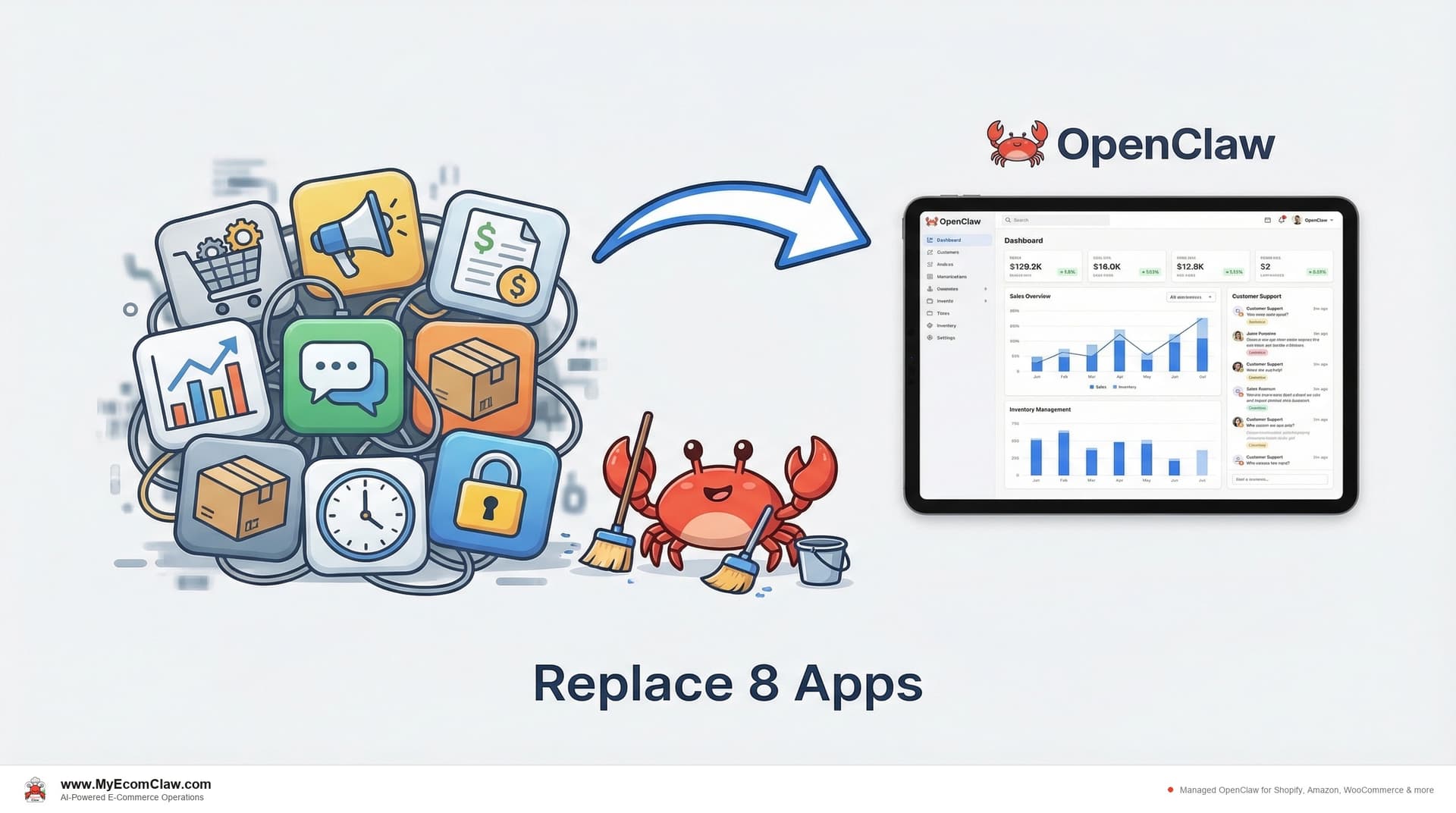
Open your Shopify admin right now. Click Settings, then Apps. Count them. If you’re like most sellers doing 1,000+ orders per month, you’re looking at 6 to 8 apps — maybe more. An inventory sync app. A shipping app. A support desk. An email marketing tool. A review aggregator. An analytics dashboard. Maybe a returns app. Maybe a loyalty program.
Each app costs $30 to $300 per month. Each one has its own login, its own dashboard, its own notification email. And not a single one of them talks to the others.
This is the app tax. You’re paying $500-$2,000/month in SaaS fees — and you’re still the one connecting the dots between all of them every morning.
The Shopify app fragmentation problem
A 2025 Shopify ecosystem report found that the average Shopify store installs 6-8 apps. Stores doing over $1M in annual revenue average 12+. On r/shopify, a seller posted: "I just counted. I have 11 apps. Three of them do overlapping things and I’m not sure which one is actually running."
Here’s what fragmentation actually costs you:
- Direct cost: $500-$2,000/month in combined subscription fees
- Hidden cost: 8-15 hours/week spent switching between dashboards, reconciling data, and being the human coordination layer
- Opportunity cost: At $50/hour founder time, that’s $1,600-$3,000/month in lost productivity
- Performance cost: Each app injects scripts into your storefront, slowing page load by 0.3-1.2 seconds per app
And the biggest cost nobody tracks? The decisions you don’t make because the data lives in 6 different places.

The 6-app stack: a real cost breakdown
Here’s what a typical Shopify store running 2,000-5,000 orders per month pays across its app stack:
| App Category | Common Apps | Monthly Cost | What It Does | What It Doesn’t Do |
|---|---|---|---|---|
| Inventory sync | Sellbrite, Trunk | $49-$199/mo | Sync stock across channels | Predict stockouts, generate POs |
| Shipping | ShipStation, Shippo | $25-$159/mo | Print labels, track shipments | Flag risky orders, coordinate with support |
| Support | Gorgias, Zendesk | $50-$750/mo | Ticket management | Know inventory levels, know order context |
| Email marketing | Klaviyo, Omnisend | $45-$350/mo | Campaigns, flows | Generate discounts, pause ads on low stock |
| Reviews | Judge.me, Yotpo | $15-$299/mo | Collect/display reviews | Route negative reviews to support |
| Analytics | Triple Whale, Lifetimely | $100-$400/mo | Data visualization | Take action on what it sees |
| Total | 6 apps, 6 dashboards | $284-$2,157/mo | Siloed functionality | None of them coordinate |
Annual cost: $3,408-$25,884. And that’s before the hidden time cost of managing all six.
The cruel irony? You’re paying six companies to do six things — and you’re the seventh employee stitching their outputs together.

The decision framework: when to replace your stack
Not every store should switch from apps to an AI agent team. Here’s the honest framework.
Stay with individual apps if:
- You’re doing fewer than 500 orders/month on a single channel
- Your current stack costs under $200/month total
- You spend fewer than 3 hours/week on operational tasks
Consider switching to OpenClaw if:
- You’re doing 1,000+ orders/month across 2+ channels
- Your app stack costs $400+/month
- You spend 8+ hours/week on operational tasks
- You’re the human coordination layer between apps that don’t talk to each other
Definitely switch if:
- Your app stack costs $600+/month
- You’re hiring a VA just to manage operations
- You’ve experienced cross-channel inventory failures more than twice in the past month
Here’s the question that cuts through all the framework logic: Do your apps coordinate with each other? If no, you’re the coordination layer. And you’re expensive.
What OpenClaw actually replaces
OpenClaw is the world’s most popular open-source AI agent — 191,000+ GitHub stars, MIT licensed, trusted by thousands of developers. MyEcomClaw deploys and manages it on your own private server, pre-configured with skills for Shopify, WooCommerce, Amazon, and Walmart.
Here’s the direct replacement mapping:
| Shopify App | OpenClaw Agent | What Changes |
|---|---|---|
| Sellbrite / Trunk (inventory sync) | Inventory Agent | Real-time webhook sync (not batch). Predictive stockouts. Auto-generated POs. Buffer stock logic. |
| ShipStation / Shippo (shipping) | Order Agent | Payment validation, fraud flagging, fulfillment routing, label generation, tracking updates — all in one agent |
| Gorgias / Zendesk (support) | Support Agent | Ticket triage, order lookups, refund processing, sentiment detection — with full context from inventory and order data |
| Klaviyo / Omnisend (email marketing) | Marketing Agent | Customer segmentation, discount code generation, campaign scheduling, ROI tracking — coordinated with inventory levels |
| Triple Whale (analytics) | Orchestration Agent | Cross-agent coordination, priority management, conflict resolution — it doesn’t just see data, it acts on it |
| Reviews app (various) | Support Agent | Negative review routing, sentiment-based escalation |
The fundamental difference: Individual apps are isolated tools. OpenClaw agents are a coordinated team. When the Inventory Agent detects a stockout risk, the Marketing Agent pauses ads, the Support Agent prepares responses, and the Order Agent flags pending orders — automatically.

Talk to your agent on WhatsApp — not 6 dashboards
Here’s what app stack management looks like when your OpenClaw agent is running. You don’t open 6 dashboards. You open WhatsApp.
Checking your entire operation:
Morning update?
Good morning! Here’s your ops summary:
📦 Orders: 62 processed overnight. 0 failures. 3 flagged for manual review (high-value, new customer).
📊 Inventory: 94% in-stock across Shopify + Amazon. 2 SKUs below reorder point — PO drafts ready.
💬 Support: 18 tickets received. 14 auto-resolved. 4 escalated to your queue (2 refund requests, 1 shipping complaint, 1 product question).
📣 Marketing: Welcome flow sent to 47 new customers. Abandoned cart emails recovered 8 orders ($1,240 revenue).
⚠️ 1 alert: Red Hoodie XL down to 12 units. At current velocity (6/day), stockout in 2 days. PO drafted. Approve?
Approve the PO. And pause ads on the Red Hoodie until restock.
Done.
✅ PO #3201 sent to TextileCo. Est. delivery: March 27.
✅ Facebook and Google ads paused for Red Hoodie XL. Will resume when stock > 50 units.
That took 45 seconds. You just did what would have required opening Shopify admin, Amazon Seller Central, Gorgias, Klaviyo, Triple Whale, and your shipping dashboard. Six logins. Six tabs. 30-45 minutes of context switching.
One WhatsApp thread. 45 seconds. That’s the difference between an app stack and an agent team.
A day in the life: before and after
Before: Tuesday with a 6-app stack
| Time | What You’re Doing | Time Spent |
|---|---|---|
| 8:00 AM | Open Shopify admin, review overnight orders | 10 min |
| 8:10 AM | Open ShipStation, print labels, fix 2 address errors | 20 min |
| 8:30 AM | Open Gorgias, triage 15 support tickets | 25 min |
| 8:55 AM | Open Sellbrite, check inventory sync — find 3 mismatches | 15 min |
| 9:10 AM | Manually reconcile inventory across Shopify + Amazon | 20 min |
| 9:30 AM | Open Klaviyo, check campaign performance, adjust a flow | 15 min |
| 9:45 AM | Open Triple Whale, review yesterday’s ROAS | 10 min |
| 9:55 AM | Discover ad spend was wasted on a product that went out of stock yesterday | 5 min |
| 10:00 AM | Process 2 refunds for oversold items | 10 min |
| 10:10 AM | Finally start working on product development | — |
| Total | App management + ops busywork | 2 hours 10 min |
After: Tuesday with OpenClaw
| Time | What You’re Doing | Time Spent |
|---|---|---|
| 8:00 AM | Check WhatsApp. Agent: “62 orders shipped. 14 tickets resolved. 2 POs sent. 1 item needs approval.” | 30 sec reading |
| 8:01 AM | Reply: “Approve. Show me yesterday’s campaign ROI.” | 10 sec |
| 8:01 AM | Agent: “PO approved. Yesterday’s email campaign: $3,400 revenue, 4.2x ROI. Abandoned cart flow recovered $1,240.” | 15 sec reading |
| 8:02 AM | Start working on product development | — |
| Total | Operations | Under 2 minutes |
- Time saved:2 hours 8 minutes every morning = 10+ hours per week
- At $50/hour(conservative founder rate) = $500/week = $26,000/year
- App stack eliminated:$284-$2,157/mo = $3,408-$25,884/year saved
- Total annual value: $29,408-$51,884

The cost math: app stack vs. OpenClaw
| 6-App Stack | MyEcomClaw Starter | MyEcomClaw Growth | |
|---|---|---|---|
| Monthly cost | $284-$2,157/mo | $299/mo | $599/mo |
| Annual cost | $3,408-$25,884/yr | $3,588/yr | $7,188/yr |
| Setup | Free (but hours of config) | $499 one-time | $999 one-time |
| What you get | 6 siloed tools | 3 AI agents (Orders, Inventory, Support) | All 5 AI agents on your own server |
| Cross-tool coordination | None — you are the glue | Orchestration within 3 agents | Full 5-agent orchestration |
| Data ownership | Spread across 6 vendor clouds | Your server. Your data. MIT licensed. | Your server. Your data. MIT licensed. |
| Page speed impact | 6 apps injecting scripts | Zero — agents run server-side | Zero — agents run server-side |
| Communication | 6 dashboards | WhatsApp, Slack, or Telegram | WhatsApp, Slack, or Telegram |
| Lock-in | 6 separate contracts | MIT licensed. Leave anytime. | MIT licensed. Leave anytime. |
Bottom line: The Growth plan at $599/month replaces an app stack that typically costs $800-$2,000/month — and you get coordinated AI agents instead of siloed tools. Add the 10+ hours/week of recovered time, and the ROI is overwhelming.
And here’s what the spreadsheet doesn’t capture: you stop being the coordination layer. That’s not a time savings — that’s a cognitive load savings. Your mornings go from reactive firefighting to proactive growth work.

The migration path: how to switch without breaking anything
Switching from 6 apps to OpenClaw isn’t a rip-and-replace. Here’s the staged migration path:
Phase 1: Parallel run (Week 1-2)
Your OpenClaw agents run alongside your existing apps. The Inventory Agent syncs and validates against your current sync tool. The Order Agent mirrors your shipping workflow. Nothing is turned off yet — we’re confirming data accuracy.
Phase 2: Agent takeover (Week 3-4)
Once sync accuracy is confirmed (typically 99.8%+ match rate), we start deactivating apps one by one. Inventory sync app goes first (highest impact, easiest to validate). Then shipping. Then support. Marketing app transitions last because campaign history matters.
Phase 3: Full operation (Week 5+)
All five agents running. All apps deactivated. Your Shopify admin is cleaner, your page speed is faster, and your monthly SaaS bill just dropped.
The part nobody mentions: most sellers feel nervous about the switch for about 48 hours. By day 3 of the parallel run, they’re asking "why didn’t I do this sooner?"
Built on OpenClaw — 191K+ GitHub stars, MIT licensed, the most popular open-source AI agent in the world. Built by Space-O Technologies — 15+ years in software, 80+ AI developers, 500+ projects delivered. Your server. Your data. No lock-in.
Why this matters for your business
Tool fragmentation is the silent tax on every growing Shopify store. You don’t notice it because it creeps in one app at a time. First you install an inventory app. Then a support app. Then an email tool. Then analytics. Then shipping. Before you know it, you’re managing a mini SaaS portfolio instead of growing your brand.
The stores that scale aren’t the ones with the most apps. They’re the ones that replaced fragmented tools with coordinated agents. One deployment. Five agents. One WhatsApp thread. Zero dashboard switching.
Our take
The Shopify App Store is brilliant for getting started. Install an app, solve a problem, move on. But that model breaks down at scale. At 1,000+ orders per month, those 6-8 apps become 6-8 anchors — each one holding data the others can’t see, each one adding cost without adding coordination.
The real question isn’t "which app is best for inventory sync?" It’s "why am I still the one connecting my inventory data to my marketing decisions to my support responses?" That’s what an agent team solves.
OpenClaw doesn’t replace each app one-for-one. It replaces the architecture. Instead of 6 tools that don’t talk to each other, you get 5 agents that share context, coordinate actions, and report to you on WhatsApp. And it all runs on your server, not six different vendor clouds.
If your monthly app spend exceeds $400 and you’re spending 8+ hours a week on operations, the math is already decided. See plans → · Talk to us first →
FAQ
How many Shopify apps can OpenClaw actually replace?
For most stores, OpenClaw’s five agents replace 5-8 apps: inventory sync, shipping/fulfillment, customer support, email marketing, analytics/reporting, and review management. The exact number depends on your current stack. We’ll audit your apps during onboarding and map each one to an agent capability. Book a free stack audit →
Will I lose my historical data from Klaviyo, Gorgias, etc.?
No. During migration, we export your historical data from each app before deactivation. Customer segments, email flows, ticket history, and campaign performance data are preserved. OpenClaw agents build on this foundation, not from scratch.
What happens during the parallel run period?
Your existing apps continue running normally while OpenClaw agents operate alongside them. We compare outputs — inventory counts, order processing, ticket responses — to validate accuracy. You’ll see both systems working simultaneously. No disruption to your customers or operations.
Is the setup fee worth it if I’m already paying for apps?
The one-time setup fee ($499 for Starter, $999 for Growth) covers server provisioning, API connections, SKU mapping, agent configuration, and testing. Most sellers recoup this in 1-2 months of eliminated app subscriptions alone — before counting time savings. See full pricing →
What if one of my apps does something OpenClaw can’t?
Be specific about what that app does and we’ll tell you honestly whether an OpenClaw agent covers it. Some niche functions (like advanced loyalty programs or subscription management) may still warrant a dedicated app. The goal isn’t to eliminate every app — it’s to eliminate fragmentation where agents can do the job better. Ask us about your specific stack →
Can I keep one or two apps and still use OpenClaw?
Yes. OpenClaw agents are not all-or-nothing. Some sellers keep Klaviyo for email marketing (because of complex automation flows) while using OpenClaw agents for orders, inventory, and support. The agents work alongside existing apps during the transition and permanently if needed.
Does OpenClaw slow down my Shopify store like apps do?
No. OpenClaw agents run on your own private server — VPS or Mac Mini. They connect to Shopify via the Admin API, not by injecting storefront scripts. Removing 6 apps and their scripts from your theme can improve page load by 1-4 seconds. Your Lighthouse score will thank you.
Ready to replace your app stack with one AI agent team?
MyEcomClaw deploys OpenClaw on your own server with AI agents for inventory, orders, support, marketing, and orchestration. One WhatsApp thread instead of 6 dashboards. Your data stays on your server.
More from Platform Reviews
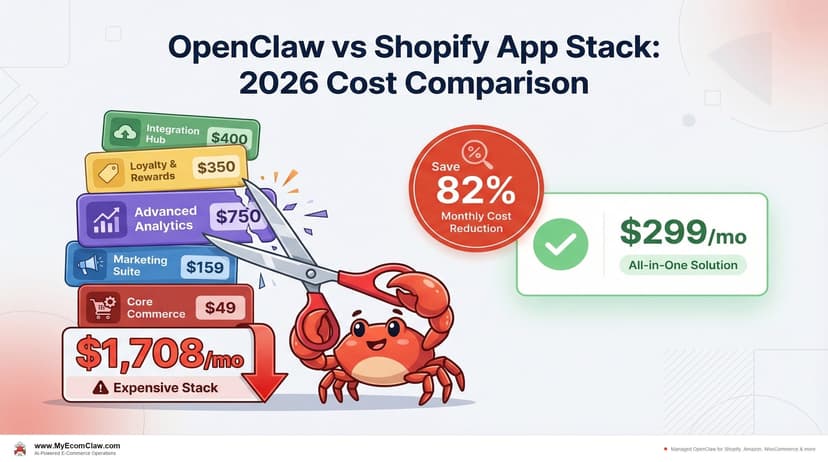
OpenClaw vs Shopify Apps: Cost Review
A typical Shopify seller spends $269-$1,858/month on 5 disconnected apps. MyEcomClaw’s managed OpenClaw deployment costs $299-$999/month — with 5.
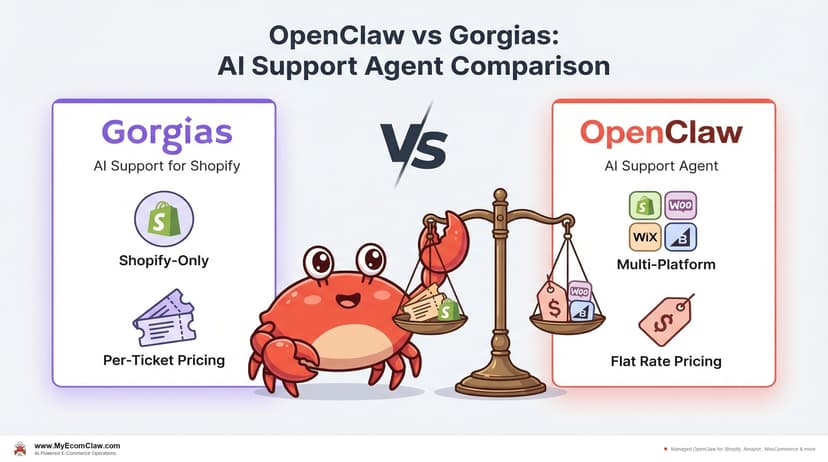
OpenClaw vs Gorgias: 2026 Comparison
Head-to-head comparison of Gorgias and OpenClaw’s Support Agent. Gorgias: Shopify-focused, $50-750/mo + per-resolution fees.
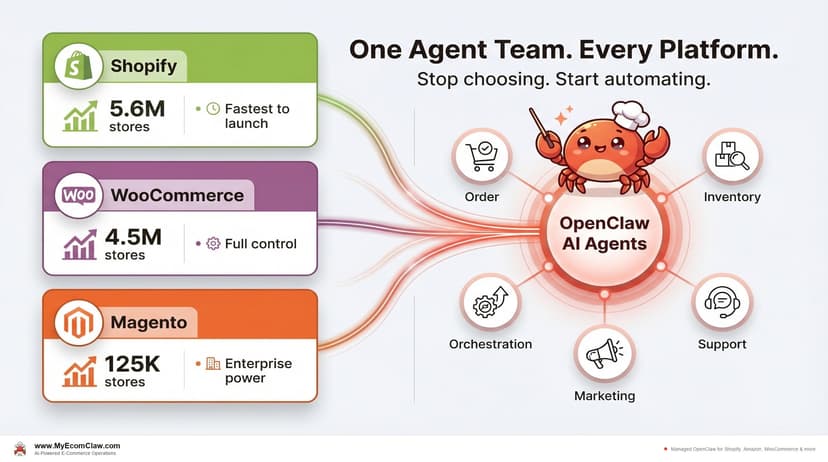
Shopify vs WooCommerce vs Magento (2026)
5.6M Shopify stores. 4.5M WooCommerce stores. 125K Magento stores. The real question isn’t which platform to pick — it’s how to run all of.