Shopify vs WooCommerce vs Magento (2026)

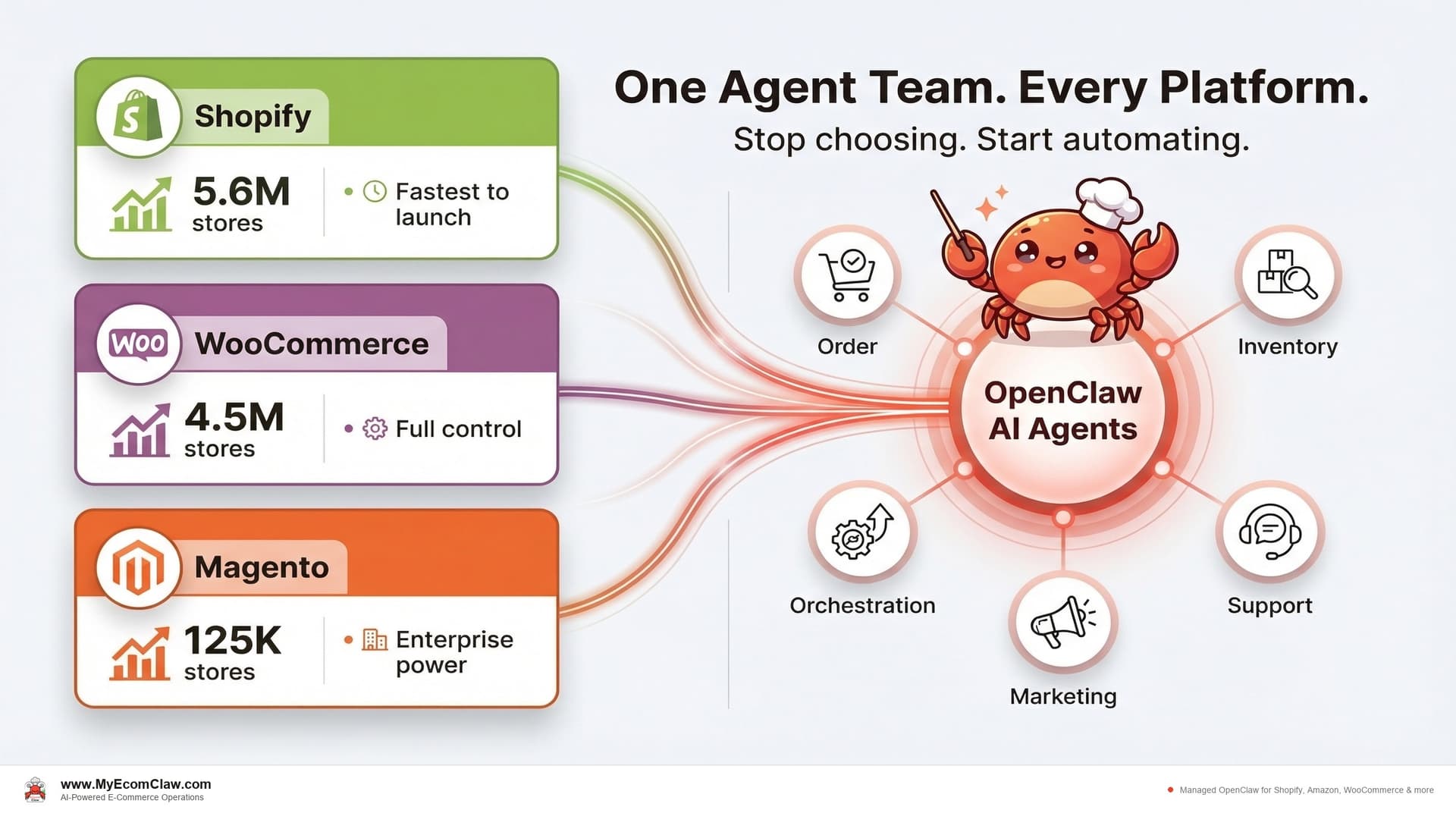
5.6 million Shopify stores. 4.5 million WooCommerce stores. 125,000 Magento stores. And you’re reading a comparison article trying to pick the "right" one.
Here’s what nobody tells you in those comparison posts: most successful sellers end up on multiple platforms anyway. You start on Shopify, add WooCommerce for your content blog, list on Amazon for reach, and maybe Magento for B2B wholesale. The platform you pick on Day 1 isn’t the platform you’ll be on exclusively by Year 2.
The real question isn’t "which platform should I choose?" It’s "how do I manage operations across whichever platforms I end up on — without spending 70% of my day switching between dashboards?"
That’s where OpenClaw AI agents change the entire conversation.
The honest comparison: Shopify vs WooCommerce vs Magento in 2026
Let’s do the comparison first — honestly, without selling you on any one platform. Then we’ll show you why the platform choice matters less than you think.
Shopify: Fastest to launch, most AI-ready
5.6 million active stores worldwide. 28.8% of top 1 million e-commerce sites.
Shopify is the easiest way to go from zero to selling. You can launch in a single afternoon. The app ecosystem is massive (8,000+ apps), support is 24/7, and the Admin API is the most AI-friendly of the three.
Strengths:
- Launch in hours, not weeks
- Built-in payments, shipping, and tax
- Most AI tools are Shopify-first (Gorgias AI Agent is Shopify-only)
- Best API for AI agent integration (Admin API + Storefront API)
- Native multi-channel: sell on Facebook, Instagram, TikTok directly
Limitations:
- Transaction fees add up without Shopify Payments (2.4-2.9% + 30¢)
- Monthly cost climbs fast: $39 base + $200-$500 in apps
- You don’t own the infrastructure — your store lives on their servers
- Limited customization compared to WooCommerce
- Vendor lock-in: migrating away is painful
Real cost for a growing store: $200-$600/month (base plan + essential apps)
For most sellers starting out, Shopify is the right first step. But it won’t be your only platform for long.
WooCommerce: Full control, full responsibility
4.5 million active stores. 33.4% global market share (largest by count).
WooCommerce is a free WordPress plugin. You own everything — the code, the hosting, the data. If you want a weird checkout flow, custom product types, or unique shipping logic, WooCommerce can do it.
Strengths:
- Free and open source (MIT-like GPL license)
- Total customization — you control every line of code
- You own your data and your server
- Massive plugin ecosystem (59,000+ WordPress plugins)
- Natural fit for content-driven brands already on WordPress
Limitations:
- You’re responsible for hosting, security, updates, performance
- Plugin conflicts can break your store without warning
- Most AI tools don’t support WooCommerce natively (Gorgias AI Agent is Shopify-only)
- Steeper learning curve — you need technical comfort or a developer
- Performance depends entirely on your hosting choice
Real cost for a growing store: $50-$300/month (hosting + premium plugins + maintenance)
WooCommerce gives you freedom. But freedom means you’re also the IT department.
Magento (Adobe Commerce): Enterprise power, enterprise complexity
125,000 stores. 8% global market share. Handles billions in GMV.
Magento is built for businesses doing serious volume. Thousands of SKUs, multiple storefronts, multi-currency, complex B2B pricing — Magento handles it without flinching.
Strengths:
- Built for scale — handles massive catalogs and high traffic
- Advanced B2B features (custom pricing, quote management, corporate accounts)
- Multi-store architecture from day one
- Open-source version available (free)
- Most powerful product management of the three
Limitations:
- You WILL need a developer (or a team). Budget $5K-$20K for initial build.
- Adobe Commerce (cloud) starts at $22,000/year
- Slowest to launch — weeks to months, not hours
- Smallest ecosystem of the three — fewer ready-made extensions
- AI tool support is weakest (most AI agents don’t integrate with Magento natively)
Real cost for a growing store: $500-$2,000/month (hosting + development + maintenance)
Magento is a powerhouse if you have the team and budget. For everyone else, it’s overkill.
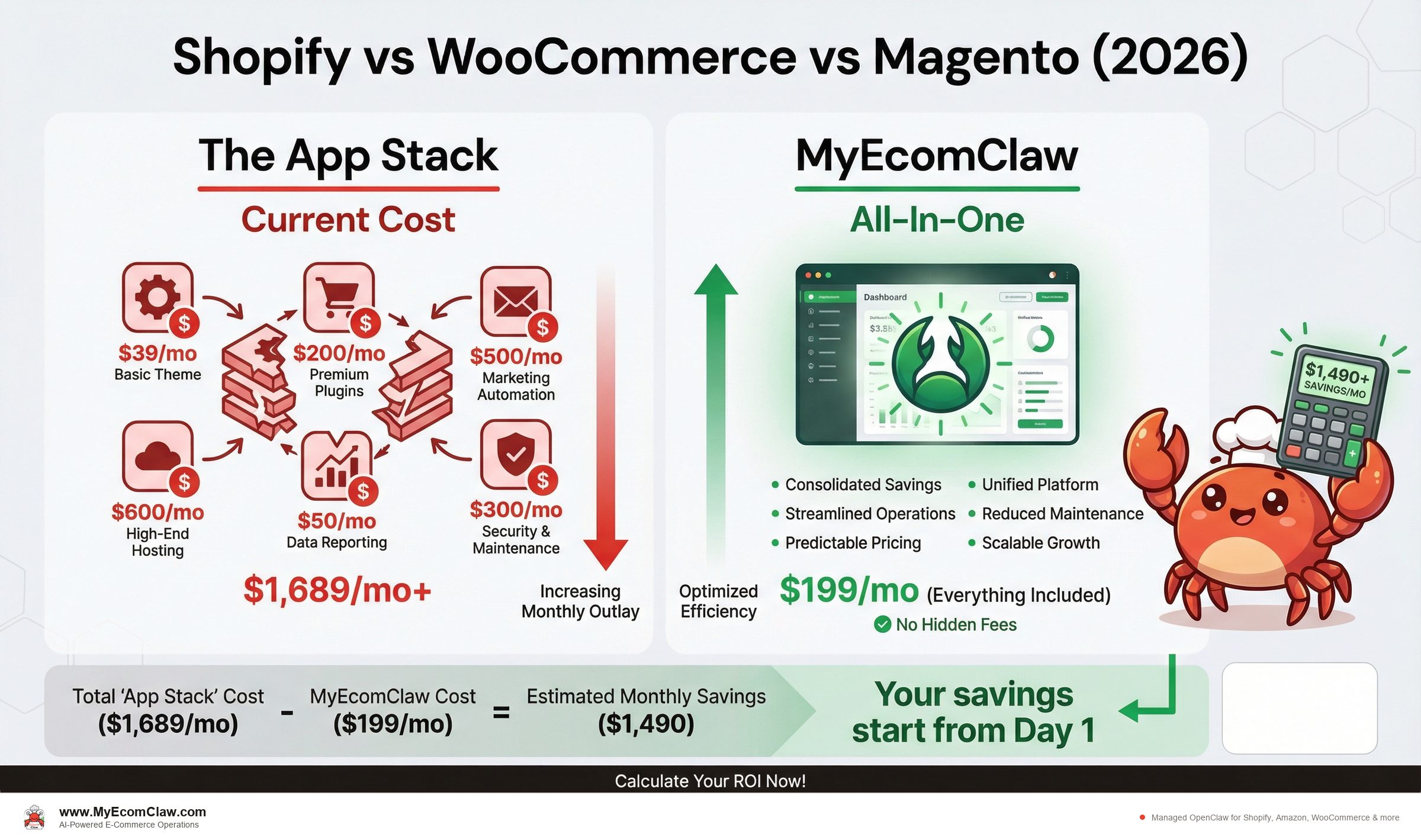
The comparison table everyone wants
| Shopify | WooCommerce | Magento | |
|---|---|---|---|
| Active stores | 5.6M | 4.5M | 125K |
| Time to launch | Hours | Days-weeks | Weeks-months |
| Monthly cost | $200-$600 | $50-$300 | $500-$2,000 |
| Data ownership | Shopify’s servers | Your servers | Your servers |
| AI agent support | Best (most tools are Shopify-first) | Limited (most AI agents don’t support WC natively) | Weakest (fewest AI integrations) |
| Customization | Limited (themes + apps) | Unlimited (full code access) | Unlimited (full code access) |
| Best for | Speed + simplicity | Control + content | Enterprise + B2B |
| OpenClaw support | Full (Admin API) | Full (REST API) | Full (GraphQL API) |
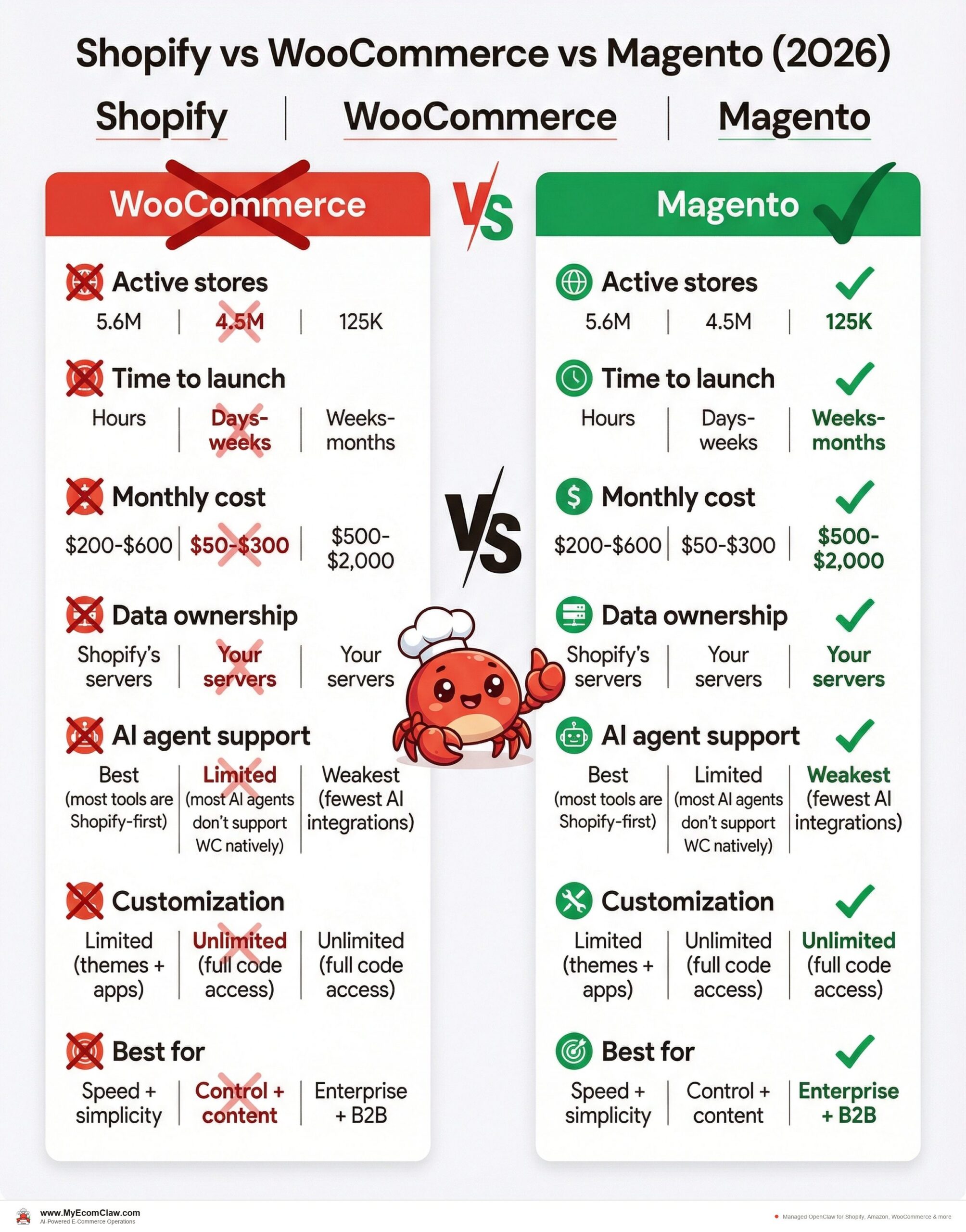
Here’s what the comparison articles don’t tell you
Most growing sellers end up on multiple platforms. A typical journey:
Month 1-6: Launch on Shopify. Simple, fast, works.
Month 6-12: Add Amazon for reach. Now you’re managing 2 platforms.
Year 2: Add WooCommerce for your content blog + wholesale portal. Now it’s 3.
Year 3: Maybe Walmart or Etsy. Now it’s 4-5 channels.
On r/ecommerce, a seller asked: "How can we accurately track COGS and profit margins across multiple sales channels?" The answer wasn’t "pick a better platform." It was "you need a system that works across all of them."
Talk to your agent on WhatsApp — across all platforms
Here’s what multi-platform management looks like with OpenClaw running on your server:
Morning update?
Good morning! Cross-platform summary:
📊 Last 24 hours across Shopify + Amazon + WooCommerce:
– 67 total orders (31 Shopify, 28 Amazon, 8 WooCommerce)
– Revenue: $4,847 combined
– 0 oversells (real-time inventory sync active)
– 2 support tickets auto-resolved (both WISMO on Amazon)
– 1 low-stock alert: Blue Widget at 18 units across all channels
⚠️ Action needed: Blue Widget reorder recommended. PO draft ready for 200 units from Acme Supplies. Approve?
Approve the PO. Also, what’s our best seller on WooCommerce this week?
✅ PO #2853 approved and sent to Acme.
WooCommerce top seller this week: Green Tee (47 units, $2,115 revenue). Up 23% from last week. Want me to increase ad spend on this product?
Yes, bump the budget by 20%
✅ Marketing Agent adjusted Green Tee campaign budget +20%. New daily spend: $36/day.
That’s 3 platforms managed from one WhatsApp conversation. No Shopify admin. No Amazon Seller Central. No WooCommerce dashboard. Just a chat message while you’re making breakfast.
The same conversation works on Telegram, Slack, Discord — whatever your team already uses.
A day in the life: before and after OpenClaw
Before: Managing 3 platforms manually
| Time | What You’re Doing | Time |
|---|---|---|
| 7:00 AM | Open Shopify admin — 31 orders to review | 15 min |
| 7:15 AM | Switch to Amazon Seller Central — 28 orders, 2 returns to process | 20 min |
| 7:35 AM | Open WooCommerce — 8 orders, stock counts don’t match | 15 min |
| 7:50 AM | Open spreadsheet, reconcile inventory across 3 platforms | 30 min |
| 8:20 AM | Process Amazon returns, update Shopify stock manually | 15 min |
| 8:35 AM | Handle 4 “where is my order” emails (check 3 different tracking systems) | 20 min |
| 8:55 AM | Check which products need reordering across all channels | 15 min |
| 9:10 AM | Create POs in Google Docs, email suppliers | 10 min |
| 9:20 AM | Check marketing campaigns on Shopify vs Amazon Ads | 15 min |
| 9:35 AM | Finally start working on actual growth | — |
| Total | Multi-platform operations busywork | 2 hrs 35 min |
After: OpenClaw manages all 3 platforms
| Time | What You’re Doing | Time |
|---|---|---|
| 7:00 AM | Check WhatsApp. Agent says: “67 orders across 3 platforms, 0 oversells, 2 tickets auto-resolved, 1 PO ready for approval.” | 30 sec |
| 7:01 AM | “Approve the PO. Bump Green Tee ads 20%.” | 10 sec |
| 7:01 AM | Agent: “✅ Done. PO sent. Ad budget adjusted.” | Done |
| 7:02 AM | Start working on your next product launch | — |
| Total | Multi-platform operations | 2 minutes |
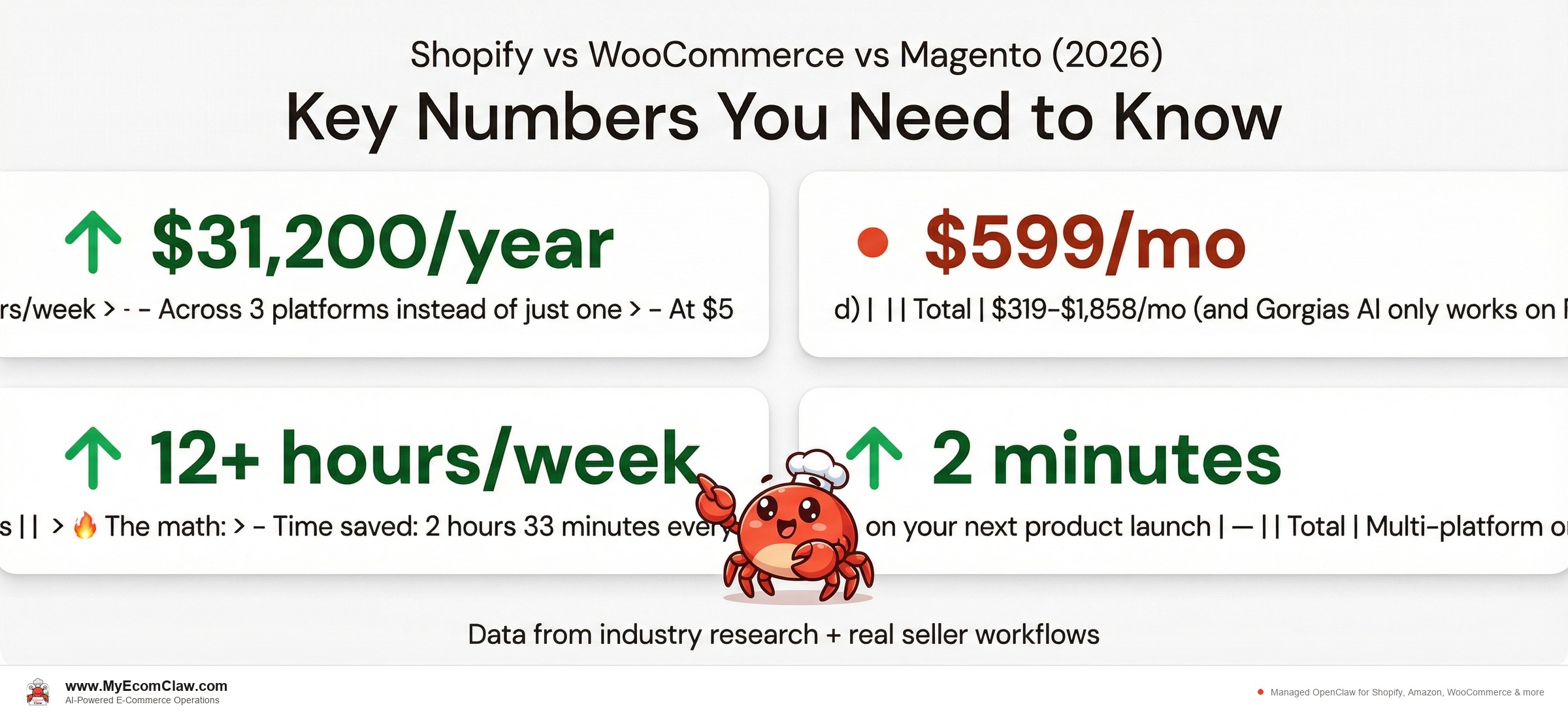
- Time saved:2 hours 33 minutes every morning = 12+ hours/week
- Across 3 platformsinstead of just one
- At $50/hour:= $31,200/year in recovered productive time
- Plus:zero oversells, auto-resolved support tickets, predictive stockout alerts
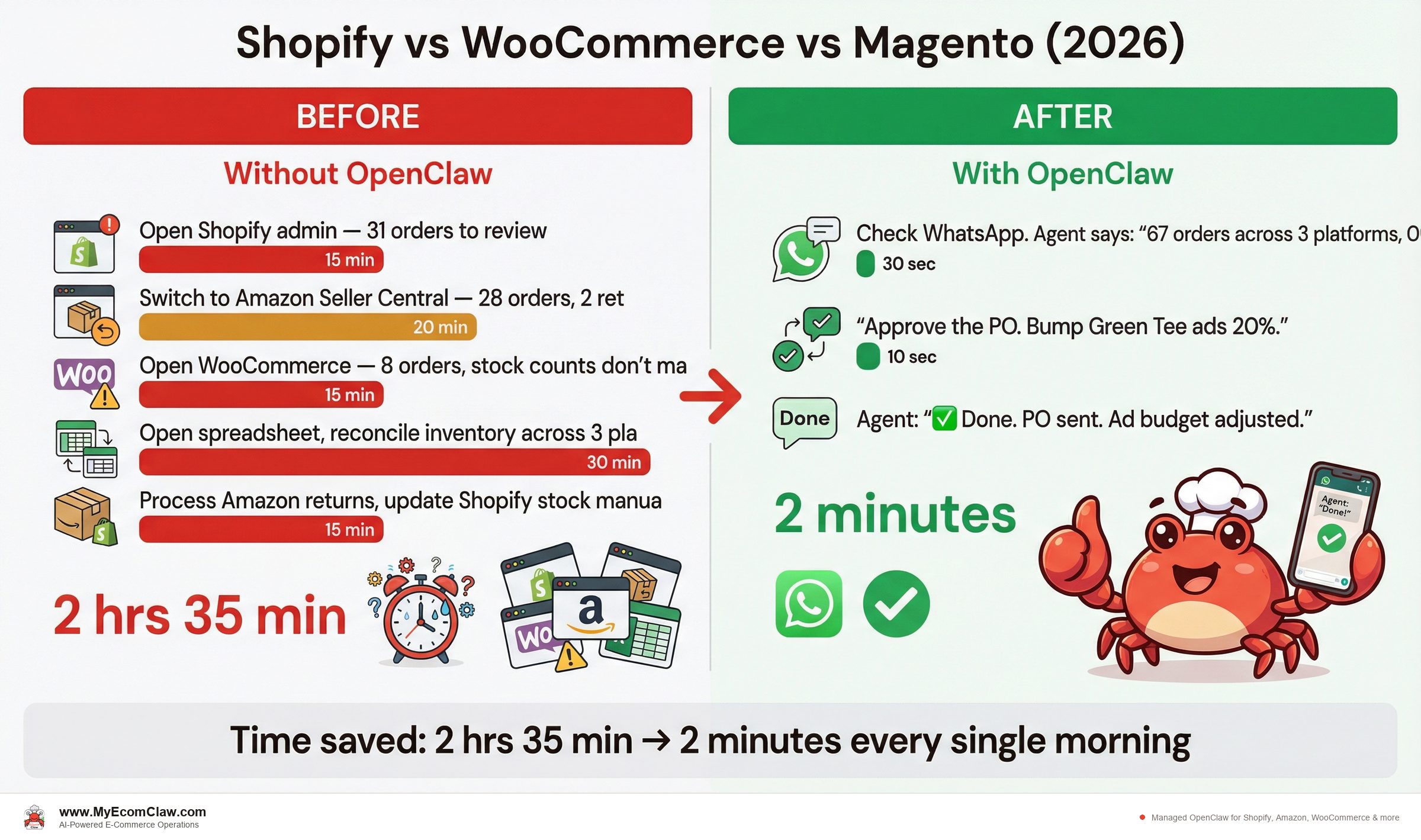
The cost of multi-platform management: apps vs. one OpenClaw agent
| App Stack (3 platforms) | MyEcomClaw (Growth) | |
|---|---|---|
| Inventory sync | Sellbrite: $99-$199/mo | ✅ Inventory Agent (included) |
| Order management | ShipStation: $25-$159/mo | ✅ Order Agent (included) |
| Customer support | Gorgias: $50-$750/mo (Shopify only!) | ✅ Support Agent — works across ALL platforms |
| Marketing | Klaviyo: $45-$350/mo | ✅ Marketing Agent (included) |
| Analytics | Triple Whale: $100-$400/mo | ✅ Dashboard + Audit Trail (included) |
| Coordination | You. Every morning. | ✅ Orchestration Agent (included) |
| Total | $319-$1,858/mo (and Gorgias AI only works on Shopify!) | $599/mo — all 5 agents, all platforms |
| Works on | Mostly Shopify, partial Amazon, limited WooCommerce | Shopify + Amazon + WooCommerce + Magento + Walmart |
| Data | Spread across 5 vendors | Your server. Your data. MIT licensed. |
The biggest problem with the app stack approach: most of these tools are Shopify-only. Gorgias AI Agent? Shopify-only. Most inventory sync apps? Shopify + maybe Amazon. When you’re on 3+ platforms, the app stack breaks down. OpenClaw doesn’t — it connects to every platform’s API natively.
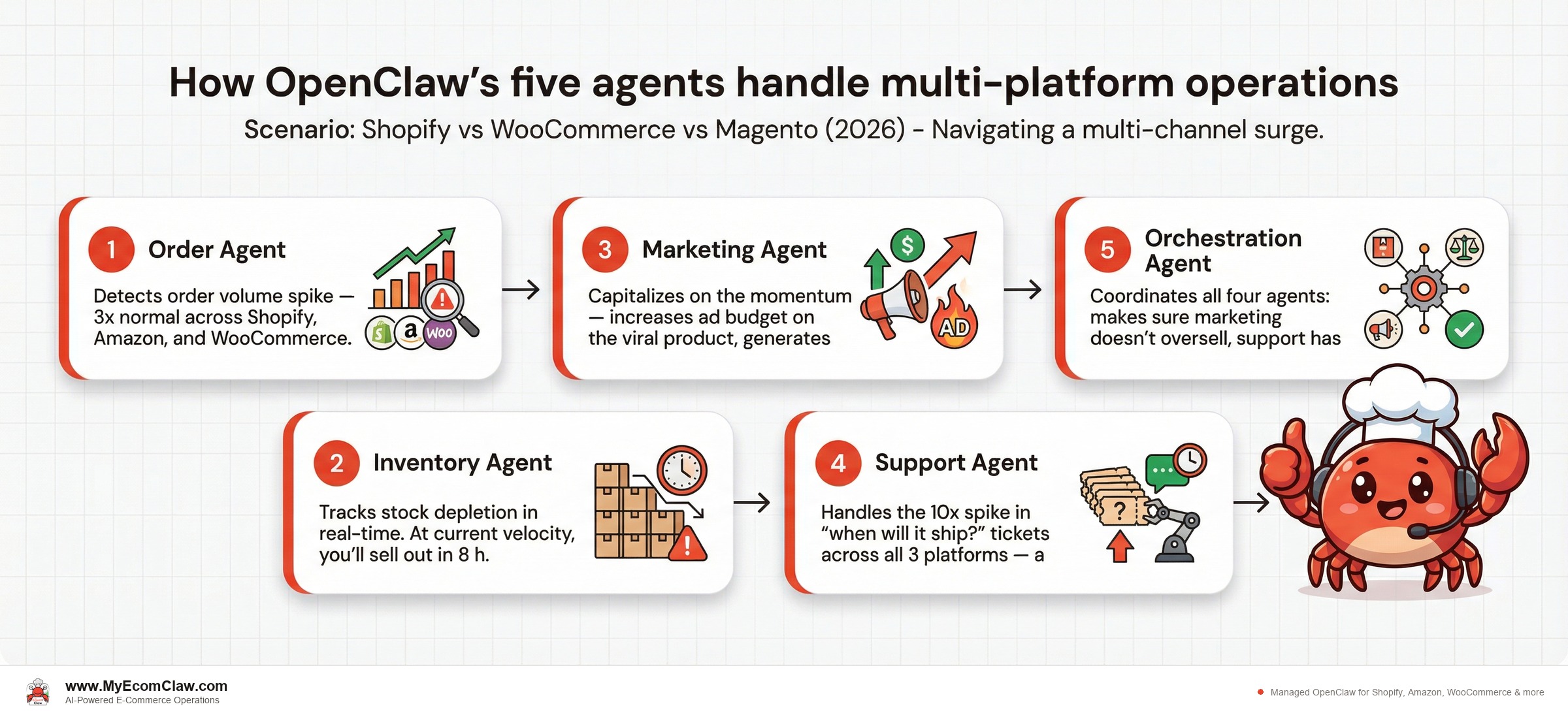
How OpenClaw’s five agents handle multi-platform operations
The difference: A Shopify app manages Shopify. An Amazon tool manages Amazon. OpenClaw’s agents manage EVERYTHING — and they coordinate with each other.
Scenario: A product goes viral on TikTok and orders spike across all channels
Order Agent detects order volume spike — 3x normal across Shopify, Amazon, and WooCommerce simultaneously. Routes orders for fulfillment, validates payments, sends confirmations on all 3 platforms.
Inventory Agent tracks stock depletion in real-time. At current velocity, you’ll sell out in 8 hours. Creates emergency PO and sends you a WhatsApp alert: "Viral spike detected. Blue Widget selling 5x normal across 3 channels. Stock will deplete in 8 hours. Emergency PO ready. Approve?"
Marketing Agent capitalizes on the momentum — increases ad budget on the viral product, generates Shopify discount codes for the traffic surge, and pauses ads on other products to redirect budget.
Support Agent handles the 10x spike in "when will it ship?" tickets across all 3 platforms — auto-responding with tracking info, estimated delivery dates, and proactive shipping updates.
Orchestration Agent coordinates all four agents: makes sure marketing doesn’t oversell, support has the right templates, orders route correctly, and inventory POs go out before you stock out.
No single Shopify app, Amazon tool, or WooCommerce plugin does this. Only a coordinated agent team that works across all platforms can handle a viral moment without you touching a keyboard.
Built on OpenClaw — 191K+ GitHub stars, MIT licensed. Built by Space-O Technologies — 14+ years, 1,200+ projects delivered. Your server. Your data. No lock-in.
Your first week running all platforms on OpenClaw
Shopify? Amazon? WooCommerce? Magento? Walmart? Tell us which channels you sell on. We start provisioning your dedicated server.
You get a WhatsApp message: “Connected to Shopify Admin API, Amazon SP-API, and WooCommerce REST API. SKU mapping complete: 248 products matched across all channels. Running first inventory sync now.”
Agent: “Good morning! 24-hour summary: 52 orders across 3 channels. All inventory synced. 2 POs generated for low-stock items. 3 support tickets auto-resolved. 0 oversells.”
Day 7: Your first predictive alert saves you money
Agent: "Red Hoodie sales velocity up 40% on Amazon this week (seasonal trend). At current pace, you’ll stock out on Amazon in 3 days but have excess stock on WooCommerce. I can transfer 50 units from WooCommerce allocation to Amazon. Approve?"
You just prevented a stockout on your highest-velocity channel by reallocating stock across platforms — from a WhatsApp message.
Total setup: 5-7 business days. You don’t configure APIs. You don’t map SKUs. We handle everything. You just approve POs from WhatsApp.
So which platform should you actually choose?
Here’s our honest take:
- Just starting out? Start with Shopify. It’s the fastest path to your first sale and the most AI-ready platform.
- Already on WordPress? Add WooCommerce. Your content + commerce in one place.
- Doing $1M+ with a dev team? Magento gives you enterprise power.
- Selling on 2+ platforms already? Stop debating platforms and start automating operations.
The platform you choose on Day 1 matters less than how you manage operations on Day 365. By then, you’ll likely be on 2-3 platforms anyway. The sellers who win aren’t the ones on the "right" platform — they’re the ones whose operations scale across all of them.
Our take
The Shopify vs WooCommerce vs Magento debate is a Day 1 question. By Year 2, it’s irrelevant — you’ll be on multiple platforms, managing them all, wishing you had started with a system that works across all of them.
OpenClaw doesn’t care which platform you’re on. It connects to Shopify’s Admin API, Amazon’s SP-API, WooCommerce’s REST API, Magento’s GraphQL API, and Walmart’s Marketplace API. Five agents. One WhatsApp conversation. All your platforms managed. And it runs on your server, not ours.
If you’re already on 2+ platforms and spending more than an hour a day on operations, your OpenClaw agent will pay for itself in the first week. See plans → · Talk to us →
FAQ
Does OpenClaw actually work with all three platforms?
Yes. OpenClaw connects to Shopify Admin API, Amazon SP-API, WooCommerce REST API, Magento GraphQL API, and Walmart Marketplace API. Your five agents (Order, Inventory, Support, Marketing, Orchestration) work identically across all platforms — syncing inventory, processing orders, handling support tickets, and running campaigns regardless of which channel the activity happens on.
Can I start with just Shopify and add other platforms later?
Yes. Most sellers start with Shopify as their primary channel. You can add Amazon, WooCommerce, Magento, or Walmart connections at any time. The agent handles the SKU mapping, sync configuration, and buffer stock settings for each new channel. Start with Shopify, scale to multi-platform →
What happens to my data when it’s spread across multiple platforms?
With MyEcomClaw, all your cross-platform data is unified on your own server (VPS or Mac Mini). Your Shopify data, Amazon data, WooCommerce data — all in one place, on infrastructure you control. You have full SSH access. OpenClaw is MIT licensed. No vendor lock-in.
How does pricing compare to managing separate apps for each platform?
A typical multi-platform seller spends $319-$1,858/month on 5+ separate apps (and most don’t even work across all platforms). MyEcomClaw’s Growth plan ($599/mo) gives you 5 coordinated AI agents that work across ALL your platforms — on your own server. See current pricing →. Not sure? Book a free call →
Is Shopify really the most AI-ready platform?
As of 2026, yes. Most AI tools are Shopify-first — Gorgias AI Agent is Shopify-only, most inventory automation tools prioritize Shopify, and Shopify’s Admin API is the most developer-friendly for AI agent integration. However, OpenClaw is platform-agnostic — it works equally well across Shopify, WooCommerce, Amazon, Magento, and Walmart.
Can my OpenClaw agent transfer stock between channels?
Yes. The Inventory Agent can reallocate stock between channels based on sales velocity. If Amazon is selling 3x faster than WooCommerce, the agent can suggest transferring units from your WooCommerce allocation to Amazon — and you approve from WhatsApp.
Stop debating platforms. Start automating operations.
MyEcomClaw deploys OpenClaw on your own server with 5 AI agents that work across Shopify, Amazon, WooCommerce, Magento, and Walmart. Manage everything from one WhatsApp conversation.
Get Your Agent Running → · Book a free multi-platform audit →
More from Platform Reviews
OpenClaw vs Shopify Apps: When to Switch
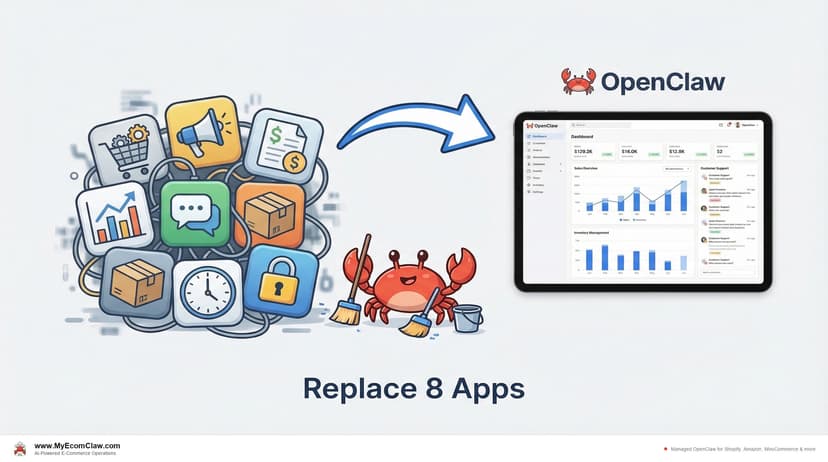
The average Shopify store runs 6-8 apps. Tool fragmentation is the #1 drag on ROI. Here’s a decision framework for when it makes sense to replace.
OpenClaw vs Shopify Apps: Cost Review
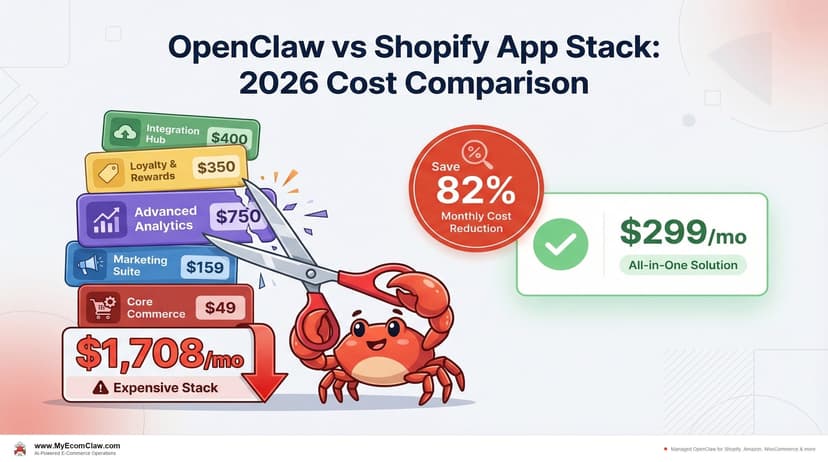
A typical Shopify seller spends $269-$1,858/month on 5 disconnected apps. MyEcomClaw’s managed OpenClaw deployment costs $299-$999/month — with 5.
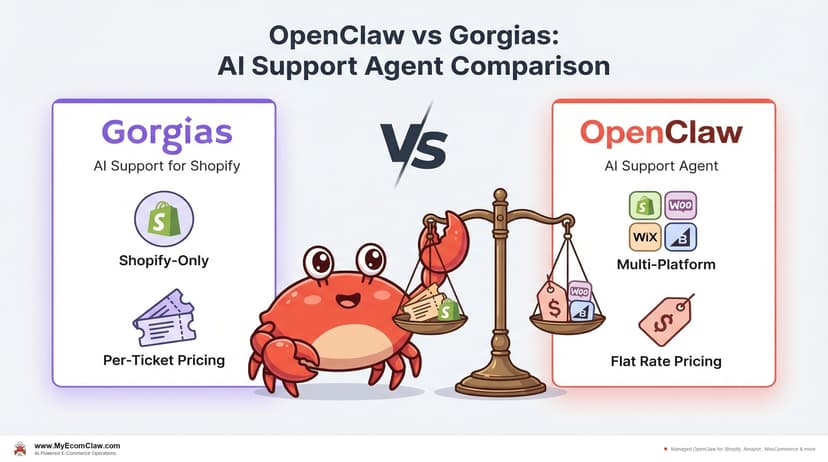
OpenClaw vs Gorgias: 2026 Comparison
Head-to-head comparison of Gorgias and OpenClaw’s Support Agent. Gorgias: Shopify-focused, $50-750/mo + per-resolution fees.