5 Signs You Need E-Commerce Automation

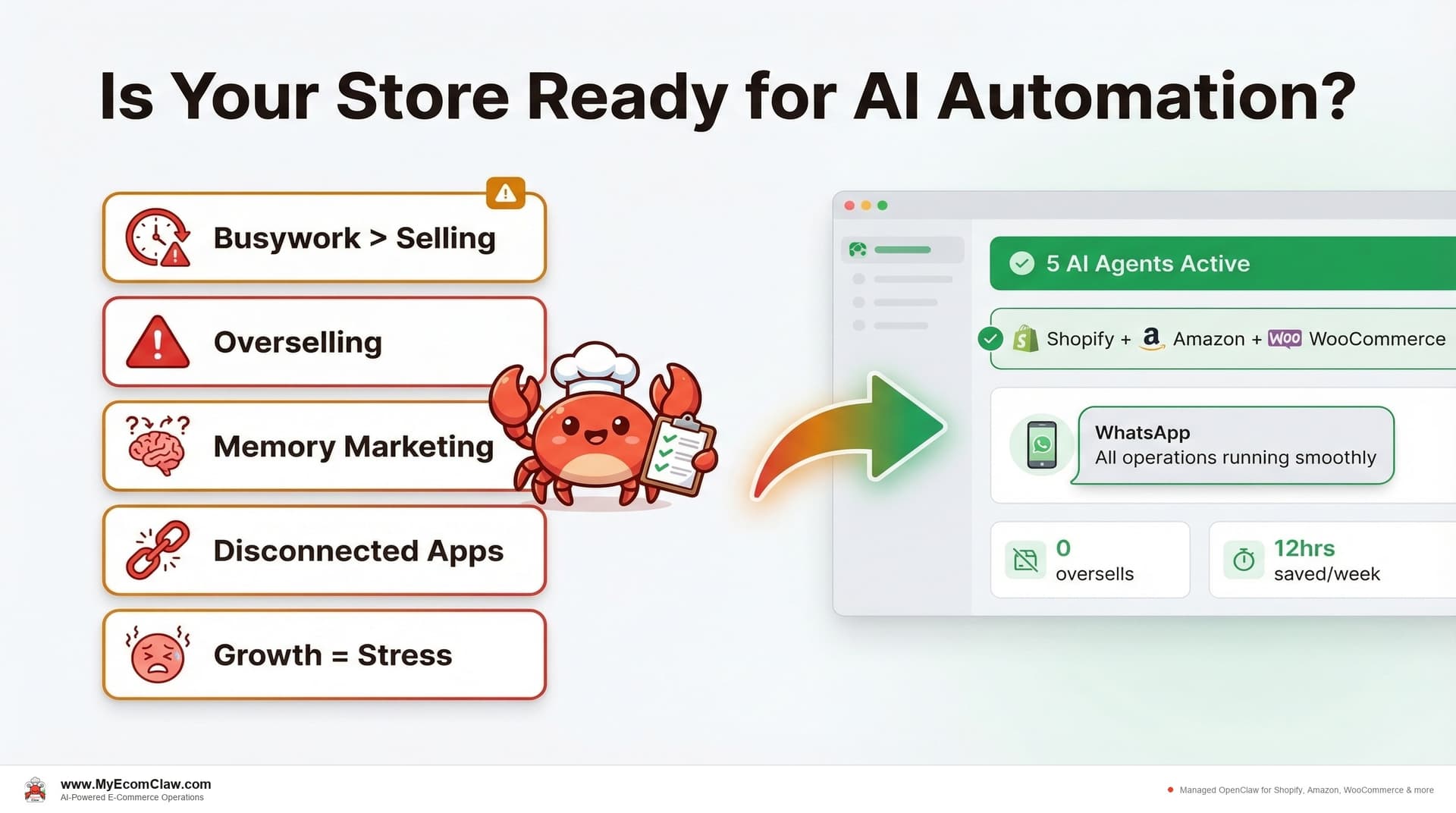
You hit 200 orders last month. Then 500. Then 1,000. And somewhere between "this is working" and "I can’t keep up," the business stopped feeling like a business and started feeling like a second job you gave yourself.
Every new order means another row in the spreadsheet. Every new channel means another dashboard to check. Every new product means another SKU to sync manually across Shopify, Amazon, and WooCommerce. You’re growing — but growth feels like punishment, not progress.
The worst part? You know automation exists. You’ve googled it. You’ve bookmarked tools. You just haven’t had time to set any of it up. Because you’re too busy doing the work that automation would eliminate.
That’s the trap. And it has five very specific warning signs.
The five warning signs (and what to do about each one)
These aren’t hypotheticals. These are the patterns we see in every growth-stage seller doing 100-10,000 orders per month on Shopify, WooCommerce, or Amazon. If three or more apply to you, your store is overdue for automation.
Sign 1: You spend more time on busywork than selling
You wake up at 7 AM. By 9:30 AM you’ve checked Shopify, reconciled Amazon orders, updated inventory in a spreadsheet, responded to six customer messages, and processed two refunds. You haven’t done a single thing to grow the business.
Sound familiar? You’re not running a store. You’re babysitting operations.
A Webgility survey of 800 online sellers found that 53% spend 1-10 hours per week just on inventory management — not counting order processing, support, or marketing. For a founder doing $50/hour work, that’s $2,600/month in time spent on tasks a machine should handle.
The fix — OpenClaw‘s Order Agent:
The Order Agent connects to your Shopify Admin API (or WooCommerce REST API, Amazon SP-API). It monitors every incoming order, validates payments, flags issues, sends confirmations, and tracks fulfillment — 24/7, without you touching a dashboard. When something actually needs your attention, it messages you on WhatsApp.
Your job shifts from "process every order" to "approve the ones that need a human decision." That’s the difference between working in your store and working on it.
Sign 2: Overselling keeps happening
You sold the last unit of your best seller on Shopify at 2:14 PM. At 2:15 PM, someone bought the same item on Amazon. Shopify’s inventory didn’t update Amazon fast enough. Now you have an order you can’t fulfill, a customer you’ll disappoint, and a seller rating that just took a hit.
This isn’t a hypothetical. Retailers lose an estimated $1.7 trillion annually to combined stockouts and overselling globally. For a seller doing 500-5,000 orders per month across two or three channels, even one oversell per week adds up to refund costs, negative reviews, and platform penalties.
The root cause: Shopify syncs inventory across its own channels (online store, POS, Markets), but it does not sync in real-time with Amazon, WooCommerce, Etsy, or Walmart. It relies on batch syncs — periodic updates that can take 15+ minutes. During a flash sale or a busy Friday, that 15-minute window is where overselling happens.
The fix — OpenClaw’s Inventory Agent:
The Inventory Agent connects to your Shopify Admin API, Amazon SP-API, and WooCommerce REST API simultaneously. When a sale happens on ANY channel, stock counts update across ALL channels in real-time via webhooks — not in 15-minute batch cycles. It also predicts stockouts 3-7 days out based on sales velocity, generates purchase orders automatically, and sends you alerts on WhatsApp before problems become emergencies.
One seller on r/shopify posted: "Am I missing something? Purchase Orders in Shopify." The answer is no — Shopify doesn’t have native purchase order support. OpenClaw’s Inventory Agent does.
Sign 3: Your marketing runs on memory, not systems
You post to social media when you remember. You run ads only when sales dip. You send email campaigns… actually, when was the last time you sent one? Your top 200 customers haven’t heard from you in three weeks, but you’ve been meaning to set up that winback sequence since January.
If your marketing depends on you having a good day, it’s not marketing. It’s hoping.
The fix — OpenClaw’s Marketing Agent:
The Marketing Agent segments your customers automatically based on purchase history, order frequency, and spending patterns. It generates Shopify discount codes, schedules campaigns, and tracks ROI — all from a WhatsApp conversation. It doesn’t replace your marketing strategy. It executes the strategy you already have in your head but never find time to implement.
Example: Your agent notices that 47 customers who bought in January haven’t returned. It drafts a winback email with a 15% discount code, shows you the segment and the message on WhatsApp, and waits for your approval. You reply "send it." Done. Campaign running. You spent 10 seconds.
The part nobody mentions: inconsistent marketing doesn’t just lose sales. It trains your customers to forget you. Every week without a touchpoint is a week your competitor’s email lands in their inbox instead.
Sign 4: You’re paying for tools that don’t talk to each other
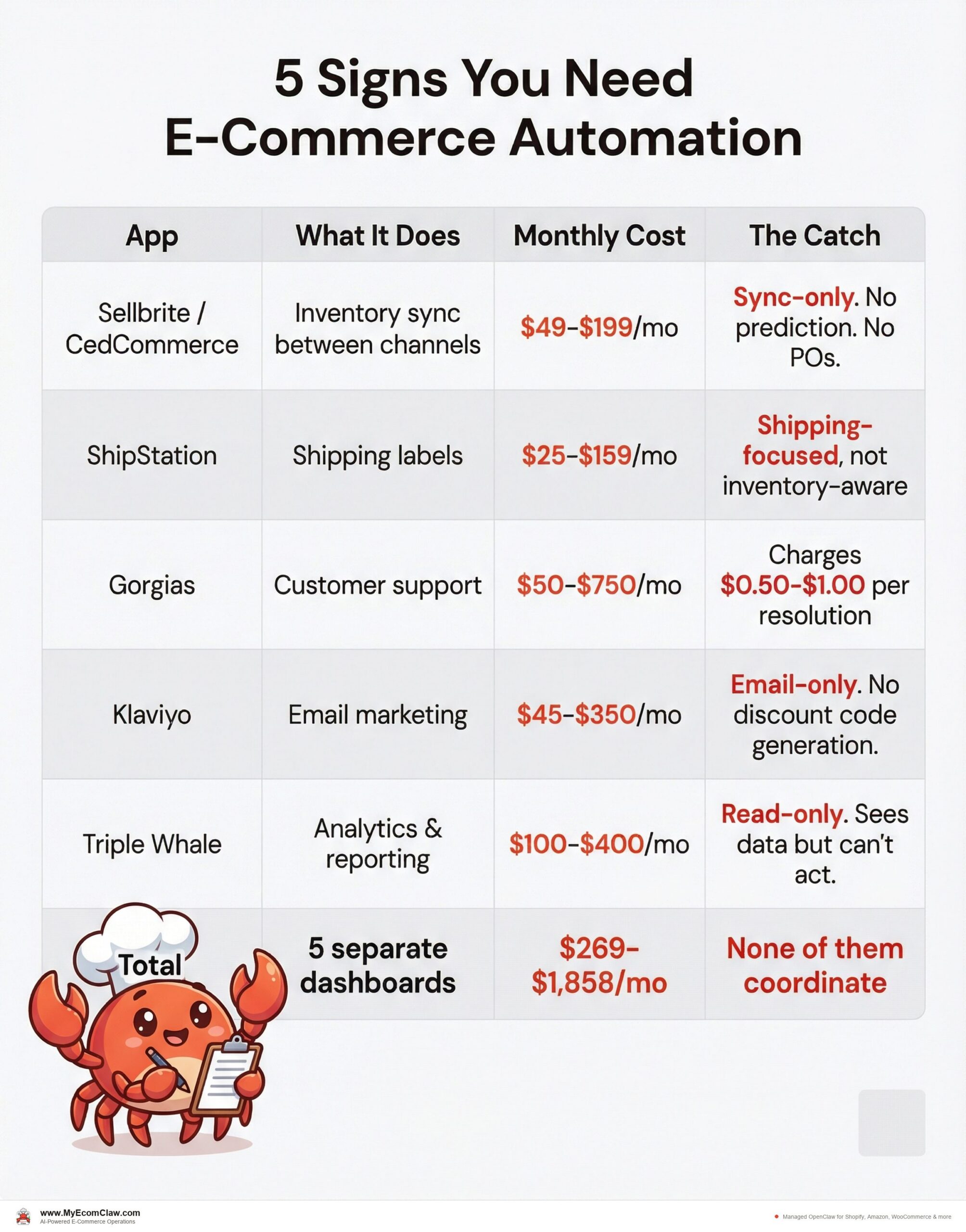
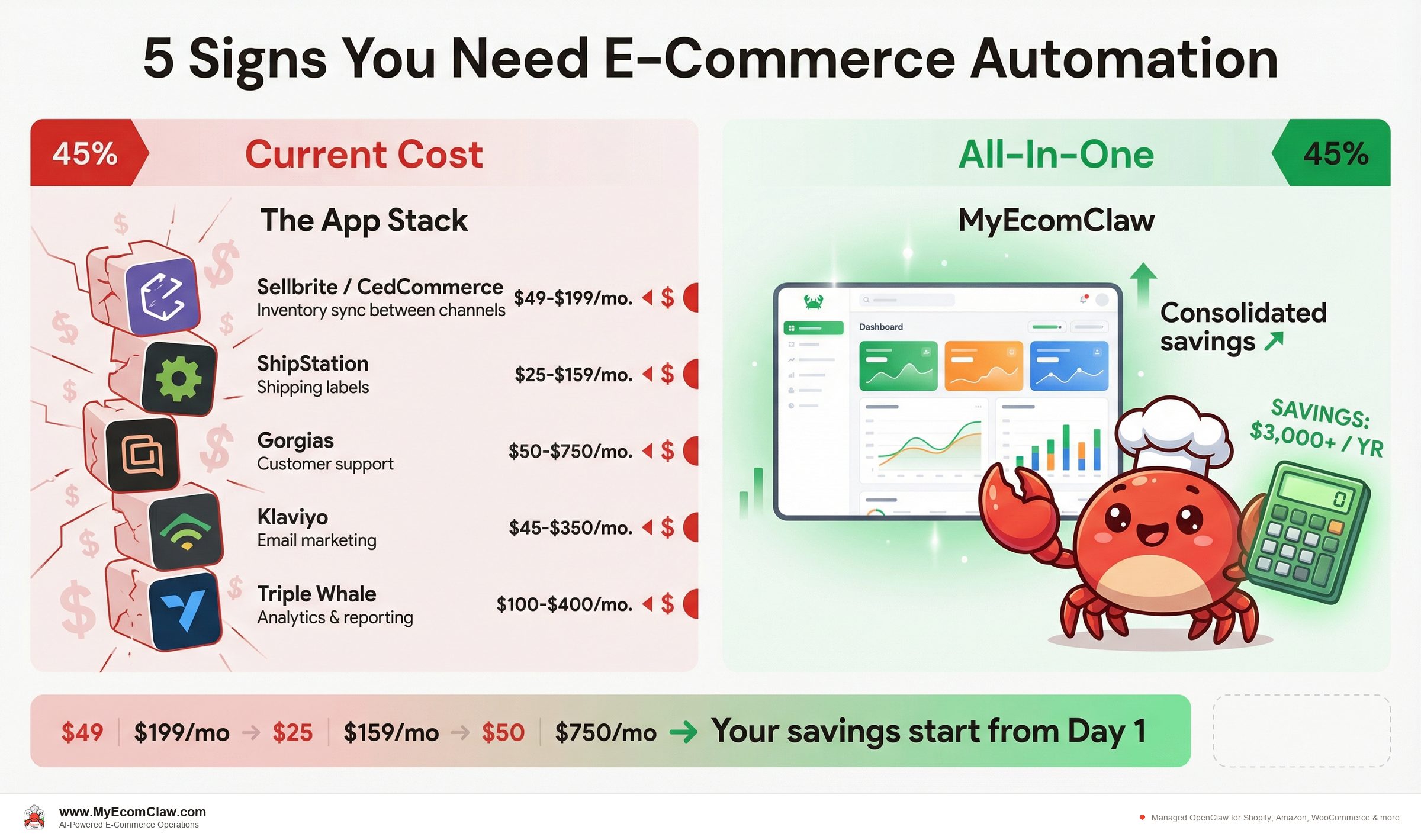
One app for inventory sync. Another for shipping. A third for customer support. A fourth for email marketing. A fifth for analytics. Each one costs money, each one has its own dashboard, and none of them share data cleanly.
Your sync app doesn’t know you’re running ads on products you’re about to stock out on. Your support app doesn’t know a delayed shipment is about to trigger 50 "where is my order" tickets. Your analytics app sees the problem but can’t do anything about it.
You’re the coordination layer. Every morning, you’re the human glue between 5 disconnected tools.
Here’s what that stack actually costs:
| App | What It Does | Monthly Cost | The Catch |
|---|---|---|---|
| Sellbrite / CedCommerce | Inventory sync between channels | $49-$199/mo | Sync-only. No prediction. No POs. |
| ShipStation | Shipping labels | $25-$159/mo | Shipping-focused, not inventory-aware |
| Gorgias | Customer support | $50-$750/mo | Charges $0.50-$1.00 per resolution |
| Klaviyo | Email marketing | $45-$350/mo | Email-only. No discount code generation. |
| Triple Whale | Analytics & reporting | $100-$400/mo | Read-only. Sees data but can’t act. |
| Total | 5 separate dashboards | $269-$1,858/mo | None of them coordinate |
That’s $3,228-$22,296 per year on tools that operate in silos.
The fix — OpenClaw’s 5-agent coordination:
One deployment. Five agents — Order, Inventory, Support, Marketing, and Orchestration — all running on your own server. They share data natively because they’re part of the same OpenClaw instance. The Inventory Agent tells the Marketing Agent to pause ads when stock runs low. The Support Agent knows about delayed shipments before customers complain. The Orchestration Agent coordinates all four so you don’t have to.
Sign 5: Growth feels scary instead of exciting
Here’s the paradox of manual operations: more sales means more work, not more freedom. Every new product you add is another SKU to track. Every new channel you expand to is another dashboard to check. Every seasonal spike is a fire drill instead of a celebration.
You should be excited about hitting 1,000 orders per month. Instead, you’re wondering how you’ll process them all without hiring someone — and whether the margins can even support another salary.
The fix — OpenClaw’s Orchestration Agent:
The Orchestration Agent is the coordinator. It watches the other four agents, resolves conflicts between them, manages priorities, and routes decisions to you only when a human judgment call is needed. When your best seller goes viral and orders spike 5x overnight, the Orchestration Agent ensures inventory syncs in real-time, marketing budgets adjust, support templates update, and order fulfillment keeps moving — without you waking up to chaos.
Growth becomes additive instead of exhausting, because the system scales with you. Going from 500 to 5,000 orders per month doesn’t mean 10x the busywork. It means the same WhatsApp conversation with your agent, just with bigger numbers.
The sellers who win aren’t the ones who work the hardest. They’re the ones whose operations scale without them.
Talk to your agent on WhatsApp — check your automation status
Here’s what it looks like when your OpenClaw agents are running. You don’t open 5 dashboards. You open WhatsApp.
How’s the store doing?
Good morning! Here’s your overnight summary:
📊 Operations Health: All 5 agents active
– Orders: 63 processed overnight (28 Shopify, 24 Amazon, 11 WooCommerce). 0 issues. 2 flagged for manual review (address mismatch).
– Inventory: 312 SKUs tracked across 3 channels. All synced. 4 items below reorder point.
– Support: 9 tickets auto-resolved (7 WISMO, 2 returns). 1 escalated to you — frustrated VIP customer (sentiment: negative).
– Marketing: Winback campaign sent to 47 lapsed customers yesterday — 23% open rate, 4 conversions so far. Daily ad spend: $142 across 3 campaigns.
⚠️ Actions needed:
1. Blue Widget: 19 units left, 8/day velocity. Stockout in 2.4 days. PO draft ready for 200 units from Acme Supplies.
2. VIP customer complaint — wants to speak to a human. Details attached.
Approve the Blue Widget PO. I’ll handle the VIP customer after coffee.
✅ PO #2861 approved and sent to Acme Supplies. Est. delivery: March 27.
✅ VIP customer flagged for your follow-up. I’ve sent them a holding response: “Our team lead is reviewing your case personally this morning.”
That took 45 seconds. You checked operations across 3 channels, approved a purchase order, and triaged a customer issue — all before your coffee was ready.
The same conversation works on Telegram, Slack, Discord, or any messaging app your team already uses. OpenClaw supports 10+ messaging integrations natively.
A day in the life: before and after automation
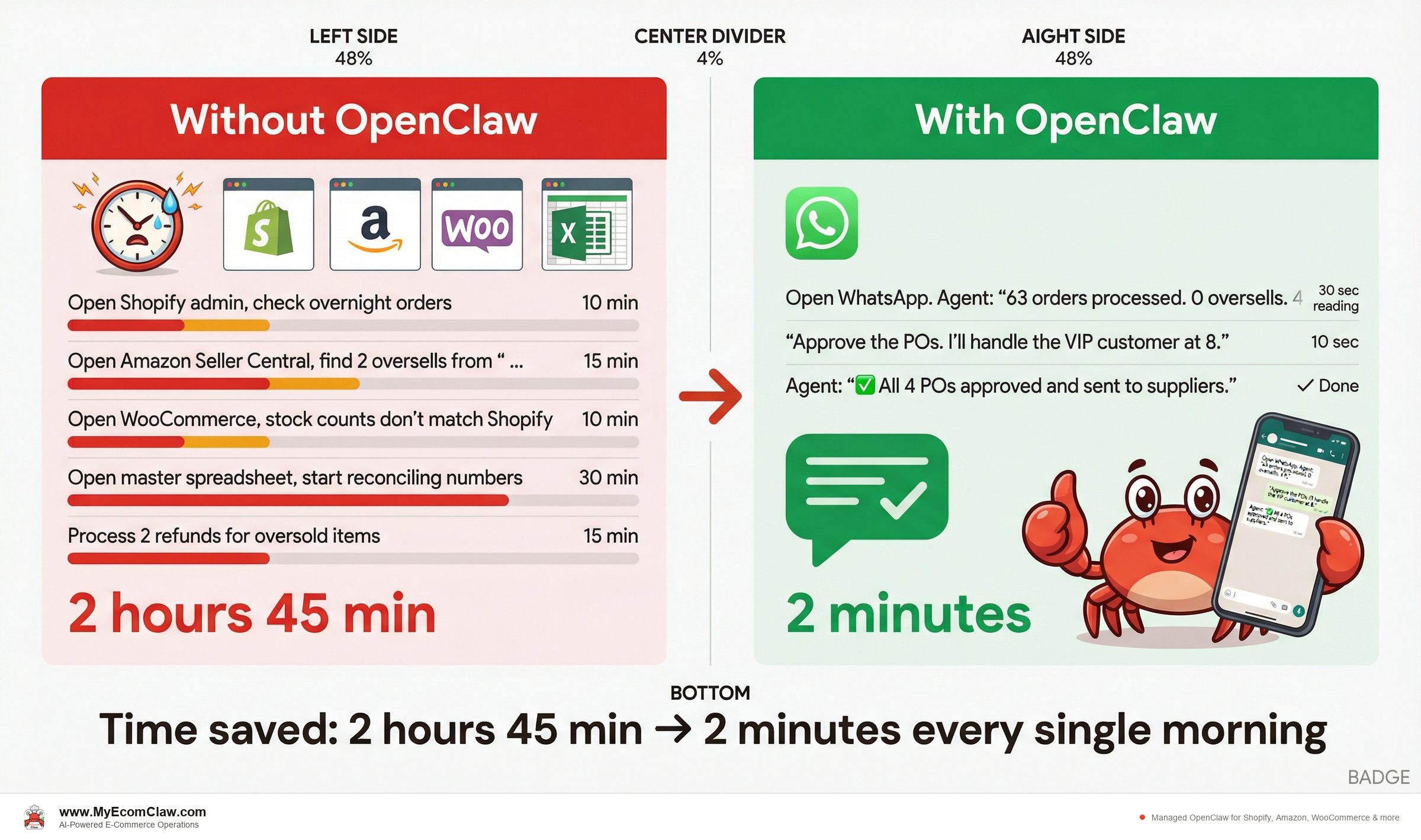
Before: A typical Tuesday without OpenClaw
| Time | What You’re Doing | Time Spent |
|---|---|---|
| 7:00 AM | Open Shopify admin, check overnight orders | 10 min |
| 7:10 AM | Open Amazon Seller Central, find 2 oversells from last night | 15 min |
| 7:25 AM | Open WooCommerce, stock counts don’t match Shopify | 10 min |
| 7:35 AM | Open master spreadsheet, start reconciling numbers | 30 min |
| 8:05 AM | Process 2 refunds for oversold items | 15 min |
| 8:20 AM | Manually update stock counts on all 3 channels | 20 min |
| 8:40 AM | Check which products need reordering, create POs in Google Docs | 25 min |
| 9:05 AM | Email suppliers with PO attachments | 10 min |
| 9:15 AM | Handle 6 “where is my order” tickets across 2 platforms | 25 min |
| 9:40 AM | Remember you were supposed to send that email campaign last week | 5 min (guilt) |
| 9:45 AM | Finally open your to-do list for actual business growth | — |
| Total | Operations busywork | 2 hours 45 min |
After: A typical Tuesday with OpenClaw
| Time | What You’re Doing | Time Spent |
|---|---|---|
| 7:00 AM | Open WhatsApp. Agent: “63 orders processed. 0 oversells. 4 POs auto-generated. 9 tickets auto-resolved. 1 needs your attention.” | 30 sec reading |
| 7:01 AM | “Approve the POs. I’ll handle the VIP customer at 8.” | 10 sec |
| 7:01 AM | Agent: “✅ All 4 POs approved and sent to suppliers.” | Done |
| 7:02 AM | Start working on your product launch, sourcing, strategy | — |
| Total | Operations | 2 minutes |
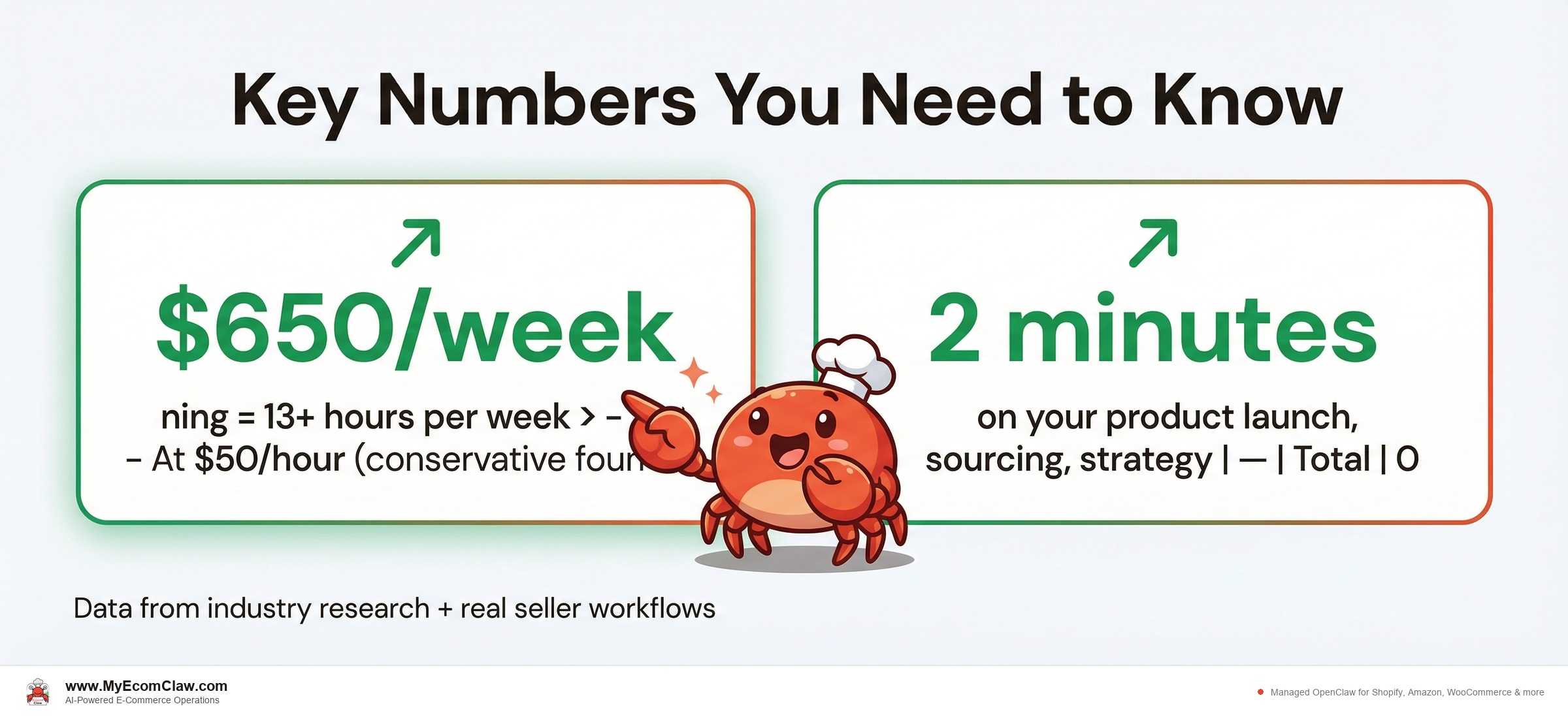
- Time saved:2 hours 43 minutes every morning = 13+ hours per week
- At $50/hour(conservative founder rate) = $650/week
- Annual value of recovered time: $33,800/year
- Oversells prevented:All of them. Real-time sync. Zero batch delays.
- Missed campaigns:Zero. Marketing Agent runs on schedule, not on memory.
You didn’t oversell a single item. You didn’t miss a customer complaint. You didn’t forget to send that campaign. Because five agents were handling it while you slept.
The cost math: 5-app stack vs. one OpenClaw deployment
| 5-App Stack | MyEcomClaw (Growth) | |
|---|---|---|
| Monthly cost | $269-$1,858/mo | $599/mo |
| Annual cost | $3,228-$22,296/yr | $7,188/yr |
| What you get | Inventory sync + shipping + support + email + analytics (separate dashboards) | 5 AI agents (Inventory + Orders + Support + Marketing + Orchestration) on your own server |
| Cross-tool coordination | None — you are the coordination layer | Orchestration Agent coordinates all 5 agents automatically |
| Predictive alerts | Most sync apps are reactive only | AI predicts stockouts 3-7 days out based on sales velocity |
| Purchase orders | Manual creation in Google Docs | Auto-generated POs with one-click approval on WhatsApp |
| Communication | 5 separate dashboards | WhatsApp, Slack, or Telegram — one conversation |
| Data ownership | Spread across 5 vendor clouds | Your server. Your data. Full SSH access. MIT licensed. |
| Lock-in | 5 separate contracts and data exports | MIT licensed. Leave anytime. Take everything. |
| Time spent on ops | 10-15 hrs/week managing tools | 1-2 hrs/week reviewing agent reports |
- App stack (mid-range):~$800/mo = $9,600/year
- MyEcomClaw Growth:$599/mo = $7,188/year
- Direct savings:$2,412/year on tools alone
- Time savings:13+ hours/week at $50/hr = $33,800/year
- Total first-year value:$36,212 in savings + recovered time
- ROI payback:Less than 1 week
Even at the Growth plan ($599/mo), you’re paying less than a mid-range app stack — and getting 5 coordinated AI agents instead of 5 disconnected tools. Add the recovered time and the math isn’t even close.
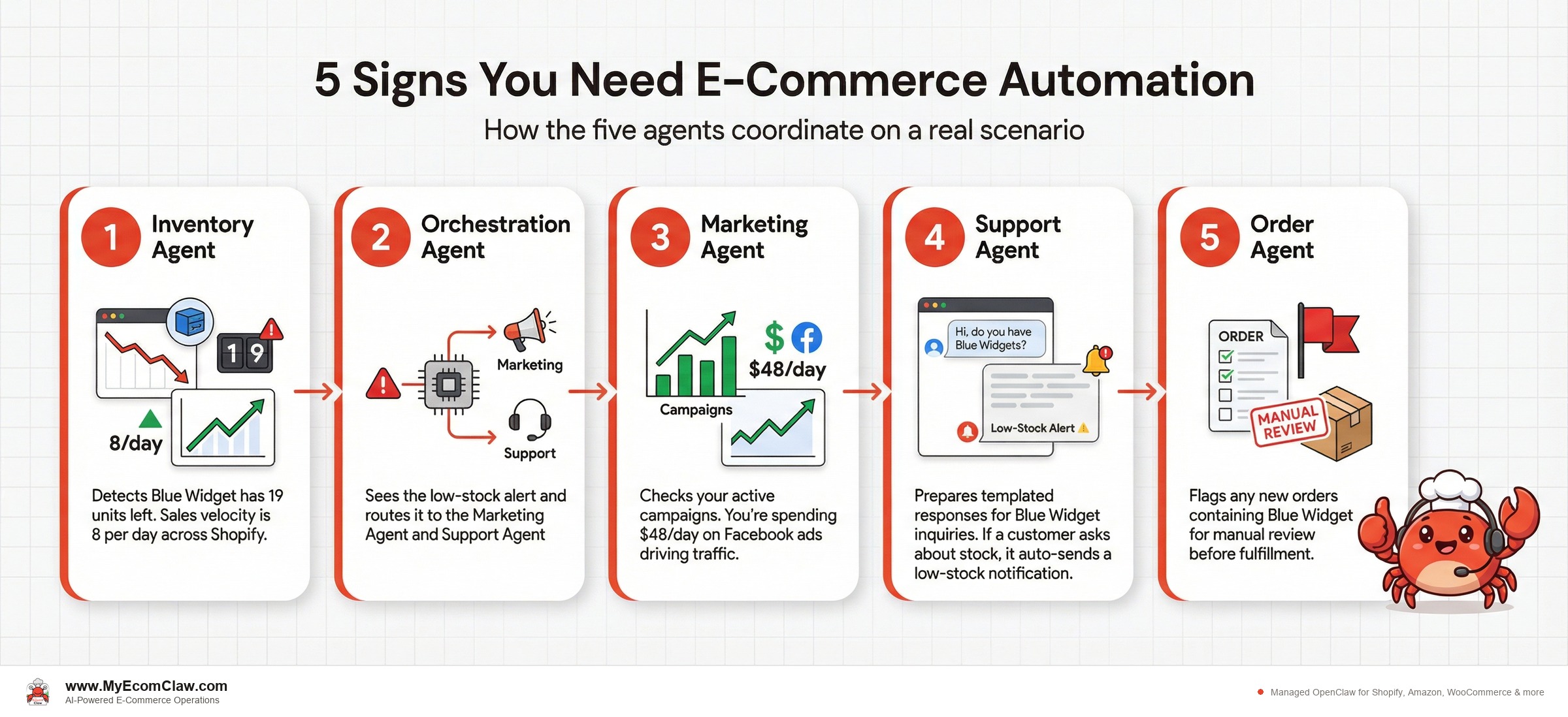
How the five agents coordinate on a real scenario
This isn’t abstract. Here’s what happens when your best-selling product is about to stock out and you have ads running:
Inventory Agent detects Blue Widget has 19 units left. Sales velocity is 8 per day across Shopify + Amazon. That’s 2.4 days of stock. Supplier lead time is 5 days. The agent creates PO #2861 and sends you an approval request on WhatsApp.
Orchestration Agent sees the low-stock alert and routes it to the Marketing Agent and Support Agent simultaneously.
Marketing Agent checks your active campaigns. You’re spending $48/day on Facebook ads driving traffic to the Blue Widget page. The agent pauses the campaign and messages you: "Paused Blue Widget ads — you’ll stock out before the next delivery. Saved $240 in wasted ad spend."
Support Agent prepares templated responses for Blue Widget inquiries. If a customer asks about the product, the agent responds proactively: "Blue Widget is temporarily low stock. Expected back March 27. Want me to notify you when it’s available?"
Order Agent flags any new orders containing Blue Widget for manual review before fulfillment — preventing oversells during the low-stock window.
No combination of Shopify apps does this. Sellbrite doesn’t know about your ad spend. Gorgias doesn’t know about your inventory levels. Klaviyo doesn’t know about supplier lead times. Only a coordinated agent team connects these dots automatically.
Built on OpenClaw — 191K+ GitHub stars, MIT licensed, the most popular open-source AI agent in the world. Deployed on your own private server. Your data never leaves your infrastructure. Built by Space-O Technologies — 15+ years in software, 80+ AI developers, 500+ projects delivered. No lock-in. No black boxes.
What your first week with MyEcomClaw looks like
Here’s what actually happens from the moment you sign up — from YOUR perspective:
You pick a plan (Starter at $299/mo for up to 1,000 orders, Growth at $599/mo for up to 5,000). You share which channels you sell on — Shopify, Amazon, WooCommerce — and tell us your biggest pain points. We start provisioning your dedicated server. Your data will never touch our servers.
We connect your Shopify Admin API, Amazon SP-API, and WooCommerce REST API. We map your SKUs across channels (so “Blue Widget SKU-001” on Shopify matches “Blue Widget” on Amazon). We set buffer stock, reorder thresholds, and supplier profiles. You don’t touch a terminal.
Your agent sends its first message: “Hi! I’m your OpenClaw agent. I’ve synced 312 SKUs across your 3 channels. Current stock health: 93%. 4 items below reorder point. 63 orders processed in the last 24 hours. Want me to create purchase orders for the low-stock items?”
Done.
You wake up. Check WhatsApp. Agent says: “48 orders processed overnight. 0 oversells. 1 PO sent to Acme Supplies. 6 support tickets auto-resolved. All channels synced.” You reply with a thumbs up and start working on your product launch.
Agent messages you at 2 PM: “Red Hoodie XL sales velocity increased 35% this week (seasonal trend detected). At current pace, you’ll stock out in 4 days. Supplier lead time is 5 days. I’ve drafted PO #2865 for 150 units. Approve?”
Total time from signup to running agents: 3-5 business days on Starter, 5-7 on Growth. You don’t configure anything — we handle the deployment, API connections, SKU mapping, and testing.
Why this matters for your business
The automation question isn’t about technology. It’s about what you do with your time.
When operations are handled — really handled, with real-time sync across every channel, with AI predicting problems before they happen, with agents coordinating marketing, support, and inventory automatically — you stop firefighting and start building.
The sellers who grow past 10,000 orders per month aren’t the ones who work the hardest. They’re the ones who replaced 5 dashboards with one agent team, replaced reactive spreadsheets with predictive alerts, and replaced manual coordination with an Orchestration Agent that handles it 24/7.
Every hour you spend on busywork is an hour you didn’t spend on product development, supplier negotiations, new channel expansion, or customer relationships. The math compounds. 13 hours per week is 676 hours per year. That’s 84 full workdays. What would you build with 84 extra days?
Our take
The "should I automate?" question has an expiration date. Every seller hits a point where manual operations become the bottleneck — not the product, not the market, not the competition. Just the sheer weight of operational tasks that multiply with every order.
The five signs in this post aren’t independent problems. They’re symptoms of the same root cause: you are the system. You’re the sync engine, the coordinator, the support agent, the marketing scheduler, and the stockout detector — all rolled into one human who also needs to eat, sleep, and occasionally think about strategy.
OpenClaw’s five agents don’t just automate tasks. They replace you as the system. Order Agent handles fulfillment. Inventory Agent handles sync and prediction. Support Agent handles tickets. Marketing Agent handles campaigns. Orchestration Agent coordinates all four. And the whole thing runs on your own server, talks to you on WhatsApp, and costs less than the app stack you’re duct-taping together today.
If three or more of the five signs apply to your store, you’re past the decision point. The cost of not automating is already higher than the cost of automating. See plans starting at $299/mo → · Talk to us about your specific setup →
FAQ
How do I know if my store is ready for automation?
If you’re doing 100+ orders per month and spending more than an hour a day on operational tasks (order processing, inventory updates, support tickets, marketing execution), your store is ready. The five signs in this post are the diagnostic. Three or more means you’re overdue. Check our plans to find the right fit →
What exactly are the five OpenClaw agents and what does each one do?
The five agents are: Order Agent (monitors orders, validates payments, tracks fulfillment), Inventory Agent (syncs stock across channels, predicts stockouts, generates POs), Support Agent (handles customer inquiries, processes refunds, escalates intelligently), Marketing Agent (segments customers, generates discount codes, schedules campaigns), and Orchestration Agent (coordinates all four agents, resolves conflicts, manages priorities). Starter plan includes 3 agents (Orders, Inventory, Support). Growth and Scale include all 5. See full plan comparison →
Does this work with my Shopify store? What about Amazon and WooCommerce?
Yes. OpenClaw connects natively to Shopify Admin API, Amazon SP-API, WooCommerce REST API, Magento GraphQL API, and Walmart Marketplace API. Shopify has the deepest skill set and is the primary platform. WooCommerce, Amazon, Magento, and Walmart are fully supported and growing. You can start with one channel and add more at any time.
How is this different from just installing more Shopify apps?
Shopify apps are individual tools that don’t coordinate. Sellbrite doesn’t know about your ad spend. Gorgias doesn’t know about your inventory levels. Klaviyo doesn’t know about supplier lead times. OpenClaw’s five agents share data natively because they run on the same instance on your server. When inventory runs low, the Marketing Agent pauses ads, the Support Agent updates templates, and the Order Agent flags risky orders — automatically. No app stack does this. See the cost comparison →
Where does my data live? Is it secure?
Your OpenClaw agent runs on your own private server — VPS or Mac Mini. Your data, API keys, sales patterns, customer information, and supplier details are stored on your infrastructure. Not on a shared cloud. Not on our servers. You have full SSH access. OpenClaw is MIT licensed — open source, no lock-in. If you ever leave, you take everything with you. Talk to us about security →
How long does setup take?
Starter plan: 3-5 business days. Growth plan: 5-7 business days. We handle everything — server provisioning, API connections, SKU mapping, agent configuration, and testing. You don’t touch a terminal. Your first WhatsApp message from your agent arrives within days of signup. Get started →
Can I start small and add more agents later?
Yes. The Starter plan ($299/mo) includes 3 agents — Orders, Inventory, and Support — for up to 1,000 orders per month. When you’re ready for marketing automation and cross-agent coordination, upgrade to Growth ($599/mo) for all 5 agents and up to 5,000 orders. Compare plans → · Not sure which plan? Ask us →
Still on the fence? Count your signs.
If three or more of the five signs apply to your store, the operational drag is already costing you more than automation would. OpenClaw’s five agents — deployed on your own server, managed by MyEcomClaw, accessible from WhatsApp — replace the spreadsheets, the app stack, and the daily dashboard marathon.
More from Automation
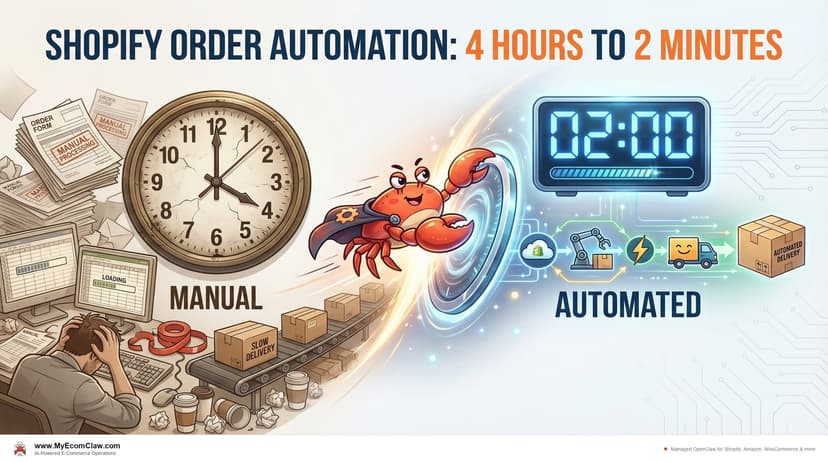
Shopify Order Automation: 4 Hrs to 2 Min
Shopify sellers spend 4-5 hours daily on manual order processing. Here’s a step-by-step breakdown of what OpenClaw’s Order Agent automates —.
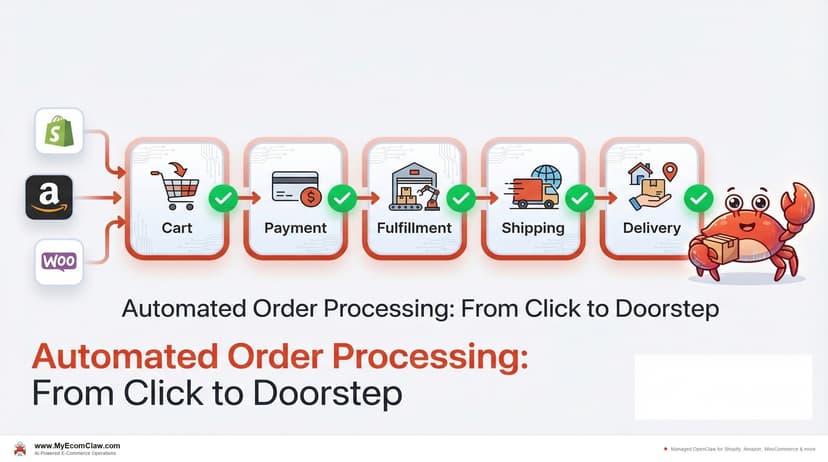
Order Automation: Click to Doorstep
The average Shopify seller spends 2+ hours per day on order processing. OpenClaw’s Order Agent validates payments, routes fulfillment, generates.
AI Returns: Turn Refunds Into Revenue
The average e-commerce return rate is 20-30%. Most sellers treat returns as pure cost. OpenClaw’s Support + Order agents automate approvals,.