AI Returns: Turn Refunds Into Revenue

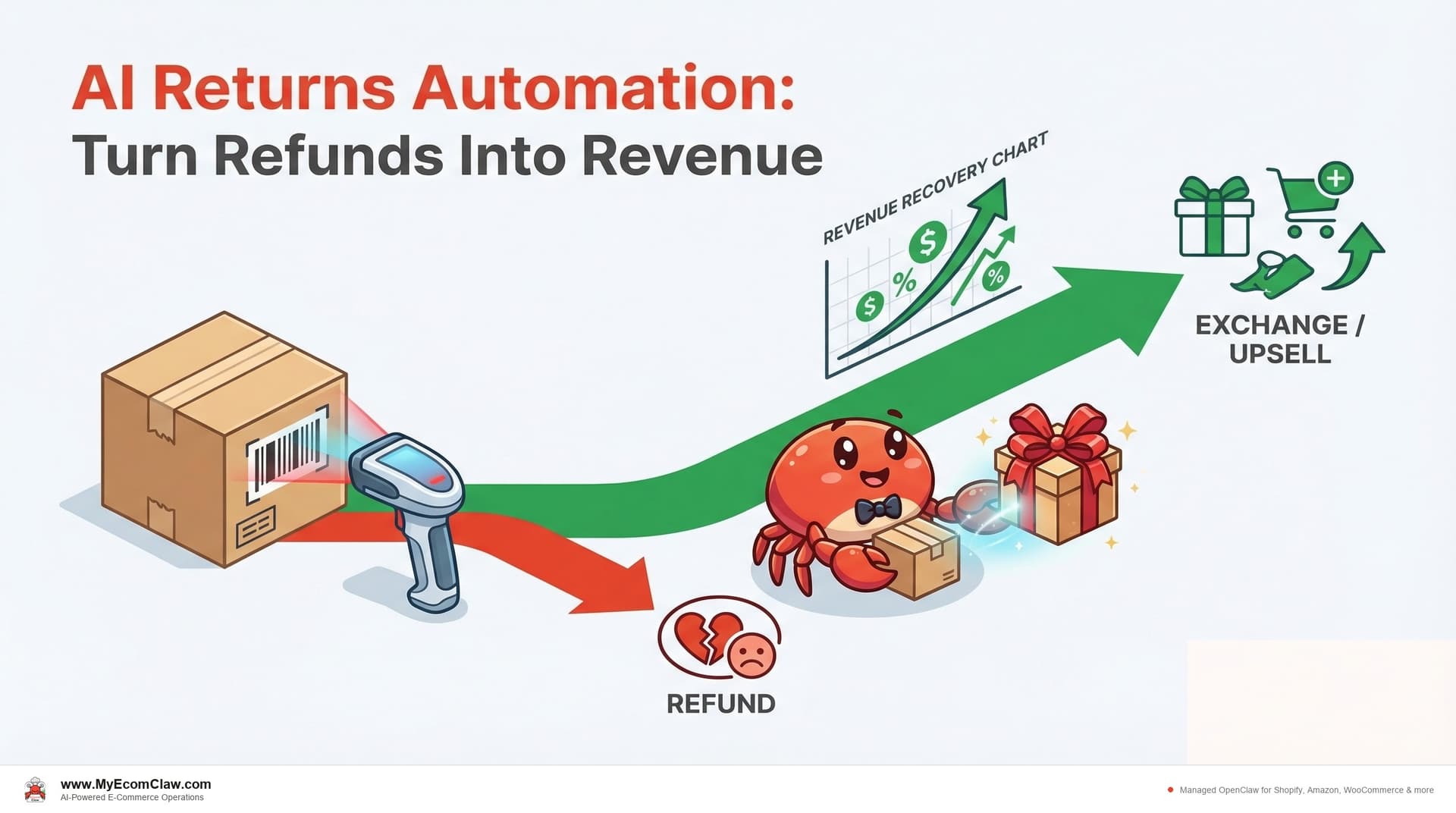
A Shopify customer emails you: "I want to return this. It doesn’t fit." You read the email at 9 AM. You check the Shopify order date — within the 30-day window. You look up the return policy. You create an RMA number in a spreadsheet. You generate a return shipping label. You email it back. It’s now 9:18 AM and you’ve processed one Shopify return.
Meanwhile, you have 3 Amazon FBA returns that Amazon auto-processed overnight (but you need to update your Shopify inventory to reflect the returned stock). And 2 WooCommerce refund requests waiting in your WooCommerce dashboard.
You have 14 more return requests in your inbox — a mix of Shopify store returns, Amazon buyer complaints about damaged-in-transit items, and a WooCommerce customer who changed their mind.
By the time you’re done, it’s 11 AM. You’ve spent two hours on returns across three platforms — and you haven’t even processed the Shopify refunds yet. Those will happen when the items arrive back, which means another round of manual work next week.
Meanwhile, the Shopify customer who emailed at 9 AM has been waiting 18 minutes for a return label. Your competitor’s automated Shopify store sent one in 30 seconds. Guess whose store that customer will shop at next time.
The returns crisis across Shopify, Amazon, and WooCommerce
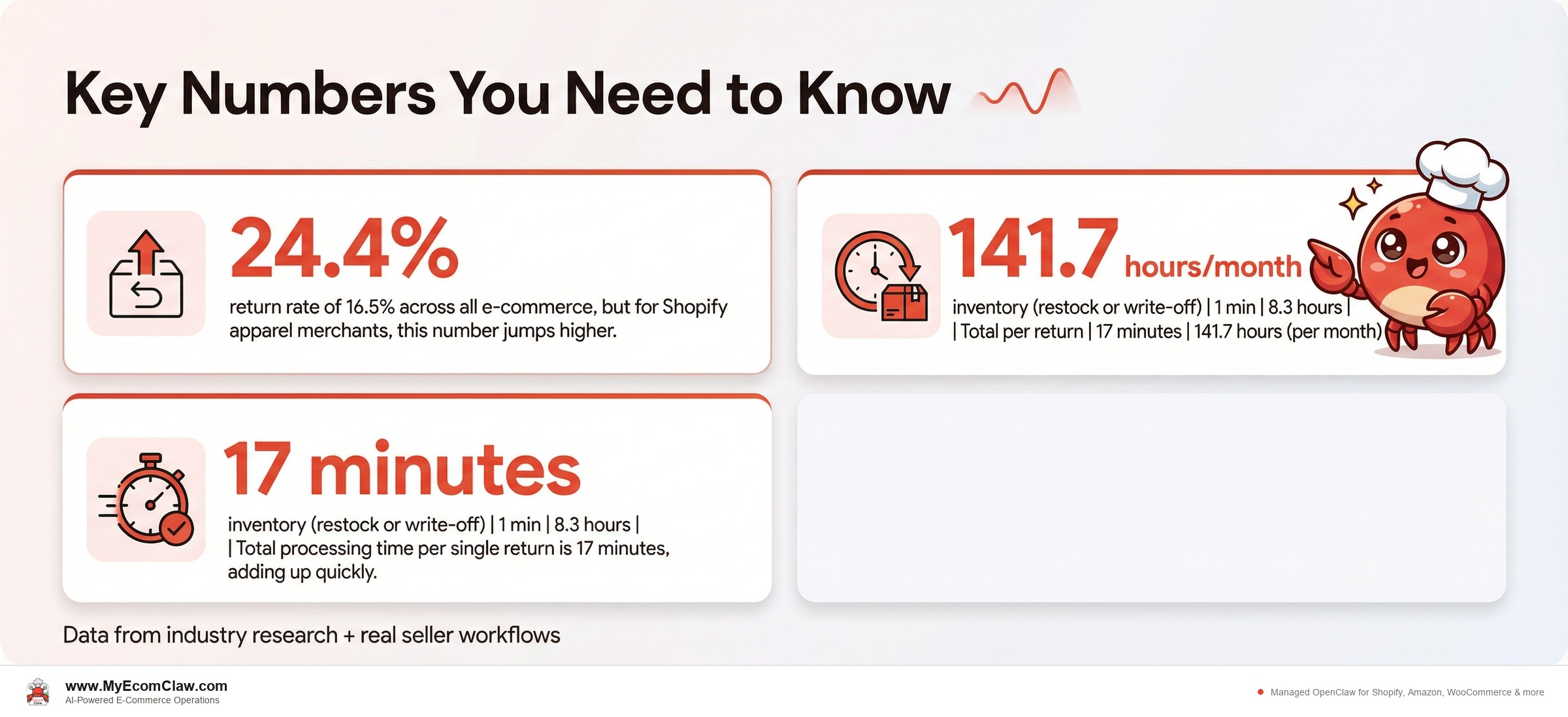
E-commerce return rates are brutal — and each platform handles them differently. The National Retail Federation reports an average return rate of 16.5% across all e-commerce, but for Shopify apparel stores it’s 24.4%, Amazon FBA returns hit 20-25% (because Amazon’s liberal return policy makes it effortless for buyers), and WooCommerce stores see 15-20% with holiday purchases spiking to 30%+. For a Shopify store doing 3,000 orders/month selling across Amazon and WooCommerce, that’s 500-900 returns every month across three different platforms with three different return processes.
On r/shopify, a seller posted: "Returns are killing my margins. I spend more time processing Shopify returns and reconciling Amazon FBA returns than I do on marketing." Another wrote: "We have a 28% return rate on our Shopify clothing line. Amazon FBA handles their own returns but I still need to restock that inventory back to Shopify. I hired a part-time person just to handle returns across all channels. It’s my biggest operational expense after COGS."
Here’s the hidden cost breakdown of manual returns processing:
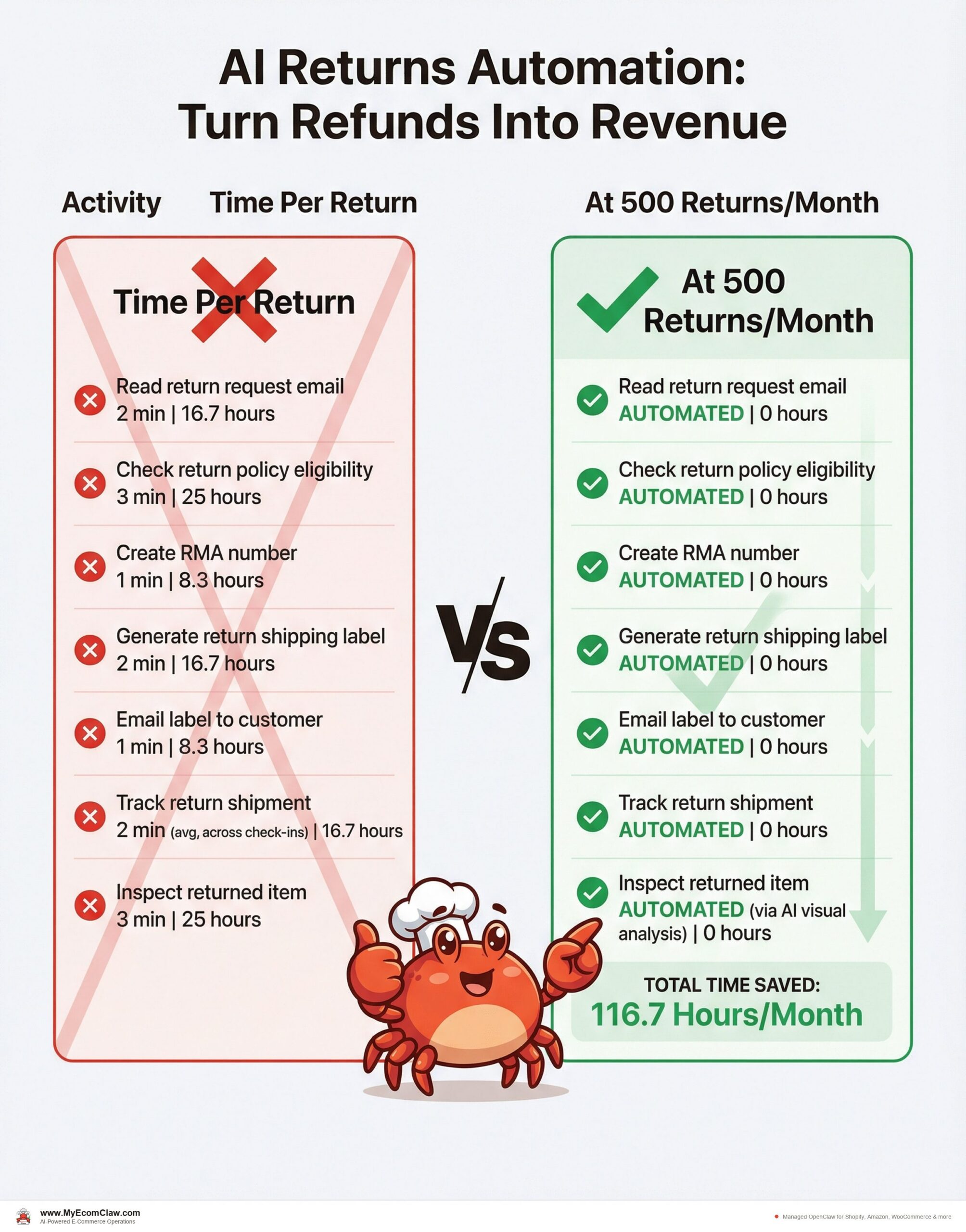
| Activity | Time Per Return | At 500 Returns/Month |
|---|---|---|
| Read return request email | 2 min | 16.7 hours |
| Check return policy eligibility | 3 min | 25 hours |
| Create RMA number | 1 min | 8.3 hours |
| Generate return shipping label | 2 min | 16.7 hours |
| Email label to customer | 1 min | 8.3 hours |
| Track return shipment | 2 min (avg, across check-ins) | 16.7 hours |
| Inspect returned item | 3 min | 25 hours |
| Process refund or exchange | 2 min | 16.7 hours |
| Update inventory (restock or write-off) | 1 min | 8.3 hours |
| Total per return | 17 minutes | 141.7 hours/month |
That’s 141 hours per month — nearly a full-time employee — just on Shopify returns processing. And this doesn’t even include the separate workflows for Amazon FBA returns (which Amazon processes automatically but you need to reconcile inventory) or WooCommerce refund webhook handling (which requires a completely different admin panel). At $20/hour, that’s $2,834/month in labor. At founder rates of $50/hour, it’s $7,085/month in opportunity cost.
And none of that includes the actual cost of the Shopify refund, the return shipping, or the revenue you lose when that Shopify customer doesn’t come back — or when an Amazon buyer leaves a negative review because you didn’t process their return fast enough.
How returns actually destroy revenue (and how to stop it)
The return itself is just the beginning. Here’s the full financial impact most sellers don’t calculate:
| Cost Category | Average Impact | For a $50 AOV, 500 Returns/Month |
|---|---|---|
| Refund amount | 100% of order value | $25,000/month |
| Return shipping | $5-$12 per return | $2,500-$6,000/month |
| Processing labor | 17 min at $20/hr | $2,834/month |
| Restocking/inspection | $2-$5 per item | $1,000-$2,500/month |
| Inventory shrinkage | 5-10% of returns unsellable | $1,250-$2,500/month |
| Customer churn | 60% of customers with bad return experience don’t come back | Incalculable (but massive) |
| Total monthly cost | — | $32,584-$39,834/month |
That last line — customer churn — is where the real damage happens. A Narvar study found that 96% of consumers would shop with a retailer again based on a positive return experience. And 60% won’t come back after a negative one.
Returns aren’t just a cost center. They’re a customer retention event disguised as a logistics problem.
How OpenClaw’s agents turn returns into a retention opportunity
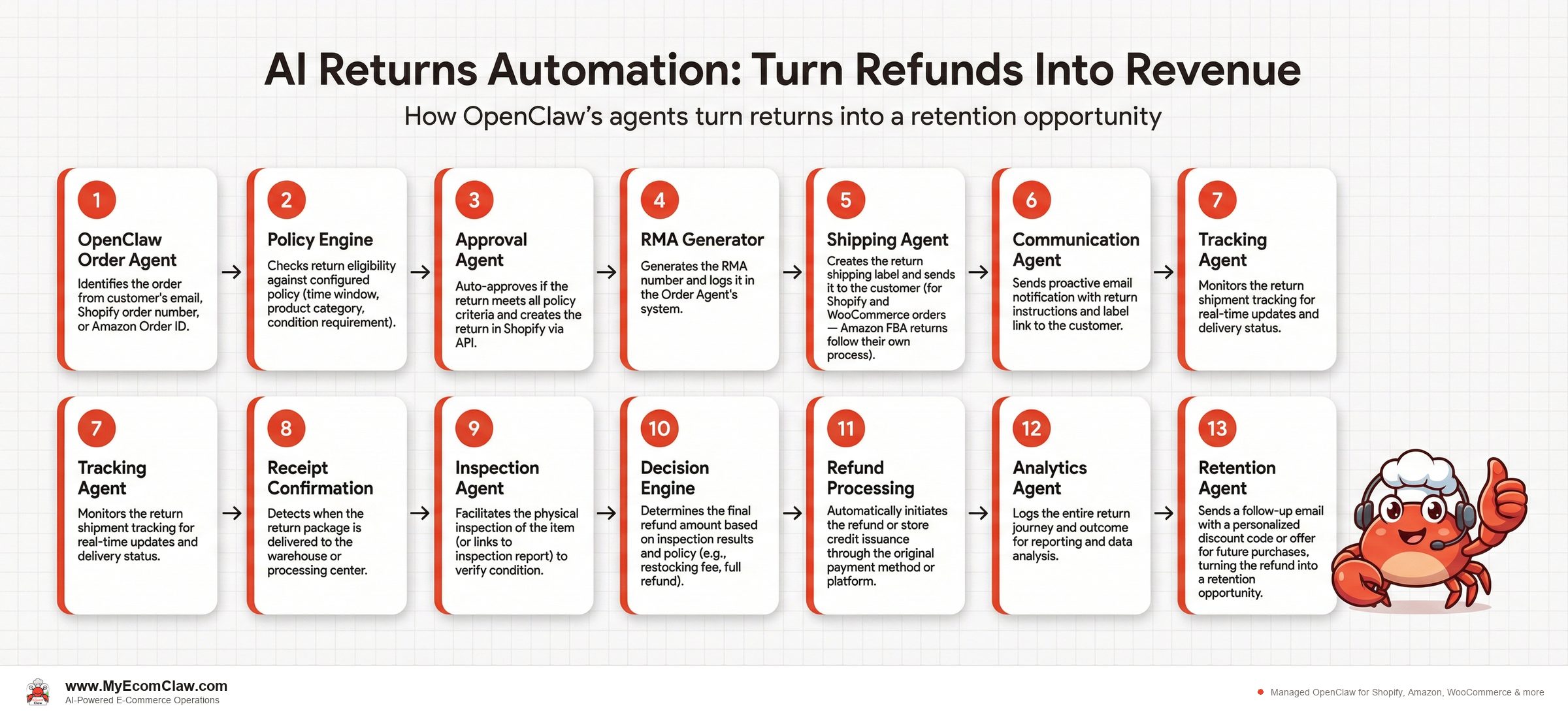
Three agents coordinate on every return: the Support Agent (customer-facing), the Order Agent (logistics), and the Marketing Agent (retention). Here’s the full flow:
Phase 1: Shopify return request via the Admin API (Support Agent)
When a customer requests a return — via email, Shopify chat, WooCommerce contact form, or an Amazon A-to-Z claim — the Support Agent:
Identifies the order from the customer’s email, Shopify order number, or Amazon Order ID
Checks return eligibility against your configured policy (time window, product category, condition requirements — different rules for Shopify direct orders vs. Amazon FBA vs. WooCommerce)
Auto-approves if the return meets all policy criteria and creates the return in Shopify via the Admin API (or initiates the appropriate process for Amazon/WooCommerce)
Generates the RMA number and logs it in the Order Agent’s system
Creates the return shipping label and sends it to the customer (for Shopify and WooCommerce orders — Amazon FBA returns use Amazon’s own label system)
Phase 2: Return logistics across Shopify, Amazon, and WooCommerce (Order Agent)
Once the return is initiated, the Order Agent takes over — with platform-specific handling:
Tracks the return shipment using the carrier’s API (for Shopify and WooCommerce merchant-fulfilled returns). For Amazon FBA returns, monitors the FBA return report via SP-API.
Alerts you when the package is in transit and when it arrives at your warehouse (Shopify/WooCommerce) or when Amazon FBA processes the return at their fulfillment center
Triggers the refund based on your rules — Shopify refunds processed via the Admin API, Amazon refunds handled through SP-API, WooCommerce refunds triggered via the REST API webhook
Updates inventory across all channels — the Inventory Agent restocks the item on Shopify, adjusts Amazon FBA inventory, and updates WooCommerce stock levels if the item is in sellable condition, or marks it as unsellable across all platforms
Phase 3: Customer retention (Marketing Agent)
Here’s where returns stop being a cost and start becoming revenue. After the return is processed, the Marketing Agent:
Sends a personalized follow-up — “We’ve processed your return. Here’s a 15% discount on your next purchase.”
Recommends alternative products based on the return reason — “Didn’t fit? Here’s our size guide + similar items in your preferred size.”
Segments the customer — first-time returner vs. frequent returner, reason-based segments (fit, quality, changed mind)
Triggers a win-back campaign if the customer doesn’t make another purchase within 14 days
Talk to your agent on WhatsApp — returns management in real-time
Here’s what returns look like when your OpenClaw agents are handling them. You don’t process returns. You review summaries and approve edge cases.
Morning returns summary across Shopify, Amazon, and WooCommerce:
Approve both. Add a note to #8103’s profile about the sizing pattern. Can the Marketing Agent send them a personalized size guide?
✅ Both approved. Refunds processing.
✅ #8103 flagged for sizing pattern. Marketing Agent will send personalized size guide with their next order confirmation — with a note: “We noticed you’re finding the right fit. Here’s a guide based on what worked for you.”
Return exception handling across Shopify and Amazon:
Approve all three as recommended.
✅ Done.
– Blue Jacket restocked (Shopify, Amazon, and WooCommerce inventory updated)
– Red Dress listed as “open box” at $49 (was $70) on your Shopify store
– Wireless Earbuds: 70% refund ($41.30) processed via Amazon SP-API. Item written off. Amazon buyer notified.
Total time managing 15 returns today: 3 minutes on WhatsApp. Without OpenClaw: 4+ hours of manual work.
Before and after: returns processing transformation
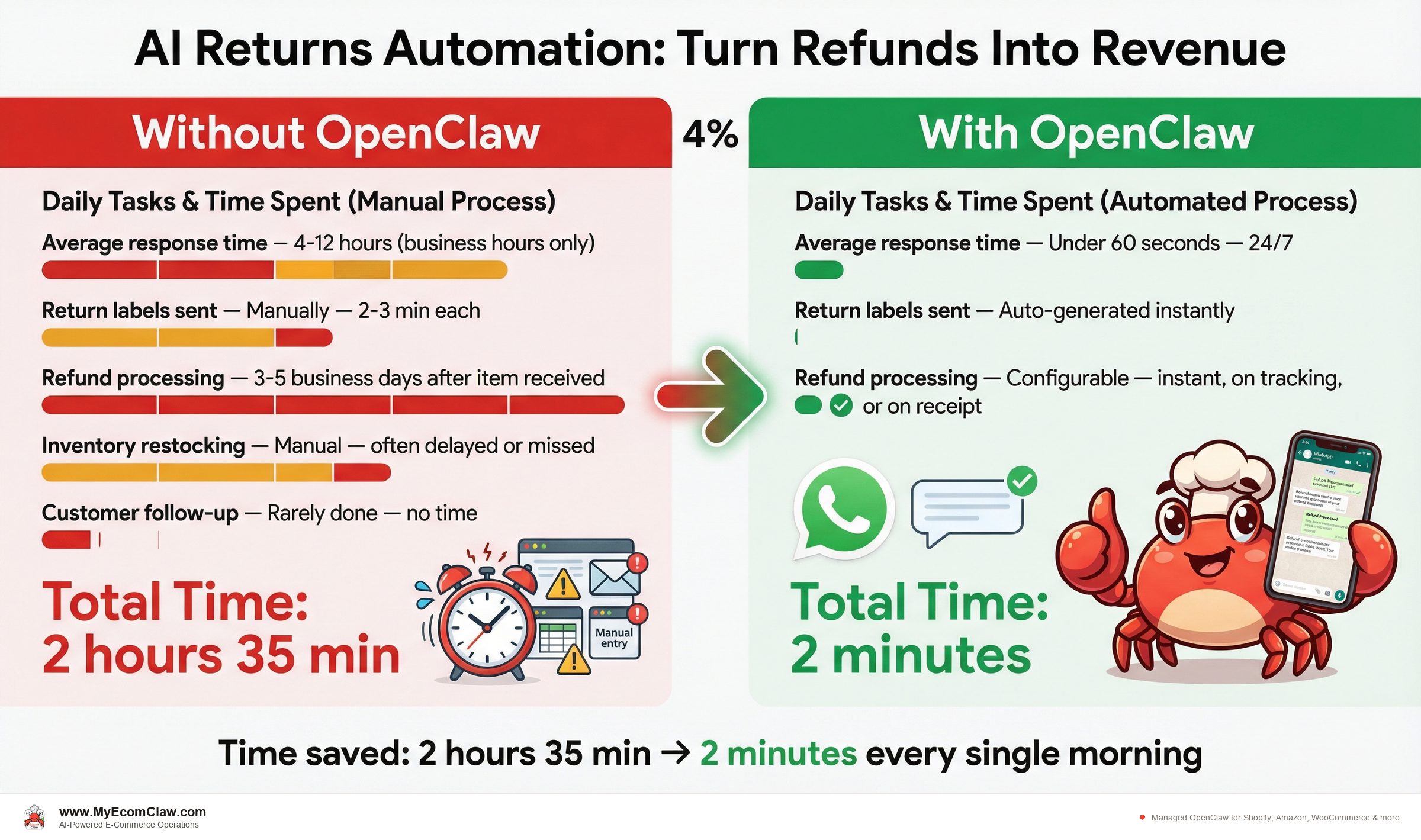
Before: Monthly returns without automation (500 returns/month)
| Metric | Current State |
|---|---|
| Average response time | 4-12 hours (business hours only) |
| Return labels sent | Manually — 2-3 min each |
| Refund processing | 3-5 business days after item received |
| Inventory restocking | Manual — often delayed or missed |
| Customer follow-up | Rarely done — no time |
| Return-to-revenue conversion | 0% — returns are pure cost |
| Monthly labor cost | $2,834 (141 hrs at $20/hr) |
| Customer satisfaction (returns) | Low — slow process, no communication |
After: Monthly returns with OpenClaw agents (500 returns/month)
| Metric | With OpenClaw |
|---|---|
| Average response time | Under 60 seconds — 24/7 |
| Return labels sent | Auto-generated instantly |
| Refund processing | Configurable — instant, on tracking, or on receipt |
| Inventory restocking | Automatic across all channels |
| Customer follow-up | 100% — personalized discount + product recommendations |
| Return-to-revenue conversion | 15-25% of returners make a follow-up purchase |
| Monthly labor cost | $0 (your time: ~30 min/week reviewing exceptions) |
| Customer satisfaction (returns) | High — instant processing, proactive communication |
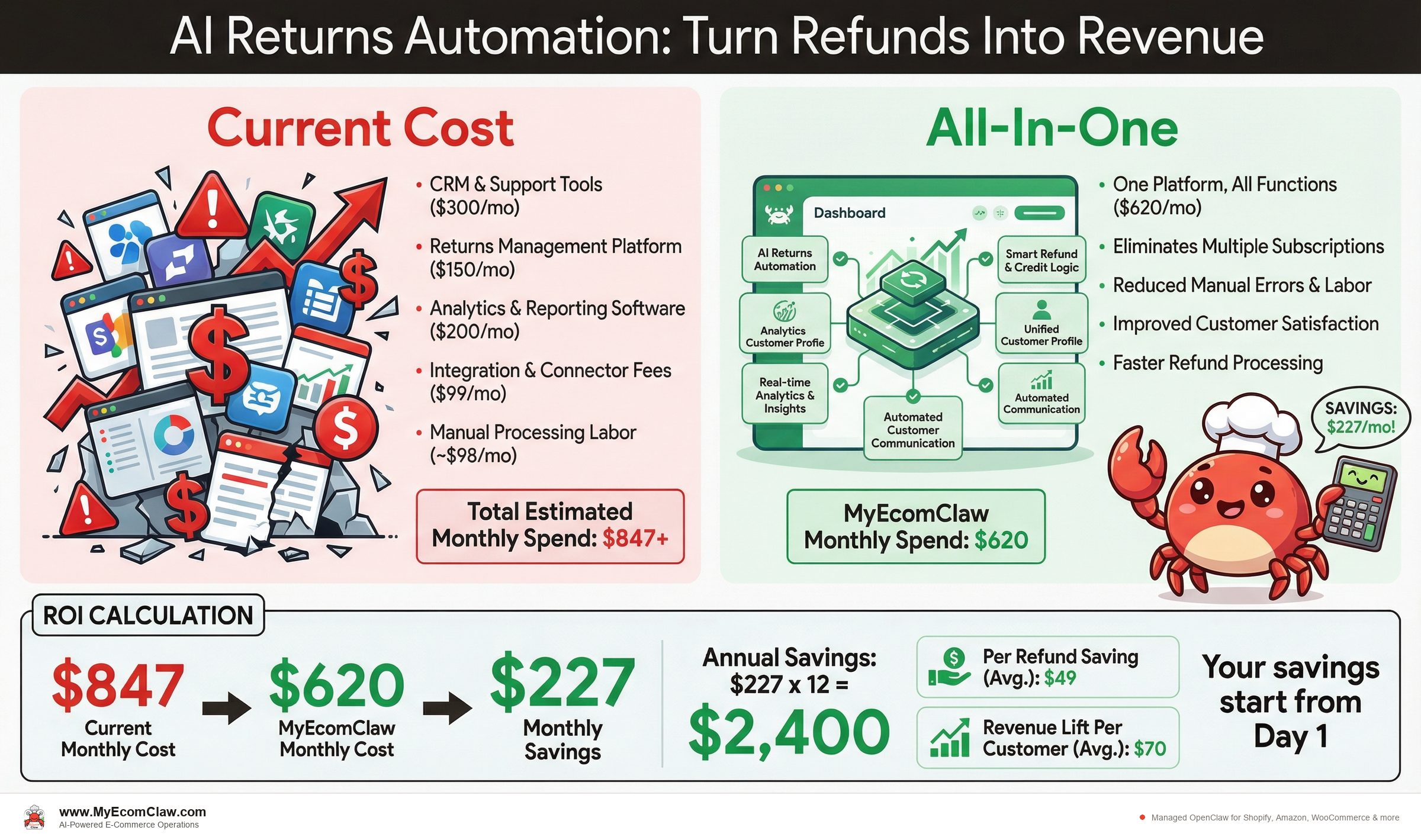
- Labor saved:$2,834/month (141 hours of manual processing eliminated)
- Revenue recovered:$2,500-$4,000/month from retention campaigns (15-25% conversion on return follow-ups)
- Customer retention:96% of customers with good return experience shop again
- Total monthly value:$5,334-$6,834/month in savings + recovered revenue
- Growth plan cost:$599/month
- Net ROI: 8-11x your investment on returns alone
The return-to-revenue playbook
Here’s exactly how OpenClaw’s Marketing Agent converts returns into future purchases:
Strategy 1: The immediate discount
When: Within 1 hour of refund processing What: Personalized email with 10-15% discount code, valid for 14 days Why it works: The customer is still thinking about your store. The refund creates goodwill. The discount creates urgency. Conversion rate: 15-20% of recipients
Strategy 2: The alternative recommendation (platform-specific)
When: Same email as the discount, or in a follow-up 3 days later What: Product recommendations based on return reason — customized by platform Examples:
- Shopify return — wrong size: "Didn’t fit? Here’s our Shopify size guide + similar items in your correct size." Links back to your Shopify store for the repurchase.
- Amazon return — damaged in transit: "Sorry about the damage. We’ve filed an Amazon FBA claim. Here’s a replacement shipped directly from our Shopify store with free express shipping."
- WooCommerce return — buyer’s remorse: "Changed your mind? Here are our best sellers in the same category — with a 15% discount applied at checkout on your WooCommerce account."
- Shopify return — not as described: "Here’s a product comparison with alternatives on our Shopify store that might be a better match." Conversion rate: 8-12% of recipients
Strategy 3: The win-back sequence
When: 7, 14, and 21 days after return if no new purchase What: Automated email sequence — new arrivals, back-in-stock alerts, exclusive offers Why it works: Keeps your brand top of mind during the post-return window when the customer is most likely to switch to a competitor Conversion rate: 5-10% of recipients by day 21
Strategy 4: The loyalty save
When: At the moment of return request (for high-value customers) What: Before processing the return, offer an alternative — exchange, store credit + bonus, partial refund to keep the item Example: Customer wants to return a $120 item → Offer $30 store credit bonus if they keep it (you save $90 + return shipping + processing) Conversion rate: 20-30% of customers accept the alternative
Most return management tools stop at "process the refund." OpenClaw’s Marketing Agent treats every return as a retention event — because a customer who returns and buys again is worth more than a customer who never returns at all.
Built on OpenClaw — 191K+ GitHub stars, MIT licensed, the most popular open-source AI agent in the world. Deployed by Space-O Technologies — 15+ years, 80+ AI developers, 500+ projects delivered. Your server. Your data. No lock-in.
The cost math: manual returns vs. automated returns
| Manual Processing | OpenClaw Agents (Growth Plan) | |
|---|---|---|
| Labor cost (500 returns/month) | $2,834/mo (141 hours at $20/hr) | $0 (automated) |
| Response time | 4-12 hours | Under 60 seconds |
| Revenue recovered from retention | $0 (no follow-up campaigns) | $2,500-$4,000/mo |
| Customer retention rate post-return | ~40% (slow, impersonal process) | ~85% (instant, personalized process) |
| Inventory accuracy | Often delayed — returned items not restocked for days | Real-time — restocked across all channels instantly |
| Error rate | 3-5% (wrong refund amount, missed restocks, policy violations) | <0.5% (automated policy checks) |
| Growth plan cost | — | $599/mo |
| Net monthly impact | -$2,834 (pure cost) | +$1,901-$3,401 (savings + revenue) |
The shift: Returns go from a $2,834/month cost center to a $1,901-$3,401/month net positive. That’s a $4,735-$6,235/month swing from automating a single operational function.
Auto-approval rules: how to configure smart return policies
The Support Agent follows your configured rules. Here’s what a typical auto-approval setup looks like:
| Rule | Auto-Approve | Escalate to You |
|---|---|---|
| Within 30-day return window | ✅ | |
| Item category: clothing/shoes | ✅ (sizing returns are expected) | |
| Item value under $100 | ✅ | |
| Item value $100-$500 | ✅ | |
| First return from customer | ✅ | |
| 3+ returns in 60 days | ✅ (possible abuse) | |
| Return reason: defective | ✅ + instant refund (no return needed under $30) | Escalate if over $100 |
| Past return window (31-45 days) | ✅ (goodwill decision) | |
| Past return window (45+ days) | Auto-decline with explanation | |
| Exchange instead of refund | ✅ + recommend alternatives |
These rules are fully customizable. During onboarding, we configure your return policy rules based on your business logic. You can adjust them anytime from WhatsApp:
Update return policy — auto-approve all returns under $75 regardless of reason. Increase return window to 45 days for VIP customers.
✅ Updated.
– Auto-approve threshold: $75 (was $50)
– VIP return window: 45 days (was 30 days)
– Changes apply to all new return requests immediately.
Common returns mistakes on Shopify, Amazon, and WooCommerce (and how OpenClaw prevents them)
| Mistake | Why It Happens | How OpenClaw Prevents It |
|---|---|---|
| Slow Shopify return response time | Manual processing during business hours only — Shopify customers wait hours | Support Agent responds to Shopify return requests in under 60 seconds, 24/7, via the Admin API |
| Inconsistent policy enforcement across channels | Different rules for Shopify vs. Amazon vs. WooCommerce applied inconsistently | Automated policy rules per channel — Shopify direct returns get your standard policy, Amazon FBA follows Amazon’s rules, WooCommerce follows your WooCommerce-specific terms |
| No follow-up after Shopify refund | Too busy processing returns to do retention on any channel | Marketing Agent sends Shopify customers a follow-up within 1 hour automatically. Amazon and WooCommerce customers get channel-appropriate follow-ups. |
| Delayed restocking across Shopify and Amazon | Returned items sit in a pile — Shopify inventory shows out of stock while Amazon FBA still shows available | Inventory Agent restocks across Shopify, Amazon, and WooCommerce within minutes of receipt |
| Missing return fraud across platforms | Hard to track patterns when a customer returns on Shopify, then buys the same item on Amazon to return there too | Agent flags cross-platform patterns — serial returners who exploit different return policies on Shopify vs. Amazon |
| No data on return reasons by platform | Shopify, Amazon, and WooCommerce returns processed but reasons not tracked or compared across channels | Every return reason logged by platform, categorized, and available for cross-channel analysis |
Why this matters for your Shopify business
Returns are the most underused operational function across Shopify, Amazon, and WooCommerce. Most Shopify sellers treat them as a cost of doing business — process the Shopify refund, take the hit, move on. Amazon sellers let FBA handle returns but never reconcile the inventory back to Shopify. WooCommerce sellers process refund webhooks manually. But returns are actually your highest-impact customer touchpoint after the initial purchase — on every channel.
A Shopify customer who returns an item and has a smooth experience — instant label via the Shopify Admin API, no hassle, personalized follow-up — becomes a loyal customer. An Amazon buyer who gets a fast resolution keeps buying from your Amazon listings instead of a competitor’s. A WooCommerce customer who returns an item and waits 12 hours for a label, 5 days for a refund, and never hears from you again becomes your competitor’s customer.
The Shopify stores with the best customer lifetime values aren’t the ones with the lowest return rates. They’re the ones who handle returns so well — across Shopify, Amazon, and WooCommerce — that customers feel confident buying again. Free returns isn’t enough. Fast, personalized, intelligent returns across every sales channel — that’s the competitive advantage.
Our take
Returns are broken across Shopify, Amazon, and WooCommerce because sellers have been treating them as a logistics problem. Process the Shopify refund. Reconcile the Amazon FBA return. Handle the WooCommerce refund webhook. Restock or write it off. Done.
But returns are a customer relationship problem — on every platform. Every Shopify return is a moment where a customer is deciding whether to buy from your Shopify store again or switch to a competitor. Every Amazon return affects your seller metrics and Buy Box eligibility. Every WooCommerce return is a chance to win back a customer or lose them permanently. The speed of your response, the ease of the process, and what happens after the refund — those three things determine whether you keep the customer or lose them.
OpenClaw’s three-agent approach to returns — Support Agent for instant Shopify return processing via the Admin API, Order Agent for cross-platform logistics including Amazon FBA reconciliation, Marketing Agent for retention — treats each return as what it actually is: a retention event. The 60-second Shopify return response time, the auto-generated label, the personalized follow-up with a discount and product recommendations — that’s not just automation. That’s turning a $50 Shopify refund into a $200 lifetime value increase. And it all runs on your server, coordinated automatically across Shopify, Amazon, and WooCommerce, managed from WhatsApp.
If returns are costing your Shopify store more than they should — in time, money, or lost customers across Shopify, Amazon, and WooCommerce — your OpenClaw agents will turn that cost center into a revenue driver within the first month. See plans → · Talk to us about returns →
FAQ
Can the Support Agent handle return requests from Shopify, Amazon, and WooCommerce?
Yes. The Support Agent processes Shopify return requests via the Admin API, monitors Amazon FBA return reports via SP-API, and handles WooCommerce refund webhook notifications — plus direct return requests from email, Shopify chat, your website’s return portal, and WhatsApp messages from customers. Each platform has its own return flow, but your agent handles all of them. Shopify returns get processed through the Admin API. Amazon FBA returns are monitored and reconciled automatically. WooCommerce refunds are triggered via REST webhooks. All return data across Shopify, Amazon, and WooCommerce is centralized on your server. See how multi-channel support works →.
What if a Shopify customer wants an exchange instead of a refund?
The Support Agent offers exchanges as a first option when configured to do so. If a Shopify customer’s return reason is "wrong size" or "wrong color," the agent recommends the correct alternative from your Shopify catalog, checks inventory availability across Shopify and Amazon with the Inventory Agent, and creates the exchange order on your Shopify store automatically via the Admin API. The Shopify customer receives the replacement before returning the original item (if your policy allows). This reduces Shopify refund rates and keeps revenue in your store.
How does return fraud detection work?
The Support Agent tracks return patterns per customer: frequency of returns, return reasons, value of returned items, and item condition. It flags potential abuse patterns — serial returners, wardrobing (wearing and returning), and empty box returns. Flagged customers are escalated to you for review. You can configure thresholds: "flag if more than 3 returns in 60 days" or "flag if return rate exceeds 50% of orders."
Can I set different return policies for Shopify vs. Amazon vs. WooCommerce?
Yes. Return rules are fully configurable by platform, product category, price range, customer segment, and sales channel. Example: 30-day window for Shopify clothing orders, Amazon FBA returns follow Amazon’s mandatory return policy, WooCommerce electronics get a 14-day window, and your Shopify VIP customers (tagged in Shopify Admin) get a 60-day window. The Support Agent applies the correct policy automatically based on the platform and order details.
Does the Marketing Agent’s retention campaign actually work?
Based on industry benchmarks and our deployment data, personalized post-return follow-ups with discount codes convert at 15-25% — significantly higher than general email campaigns (2-5%). The key is timing (within 1 hour of refund) and personalization (recommendations based on return reason). A store processing 500 returns/month at $50 average order value can expect $2,500-$4,000/month in recovered revenue. Book a call to discuss your specific retention projections →.
How fast are refunds processed?
You configure the refund timing: instant (at the moment of return approval), on tracking confirmation (when the carrier picks up the return), or on receipt (when the item arrives at your warehouse). Most sellers choose "on tracking confirmation" as the balance between customer satisfaction and risk. The Order Agent monitors tracking and triggers the refund automatically at your configured trigger point. The customer is notified at each stage.
Ready to turn your Shopify returns into a retention engine?
MyEcomClaw deploys OpenClaw on your own server with Support, Order, and Marketing agents that automate returns across Shopify, Amazon, and WooCommerce — from instant Shopify Admin API approvals to Amazon FBA reconciliation to WooCommerce refund webhook handling to cross-platform retention campaigns. 24/7. Your data. Your server.
More from Automation
Shopify Order Automation: 4 Hrs to 2 Min
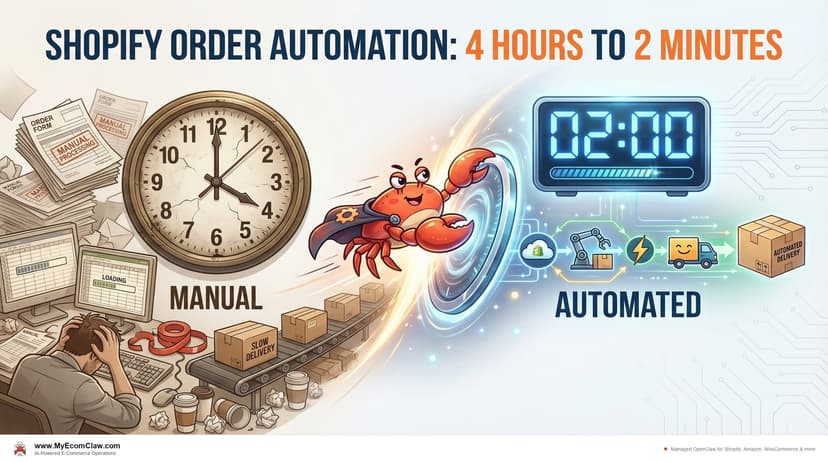
Shopify sellers spend 4-5 hours daily on manual order processing. Here’s a step-by-step breakdown of what OpenClaw’s Order Agent automates —.
Order Automation: Click to Doorstep
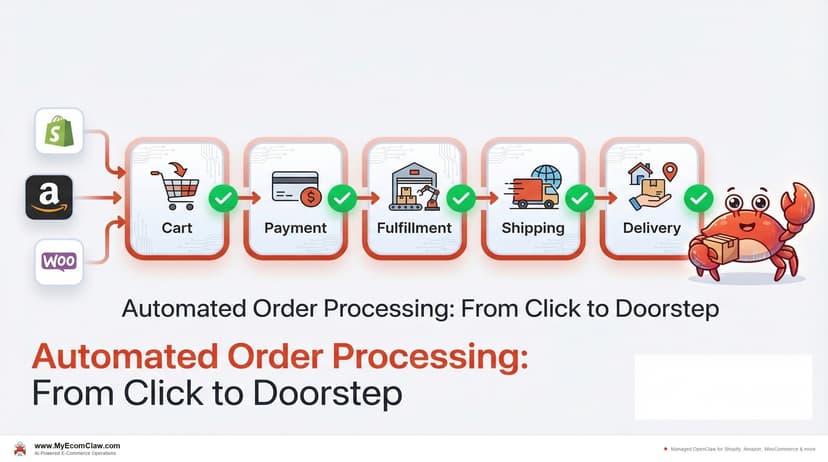
The average Shopify seller spends 2+ hours per day on order processing. OpenClaw’s Order Agent validates payments, routes fulfillment, generates.
AI Cart Recovery for Shopify Stores
70% of Shopify carts are abandoned. Klaviyo sends three emails. OpenClaw’s Marketing Agent sends AI-timed emails, generates one-time discount codes.