AI Cart Recovery for Shopify Stores

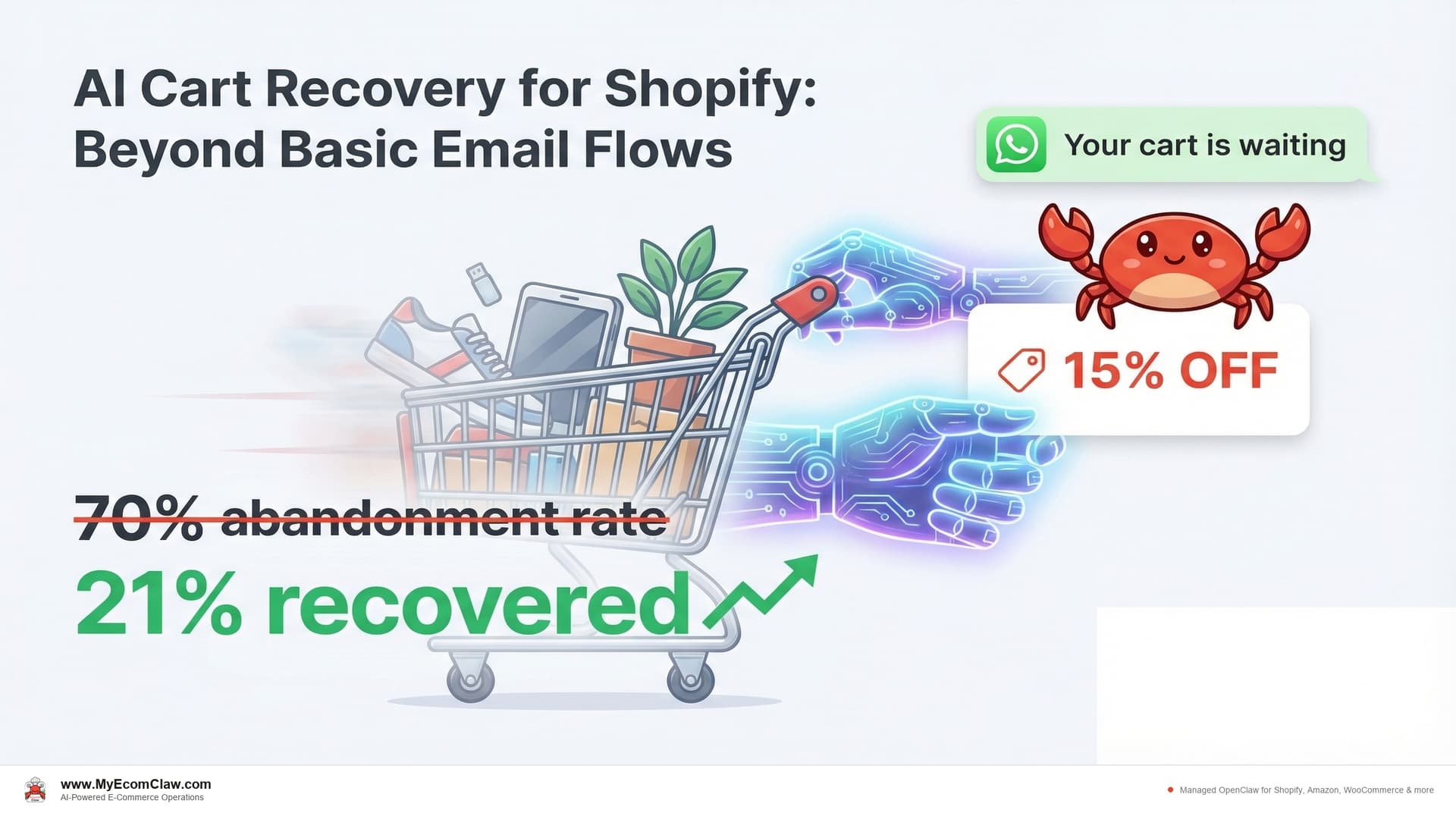
Seven out of ten people who add a product to your Shopify cart will leave without buying. That is not a rounding error. That is the majority of your revenue walking out the door.
The Baymard Institute has tracked cart abandonment rates for over a decade. The global average sits at 70.19%. For mobile shoppers — now the majority of e-commerce traffic — the rate climbs past 85%.
And the standard response? Three canned emails from Klaviyo, spaced 1 hour, 24 hours, and 72 hours apart. The same sequence every competitor runs. The same discounts. The same subject lines.
The real cost of abandoned carts
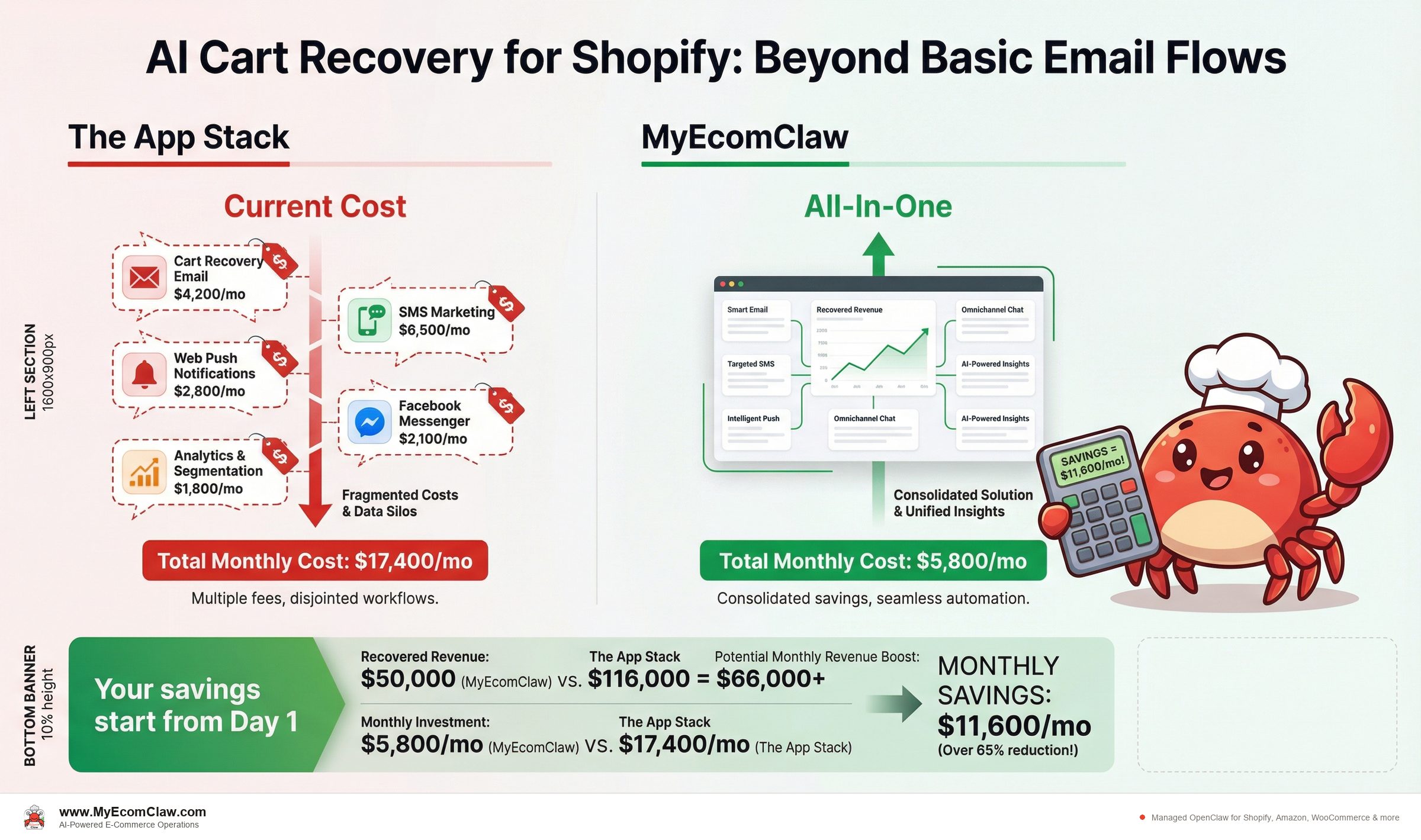
Let’s put numbers on it. If your Shopify store generates $50,000 per month in revenue, that $50,000 represents the 30% of carts that actually converted. The other 70% — roughly $116,000 in potential revenue — evaporated.
Industry benchmarks show that a competent cart recovery flow recaptures 5-15% of abandoned carts. Even at the low end, that is $5,800/month in recovered revenue. At the high end, $17,400/month.
Here’s what a typical Shopify seller’s cart recovery looks like today:
- Klaviyo sends Email 1 at 1 hour: "You forgot something!"
- Klaviyo sends Email 2 at 24 hours: "Still interested?"
- Klaviyo sends Email 3 at 72 hours: "Here’s 10% off"
- Open rate: 40-45% on Email 1, dropping to 20% by Email 3
- Click-through: 8-10% on Email 1, dropping to 3-4% by Email 3
- Total recovery rate: 5-8% of abandoned carts
That sequence was state of the art in 2020. In 2026, every Shopify store runs some version of it. Your customers have seen "You forgot something!" a thousand times. The subject line is invisible now.
The problem is not that email recovery doesn’t work. The problem is that static, timer-based flows have been optimized to death. Everyone runs the same playbook. The marginal gains are gone.
Why Klaviyo’s flows hit a ceiling
Klaviyo is a good tool. It handles email well. But its cart recovery flows have structural limitations that no amount of A/B testing can fix:
Fixed timing. Klaviyo sends emails on a schedule you set — 1 hour, 24 hours, 72 hours. But different customers abandon for different reasons. Someone who left because of shipping costs needs a different timing than someone who got distracted by their phone. Static timers cannot adapt.
Email-only channel. Klaviyo’s core is email. It added SMS, but that is a separate flow, a separate cost ($45-$350/month for email, plus SMS credits on top). WhatsApp? Not natively supported. Your customers live on WhatsApp, Telegram, and iMessage — Klaviyo reaches them in their inbox, which they check twice a day.
Generic discount codes. Klaviyo can include a discount code in the email. But it cannot dynamically generate one-time-use codes via the Shopify Price Rules API. Most stores use a single code like "SAVE10" that leaks to coupon sites within days.
No cross-agent intelligence. Klaviyo does not know that the customer who abandoned the cart also has an open support ticket. It does not know the product they abandoned is about to go out of stock. It does not know the customer’s lifetime value or purchase history across channels. It sends the same flow to a first-time visitor and a loyal repeat buyer.
How OpenClaw handles this: The Marketing Agent analyzes abandonment context — cart value, customer history, time of day, product margin, stock levels — and selects the optimal recovery action. It generates unique discount codes through the Shopify Price Rules API, chooses the right channel (email, WhatsApp, or SMS), and times the outreach based on the individual customer’s behavior pattern.
Talk to your agent on WhatsApp — cart recovery in real-time
Here is what cart recovery looks like when your OpenClaw Marketing Agent is running. You do not set up flows in a drag-and-drop builder. You have a conversation.
Setting up a cart recovery campaign:
How are cart recoveries doing this week?
Here’s your weekly cart recovery report:
📊 Cart Recovery — Last 7 Days
– Carts abandoned: 847
– Recovery attempts sent: 823 (24 suppressed — open support tickets)
– Recovered: 119 carts (14.5% recovery rate)
– Revenue recovered: $8,430
– Channels: 62% email, 28% WhatsApp, 10% SMS
🎯 Top insight:
WhatsApp recovery rate is 22% vs email at 11%. Customers respond 3x faster on WhatsApp. Recommend shifting more first-touch outreach to WhatsApp.
Makes sense. Shift first-touch to WhatsApp for carts over $75. Keep email as the default for under $75.
Done.
✅ Updated recovery flow: Carts over $75 → WhatsApp first, email fallback at 6hrs.
✅ Carts under $75 → Email first, WhatsApp follow-up at 24hrs.
✅ All discount codes generated as one-time-use via Shopify Price Rules API.
What discount tiers are we running?
Current tiers based on cart value and customer LTV:
– Cart $25-$75, new customer → 10% off (one-time code)
– Cart $75-$150, returning customer → Free shipping (one-time code)
– Cart $150+, any customer → 12% off + free shipping (one-time code, 48hr expiry)
– VIP customers (3+ orders) → Personal WhatsApp message, no discount needed (they convert at 31% without one)
Perfect. Keep running it.
That conversation took two minutes. No flow builder. No drag-and-drop. No separate SMS platform. Your agent analyzed a week of data, gave you an insight, and you adjusted the strategy with two sentences.
The same conversation works on Telegram, Slack, Discord, or any messaging platform your team already uses. OpenClaw supports 10+ messaging integrations natively.
A day in the life: before and after OpenClaw cart recovery
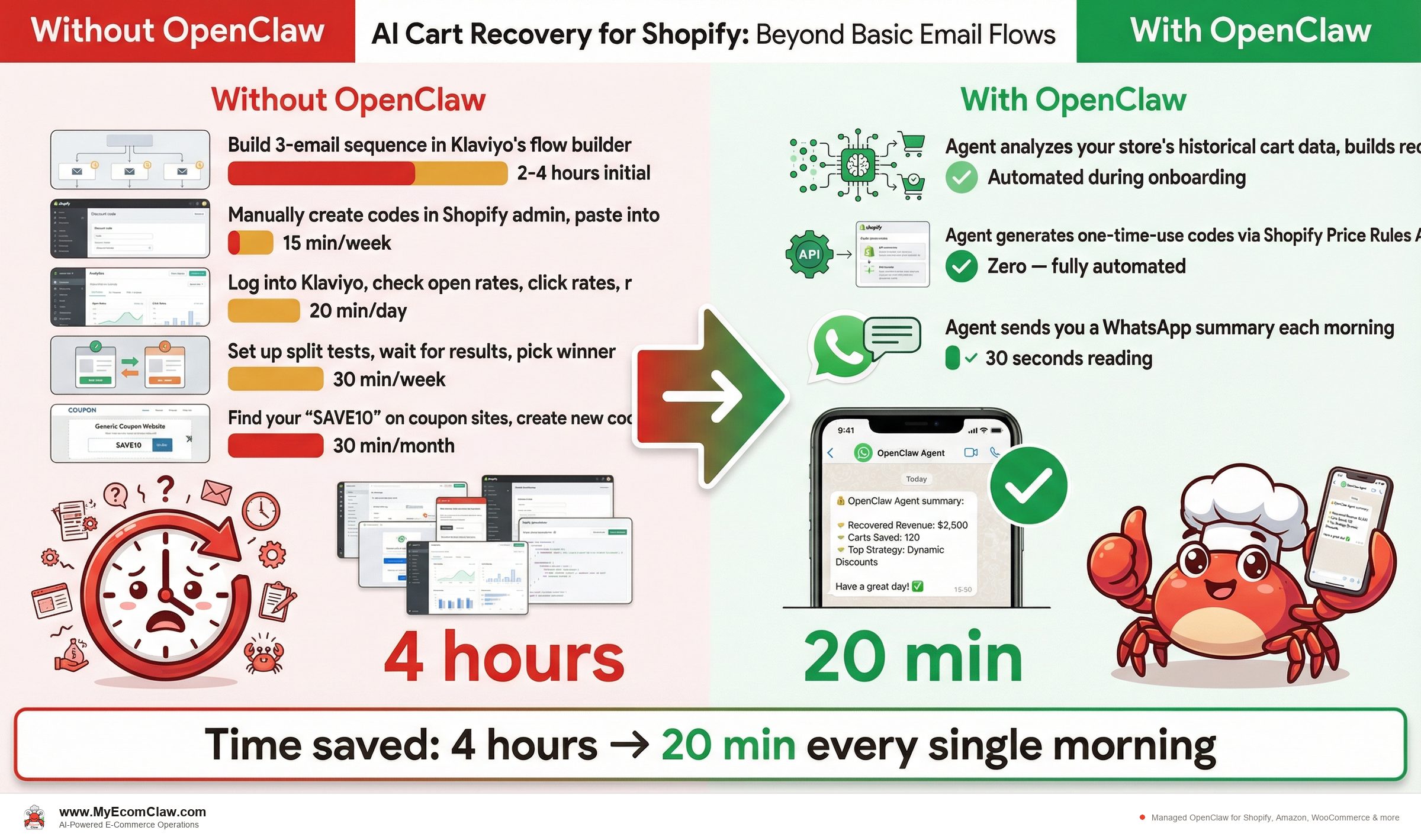
Before: Cart recovery with Klaviyo
| Activity | What You Do | Time Spent |
|---|---|---|
| Setup flows | Build 3-email sequence in Klaviyo’s flow builder | 2-4 hours initial |
| Create discount codes | Manually create codes in Shopify admin, paste into Klaviyo templates | 15 min/week |
| Monitor performance | Log into Klaviyo, check open rates, click rates, revenue | 20 min/day |
| A/B test subject lines | Set up split tests, wait for results, pick winner | 30 min/week |
| Deal with code leaks | Find your “SAVE10” on coupon sites, create new code, update all flows | 30 min/month |
| Segment by customer type | Build segments in Klaviyo for new vs returning | 1 hour initial, 15 min/week maintenance |
| Add WhatsApp/SMS | Subscribe to additional tool, build separate flows | $50-$200/mo extra + setup time |
| Total weekly effort | Manual flow management | 3-4 hours/week |
| Recovery rate | Static flows, same timing for everyone | 5-8% |
After: Cart recovery with OpenClaw Marketing Agent
| Activity | What Happens | Time Spent |
|---|---|---|
| Setup | Agent analyzes your store’s historical cart data, builds recovery strategy | Automated during onboarding |
| Discount codes | Agent generates one-time-use codes via Shopify Price Rules API, auto-expires them | Zero — fully automated |
| Monitor performance | Agent sends you a WhatsApp summary each morning | 30 seconds reading |
| Optimization | Agent continuously adjusts timing, channel, and discount tier per customer segment | Zero — AI-driven |
| Code leaks | Every code is unique, single-use, with 48-hour expiry. Nothing to leak. | Zero |
| Segmentation | Agent segments by LTV, purchase frequency, cart value, product margin in real-time | Zero — dynamic |
| Multi-channel | Email, WhatsApp, and SMS from one agent, one conversation | Zero additional tools |
| Total weekly effort | Review WhatsApp summary, adjust strategy if needed | 15-20 min/week |
| Recovery rate | AI-timed, personalized, multi-channel | 12-18% |
- Monthly abandoned carts (avg Shopify store doing $50K/mo):~1,200
- Klaviyo recovery at 6%:72 carts × $70 avg = $5,040/mo recovered
- OpenClaw recovery at 14%:168 carts × $70 avg = $11,760/mo recovered
- Difference: $6,720/month in additional recovered revenue
- Annual impact: $80,640 more per year
And that is conservative. Stores with higher AOV or stronger WhatsApp engagement see recovery rates above 20%.
The cost math: Klaviyo vs. OpenClaw Marketing Agent
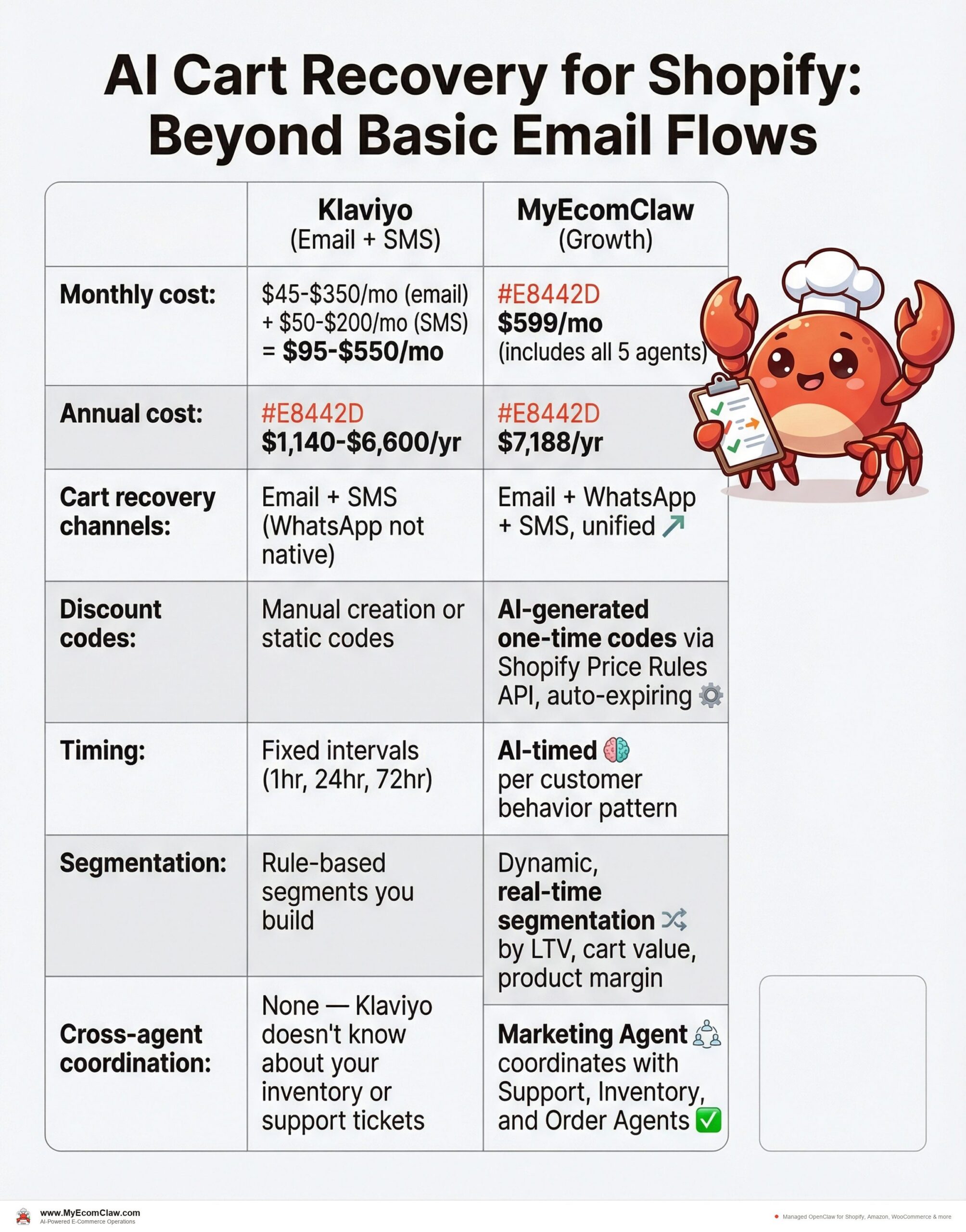
| Klaviyo (Email + SMS) | MyEcomClaw (Growth) | |
|---|---|---|
| Monthly cost | $45-$350/mo (email) + $50-$200/mo (SMS) = $95-$550/mo | $599/mo (includes all 5 agents) |
| Annual cost | $1,140-$6,600/yr | $7,188/yr |
| Cart recovery channels | Email + SMS (WhatsApp not native) | Email + WhatsApp + SMS, unified |
| Discount codes | Manual creation or static codes | AI-generated one-time codes via Shopify Price Rules API, auto-expiring |
| Timing | Fixed intervals (1hr, 24hr, 72hr) | AI-timed per customer behavior pattern |
| Segmentation | Rule-based segments you build | Dynamic, real-time segmentation by LTV, cart value, product margin |
| Cross-agent coordination | None — Klaviyo doesn’t know about your inventory or support tickets | Marketing Agent coordinates with Support, Inventory, and Order Agents |
| Additional capabilities | Email marketing only | Cart recovery + campaigns + segmentation + discount management + 4 other agents (orders, inventory, support, orchestration) |
| Data ownership | Klaviyo’s servers | Your server. Your data. Full SSH access. MIT licensed. |
| Recovery rate (typical) | 5-8% | 12-18% |
Bottom line: Klaviyo costs less per month. But it only does email (and basic SMS). At the Growth plan, you get five coordinated AI agents — the Marketing Agent handles cart recovery alongside campaign management, customer segmentation, and discount optimization. The other four agents handle orders, inventory, support, and orchestration. The additional recovered revenue ($6,000+/month) more than covers the cost difference.
How the Shopify Price Rules API powers smarter discounts
Most Shopify sellers create discount codes manually in the admin panel. Or they use a static code in their Klaviyo flows that anyone can share.
OpenClaw’s Marketing Agent uses the Shopify Price Rules API to generate discount codes programmatically. Here is what that enables:
One-time-use codes. Every abandoned cart recovery message contains a unique code that expires after one use. No code sharing. No coupon site leaks. No "SAVE10" appearing on RetailMeNot.
Dynamic discount tiers. The agent calculates the optimal discount based on:
- Cart value (higher cart = different strategy)
- Product margin (no 15% discount on a 12% margin product)
- Customer LTV (loyal customers often need no discount — just a reminder)
- Stock levels (overstocked items get deeper discounts, low-stock items get none)
Auto-expiring codes. Codes expire in 24-48 hours. Urgency is real, not fabricated. The customer knows the code disappears — because it actually does.
Margin protection. The agent never offers a discount that erodes your margin below a threshold you set. If a product has 15% margin, the agent will not offer 15% off. It might offer free shipping instead, or a dollar-off amount that keeps margin above your floor.
This is the difference between "here is 10% off everything" and "here is a discount calculated against your margin, your customer’s LTV, and your current stock position." One is a blunt instrument. The other is a scalpel.
Built on OpenClaw — 191K+ GitHub stars, MIT licensed, the most popular open-source AI agent in the world. Built by Space-O Technologies — 14+ years in software, 200+ team members, 1,200+ projects delivered. Your server. Your data. No lock-in.
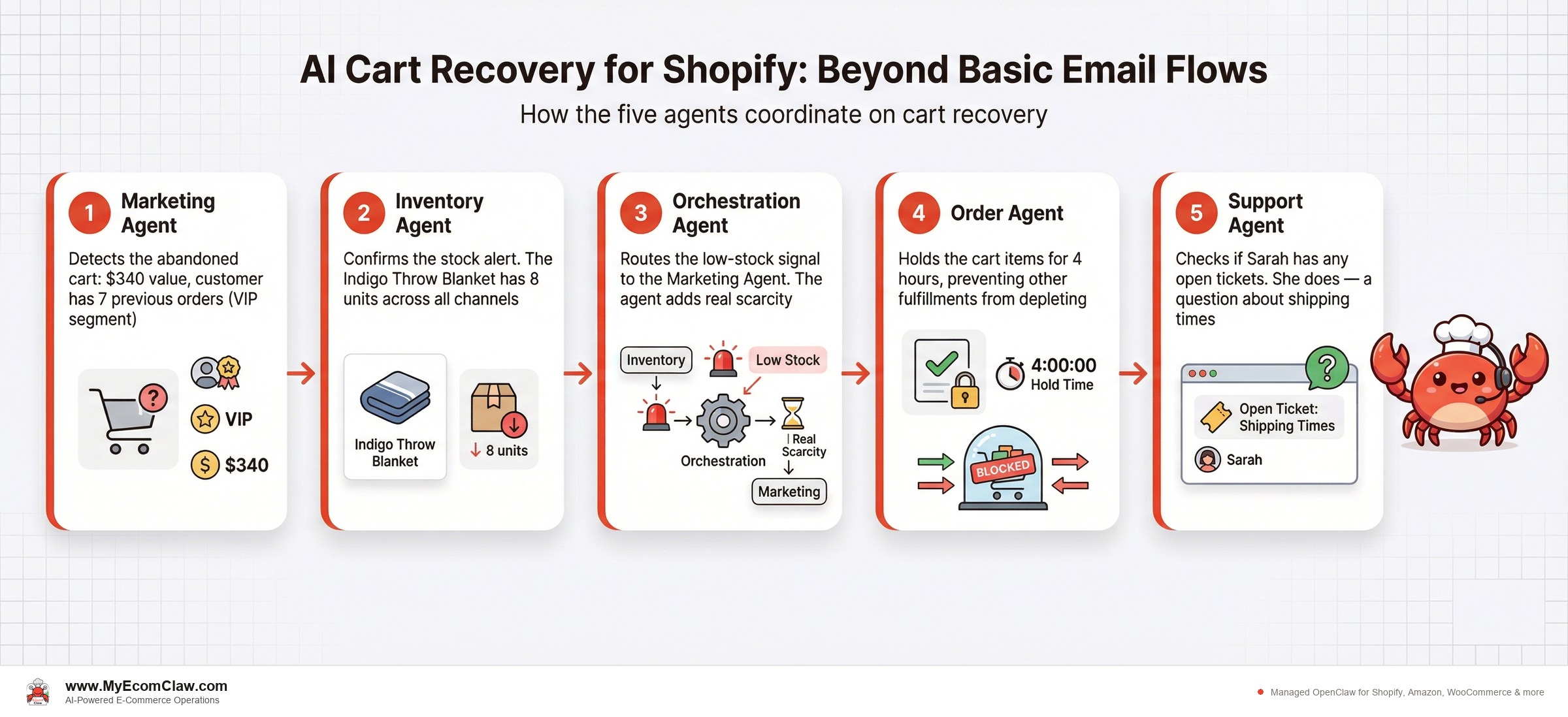
How the five agents coordinate on cart recovery
Cart recovery is not just a marketing problem. It touches inventory, support, and orders. Here is a real scenario that plays out weekly:
Scenario: A VIP customer abandons a high-value cart, and the product is running low on stock.
Marketing Agent detects the abandoned cart: $340 value, customer has 7 previous orders (VIP segment). Instead of a discount email, the agent sends a personal WhatsApp message: "Hi Sarah — noticed you left a few things in your cart. Want me to hold them for you? The Indigo Throw Blanket is down to 8 units."
Inventory Agent confirms the stock alert. The Indigo Throw Blanket has 8 units across all channels, with 3 already in other customers’ carts. Effective available stock: 5 units.
Orchestration Agent routes the low-stock signal to the Marketing Agent. The agent adds real scarcity to the recovery message — not fabricated "only 3 left!" marketing copy, but actual stock data from the Shopify Admin API.
Order Agent holds the cart items for 4 hours, preventing other fulfillments from depleting the stock before Sarah can complete checkout.
Support Agent checks if Sarah has any open tickets. She does — a question about shipping times. The Support Agent resolves it first, removing the purchase friction. Then the Marketing Agent sends the recovery message.
No email marketing tool coordinates with your inventory system, your support queue, and your order pipeline simultaneously. That requires agents that share context — not apps that share a Shopify install.
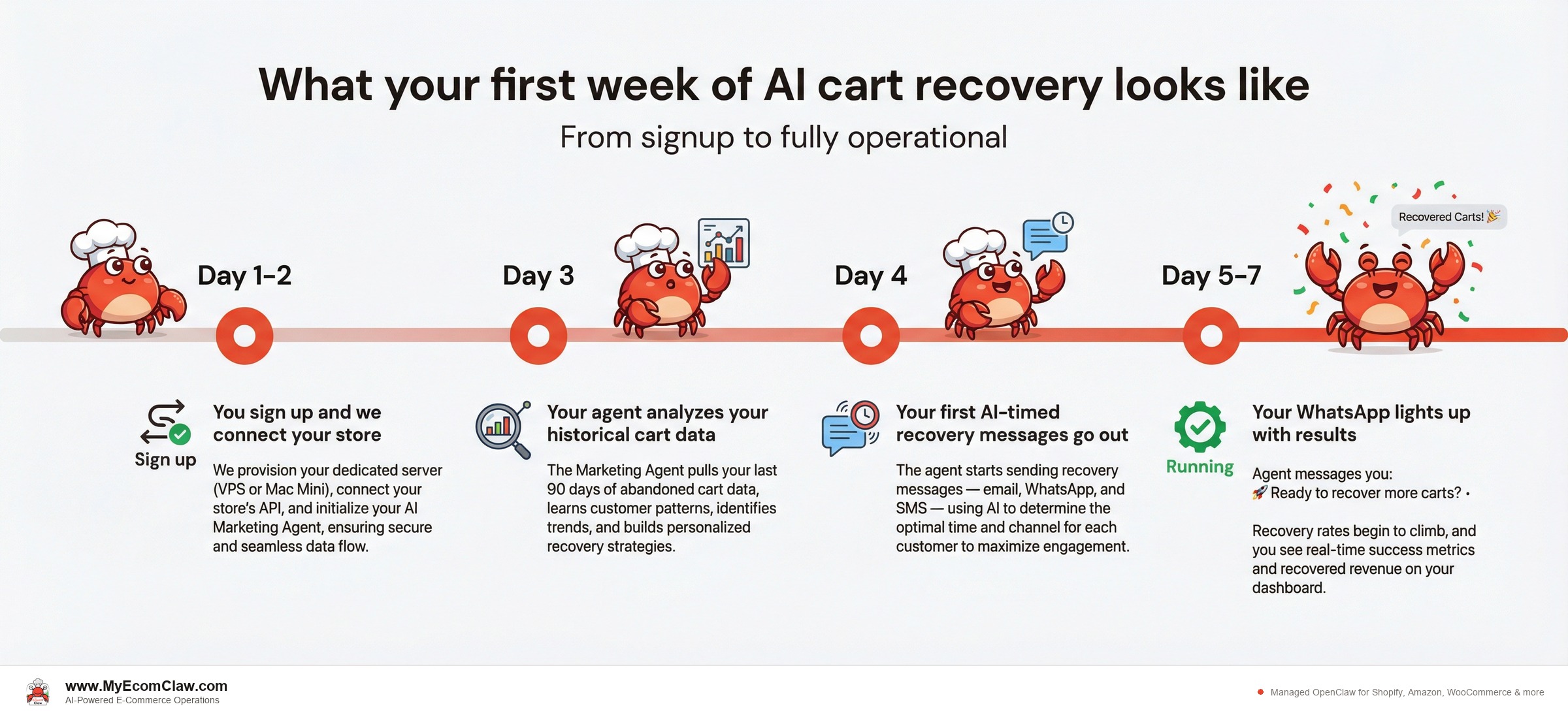
What your first week of AI cart recovery looks like
We provision your dedicated server (VPS or Mac Mini), connect your Shopify Admin API, and configure the Marketing Agent with access to your Price Rules API. Your data stays on your server — never on ours.
The Marketing Agent pulls your last 90 days of abandoned carts from Shopify. It identifies patterns: when customers abandon (time of day, day of week), what they abandon (product categories, price ranges), and who recovers (customer segments, channels).
The agent starts sending recovery messages — email, WhatsApp, or SMS — timed to each customer’s behavior pattern, not a fixed schedule. Discount codes are generated per-customer via the Price Rules API.
Agent messages you: “First week results: 47 carts recovered out of 389 abandoned (12.1% recovery rate). Revenue recovered: $3,890. Top channel: WhatsApp at 19% recovery rate. Recommend increasing WhatsApp allocation for carts over $100.”
Why this matters for your business
Abandoned cart recovery is the highest-ROI marketing activity in e-commerce. Every percentage point of improvement in recovery rate drops directly to your bottom line — no additional ad spend, no new customers to acquire, no new inventory to stock. These are people who already wanted to buy.
The sellers who win at cart recovery in 2026 are not the ones with the best Klaviyo flow. They are the ones whose recovery system understands context — customer LTV, product margin, stock levels, support ticket status, optimal channel, optimal timing — and acts on all of it simultaneously. That requires an AI agent, not a workflow builder.
Our take
The cart recovery space has been stuck in the "three-email sequence" era for five years. Klaviyo made it easy to set up. But "easy to set up" also means "everyone runs the same thing." When every Shopify store sends the same "You forgot something!" email at the same intervals, recovery rates converge to the same 5-8% floor.
The next wave is not better emails. It is smarter agents. An agent that knows your customer, your margins, your inventory, and your support queue — and coordinates across all of them in real-time. An agent that generates unique discount codes that protect your margins. An agent that reaches customers on WhatsApp where they actually respond, not just in an inbox they check once a day.
OpenClaw’s Marketing Agent does not just send reminders. It understands your cart abandonment as a system — customer intent, product economics, channel preference, timing optimization. And it runs on your server, not Klaviyo’s. That is the difference between a flow builder and an AI agent.
If you are recovering less than 10% of abandoned carts, your OpenClaw Marketing Agent will pay for itself in the first month — from recovered revenue alone. See plans → · Talk to us first →
FAQ
How does OpenClaw’s cart recovery compare to Klaviyo?
Klaviyo uses fixed-time email sequences that you build in a flow editor. OpenClaw’s Marketing Agent uses AI-timed, multi-channel outreach (email + WhatsApp + SMS) that adapts to each customer’s behavior. Klaviyo costs $45-$350/month for email alone. MyEcomClaw’s Growth plan ($599/mo) includes cart recovery plus four other agents for orders, inventory, support, and orchestration — all running on your own server. Typical recovery rates: Klaviyo 5-8%, OpenClaw 12-18%. Compare plans →
Can the agent send recovery messages on WhatsApp?
Yes. OpenClaw natively integrates with WhatsApp, Telegram, Slack, Discord, and more. WhatsApp recovery messages have a 22% average recovery rate versus 11% for email. The Marketing Agent selects the optimal channel per customer — WhatsApp for high-value carts, email for smaller ones, or whatever combination your data shows works best. WhatsApp Business API integration is available as an add-on ($49/mo). See add-on pricing →
How are discount codes generated?
The Marketing Agent uses the Shopify Price Rules API to generate unique, one-time-use discount codes for each abandoned cart. Every code is unique (no sharing or leaking to coupon sites), has a 24-48 hour expiry, and is calculated against your product margins and the customer’s LTV. You set a margin floor — the agent never discounts below it.
Does this replace Klaviyo entirely?
For cart recovery, yes. For broader email marketing (newsletters, product launches, lifecycle campaigns), the Marketing Agent handles those too — it manages customer segmentation, campaign scheduling, and ROI tracking. If you prefer to keep Klaviyo for email and use OpenClaw for everything else, you can. The agent coordinates with whatever tools you keep. Book a call to discuss your stack →
What happens if a customer has a support ticket and an abandoned cart?
The Orchestration Agent coordinates. If a customer has an open support ticket, the Support Agent resolves it first — removing purchase friction — before the Marketing Agent sends the recovery message. The Marketing Agent also suppresses discount offers for customers with active complaints until the issue is resolved. This prevents the tone-deaf "Here is 10% off!" email landing in the inbox of someone waiting on a refund.
How quickly will I see results?
Most stores see their first recovered carts within 48 hours of the Marketing Agent going live. First week typically shows 10-15% recovery rate as the agent calibrates to your customer behavior. By week 3-4, the agent has enough data to optimize timing, channel, and discount tiers for each customer segment. Full optimization takes 30 days. Get started →
Does my cart data stay private?
Yes. Your OpenClaw agent runs on your own server (VPS or Mac Mini). Your cart data, customer information, purchase history, and discount strategies are stored on your infrastructure — not on a shared cloud. You have full SSH access. OpenClaw is MIT licensed. No lock-in. If you leave, you take everything with you.
Ready to recover the 70% of revenue that is walking out the door?
MyEcomClaw deploys OpenClaw on your own server with AI agents for marketing, orders, inventory, support, and orchestration. AI-timed cart recovery across email, WhatsApp, and SMS. Unique discount codes via the Shopify Price Rules API. Managed 24/7.
More from Automation
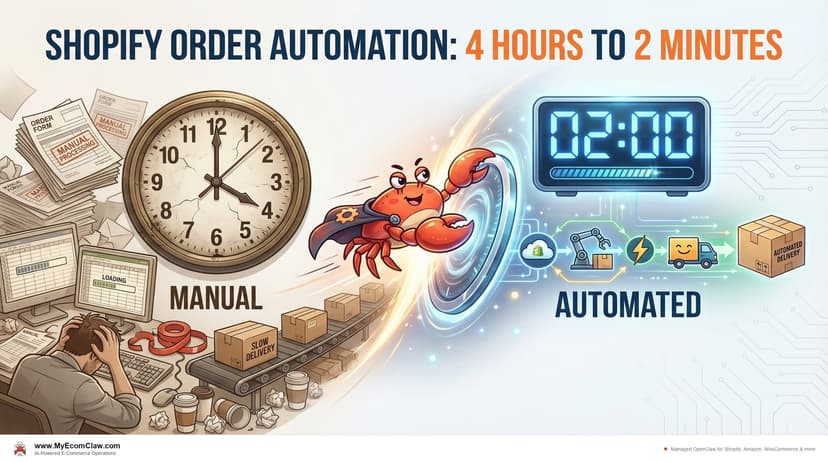
Shopify Order Automation: 4 Hrs to 2 Min
Shopify sellers spend 4-5 hours daily on manual order processing. Here’s a step-by-step breakdown of what OpenClaw’s Order Agent automates —.
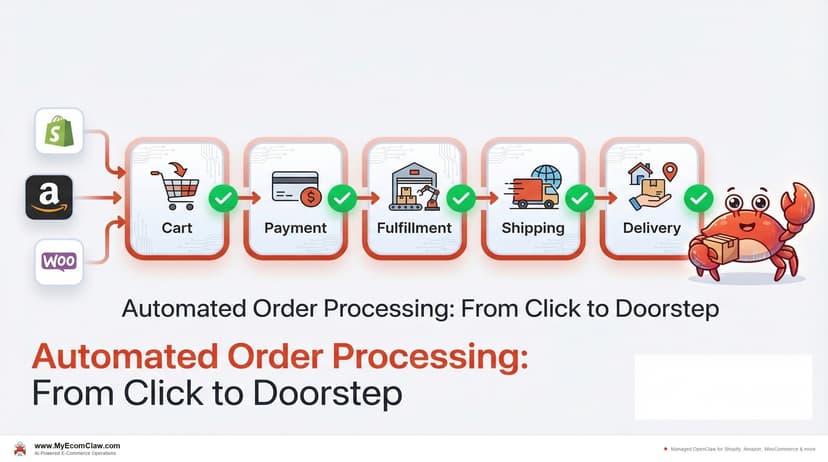
Order Automation: Click to Doorstep
The average Shopify seller spends 2+ hours per day on order processing. OpenClaw’s Order Agent validates payments, routes fulfillment, generates.
AI Returns: Turn Refunds Into Revenue
The average e-commerce return rate is 20-30%. Most sellers treat returns as pure cost. OpenClaw’s Support + Order agents automate approvals,.