AI-Ready Shopify Checklist: 15 Fixes

AI-driven traffic to Shopify stores grew 8x year-over-year in 2025. AI-driven orders grew 15x. Google launched the Universal Commerce Protocol. OpenAI turned ChatGPT into a shopping agent. Perplexity added Buy buttons.
And most Shopify stores aren’t ready for any of it.
The part nobody mentions: AI agents don’t browse your store the way humans do. They don’t see your hero banner, your lifestyle photography, or your clever tagline. They read structured data, API responses, and schema markup. If that layer is broken — or missing — your products don’t exist to them.
Why AI readiness matters now
A thread on r/ShopifySEO captured it perfectly:
"How are we supposed to optimize for AI agents? They don’t use Google the way humans do. Do I need different titles? Different descriptions? What even is agentic SEO?"
The short answer: yes, you need different everything. AI shopping agents — from ChatGPT to Google’s AI Mode to Microsoft Copilot — don’t parse your store the same way a human shopper or a traditional search crawler does. They look for machine-readable product data, structured attributes, real-time inventory accuracy, and clean API access.
Stores with 99.9% attribute completion are seeing 3-4x higher visibility in AI recommendations compared to stores with sparse data. A single missing GTIN is enough for an AI agent to skip your product entirely.
And here’s what makes it worse: you won’t know you’re invisible. There’s no "AI agent impressions" dashboard. Your products just quietly stop appearing in the answers.
“Are AI shopping agents actually finding our products?”
“I audited your store’s AI-readiness. 9 of 15 checks failed. Your product schema is missing GTINs, you have no FAQ markup, and your inventory feed hasn’t synced in 72 hours. I flagged all 9 issues with fix instructions. Want me to walk through them?”
That agent is your OpenClaw Inventory Agent — running on your own server, connected to your Shopify Admin API, auditing your data quality in real time. Deployed and managed by MyEcomClaw.
Built on OpenClaw — 191,000+ GitHub stars, MIT licensed. Your data stays on your server. We deploy it, configure it for Shopify, WooCommerce, Amazon & more, and manage it. Starting at $299/mo. See plans →
The checklist
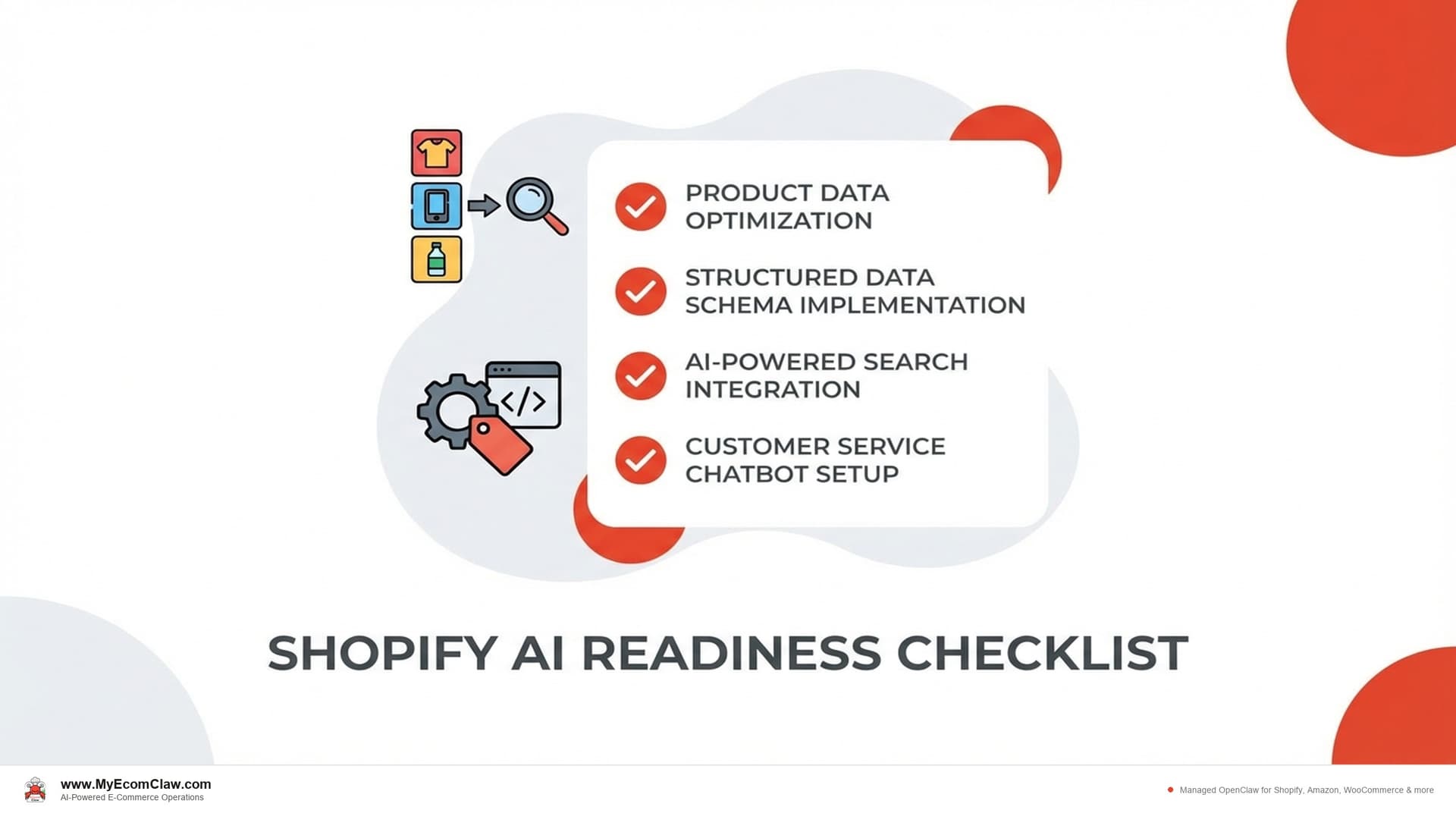
Here are the 15 things to fix, organized into three groups: Product Data, Technical Setup, and Content & Discovery.
Part 1: Product Data (Items 1-5)
1. Write AI-friendly product titles
The problem: Keyword-stuffed titles like "Blue Widget | Best Widget | Buy Cheap Widget 2026" were built for old-school SEO. AI agents parse natural language. They match titles to conversational queries like "lightweight waterproof jacket for hiking under $100."
Why AI agents care: When a shopper asks ChatGPT "find me a solid oak dining table that seats six," the agent matches against titles that include those attributes naturally. A title like "Dining Table — Oak" won’t match. A title like "Solid Oak Scandinavian Dining Table, Seats 6 — Modern Minimalist Design" will.
The test: Read your top 10 product titles out loud. Do they sound like something a knowledgeable salesperson would say? Or do they sound like a keyword spreadsheet?
How OpenClaw handles this: Your Marketing Agent analyzes product titles against conversational query patterns and flags titles that need rewriting. It can generate AI-optimized alternatives that include material, use case, and key attributes — while preserving your brand voice.
2. Write descriptions that answer questions, not just describe features
The problem: Most product descriptions are feature lists. "100% cotton. Machine washable. Available in 3 colors." AI agents need context: who is this for, what problem does it solve, how does it compare to alternatives?
Why AI agents care: When an agent evaluates products to recommend, it looks for descriptions that match the shopper’s intent. "Best running shoes for flat feet" requires a description that mentions arch support, foot type, and running style — not just "mesh upper, rubber sole."
The test: Ask ChatGPT to recommend a product in your category. Does it recommend yours? If not, compare your description to the one it did recommend. The difference is usually context, not keywords.
How OpenClaw handles this: Your Marketing Agent audits product descriptions for conversational completeness — checking for use cases, target audience, material details, care instructions, and comparison points. It flags thin descriptions and can generate enriched alternatives.
3. Fill every metafield — materials, dimensions, care, compatibility
The problem: Shopify metafields store the structured attributes that AI agents depend on: materials, weight, dimensions, care instructions, compatibility. Most stores leave them empty.
Why AI agents care: AI agents don’t infer. If your metafield for "material" is blank, the agent doesn’t guess "cotton" from your description. It marks the attribute as missing and moves on to a competitor whose data is complete. Stores with complete metafields — what the industry calls a "Golden Record" — get 3-4x more AI visibility.
The test: Go to Shopify Admin > Settings > Custom data > Products. Count how many metafield definitions you have. Now check how many are actually populated across your catalog. If it’s below 90%, you have a problem.
How OpenClaw handles this: Your Inventory Agent monitors metafield completeness across your entire catalog. It flags products with missing attributes and can auto-populate standard fields (dimensions, weight, material) from your supplier data or product feeds.
If you have 500 SKUs and each one needs 8 metafields populated, that’s 4,000 data points to fill manually. At 2 minutes per field, that’s 133 hours of data entry. Your OpenClaw agent does it in a single sync.
4. Add GTINs, MPNs, and brand identifiers to every product
The problem: GTINs (Global Trade Item Numbers), MPNs (Manufacturer Part Numbers), and brand fields are the universal identifiers AI agents use to match your products to shopper queries. Missing identifiers mean your products can’t be cross-referenced, verified, or trusted by AI systems.
Why AI agents care: Google’s Universal Commerce Protocol and ChatGPT Shopping both require product identifiers. A single missing GTIN is enough for an AI agent to skip your product entirely. These aren’t optional metadata anymore — they’re entry tickets.
The test: Export your Shopify product CSV. Filter for blank GTIN and barcode fields. If more than 10% are empty, you’re losing AI visibility right now.
How OpenClaw handles this: Your Inventory Agent cross-references your product catalog against manufacturer databases and flags missing identifiers. For private-label products, it generates internal identifiers that satisfy AI agent requirements.
5. Optimize product images with descriptive alt text and file names
The problem: Images named "IMG_4392.jpg" with empty alt text are invisible to AI agents. They need descriptive file names and alt text that explain what’s in the image — material, color, use context, angles.
Why AI agents care: Multimodal AI agents (GPT-4o, Gemini) can analyze images, but they still rely on alt text and file names as structured signals. Clean image metadata helps agents match your products to visual queries like "show me a red leather crossbody bag."
The test: Open 10 random product pages. Right-click each image and check the file name and alt text. If you see "IMG_" or "Screenshot_" or blank alt fields, fix them.
How OpenClaw handles this: Your Marketing Agent scans product images for missing or generic alt text and generates descriptive alternatives using your product data. It can also flag low-resolution images that don’t meet AI platform requirements.
Part 2: Technical Setup (Items 6-10)
6. Implement complete product schema markup (JSON-LD)
The problem: Shopify themes include basic product schema, but most miss critical fields that AI agents need: aggregateRating, review, shippingDetails, returnPolicy, gtin, brand, and offers with complete availability data.
Why AI agents care: Research shows LLMs extract 30% more accurate data from pages with complete schema markup. AI agents use schema as their primary source of structured truth about your products. Incomplete schema = incomplete understanding = lower recommendation priority.
The test: Run your product page through Google’s Rich Results Test or Schema.org validator. Count the fields. If you’re missing gtin, brand, aggregateRating, or shippingDetails, your schema is incomplete.
How OpenClaw handles this: Your Marketing Agent audits every product page for schema completeness and generates the missing JSON-LD blocks. It monitors for schema errors after theme updates — because nothing breaks schema faster than a theme migration.
Which is exactly the kind of thing that breaks at 2 AM on a Saturday and nobody notices until Monday.
Built on OpenClaw — deployed on your own private server, connected to your Shopify Admin API. Your agent monitors schema health 24/7. Talk to us →
7. Set up correct API permissions for AI agent access
The problem: AI agents need API access to interact with your store — reading product data, checking inventory, processing orders. Most stores either have overly permissive API scopes (security risk) or missing scopes (agents can’t function).
Why AI agents care: Shopify’s Admin API requires specific access scopes for each function. An agent that can check inventory but can’t read product metafields is working with incomplete data. An agent with write access to everything is a security liability.
The test: Go to Shopify Admin > Apps and sales channels > Develop apps. Check your API access scopes. You need: read_products, read_inventory, read_orders, read_customers at minimum. Write scopes should be restricted to specific functions.
How OpenClaw handles this: During setup, we configure exact API scopes following the principle of least privilege. Your Order Agent gets order scopes. Your Inventory Agent gets inventory scopes. No agent gets access it doesn’t need. All running on your server, with your API keys — never stored on ours.
8. Ensure real-time inventory accuracy
The problem: U.S. retail inventory accuracy averages just 63%. If your Shopify inventory says "in stock" but the product is actually backordered, AI agents will recommend it — and the customer gets a cancellation email. That’s a trust-destroying experience that AI platforms will penalize.
Why AI agents care: AI agents need inventory data that’s accurate at the moment of the shopper’s query, not the last time a crawler hit your site. Google’s UCP and ChatGPT Shopping both require real-time stock verification. Stale inventory data = disapproved products = invisible catalog.
The test: Pick 10 products at random. Compare the stock count in Shopify Admin to your actual warehouse count. If more than 2 are off, your inventory sync has a problem.
How OpenClaw handles this: Your Inventory Agent syncs stock levels across Shopify, Amazon, WooCommerce, and your warehouse in real time. It uses the shopify-inventory skill to pull live data via the Admin API, predicts stockouts 3-7 days in advance, and auto-generates reorder alerts.
A store with 2,000 SKUs doing manual inventory reconciliation spends roughly 30 minutes per day — about 15 hours per month. Your OpenClaw Inventory Agent does continuous sync, catches discrepancies in real time, and sends you a WhatsApp alert when something needs attention. That’s 15 hours per month reclaimed.
9. Submit and maintain clean product feeds
The problem: Google Merchant Center, ChatGPT Shopping, and other AI platforms pull product data from feeds. A feed with disapproved products, policy violations, or data that hasn’t updated in 72+ hours will tank your AI visibility.
Why AI agents care: Product feeds are a primary authority source for AI agents. Price, stock, and product attributes in your feed directly shape whether your products surface in AI recommendations. An unhealthy feed with stale data or disapprovals is worse than no feed at all.
The test: Log into Google Merchant Center. Check your diagnostics tab. If you have more than 5% disapproved products or your feed hasn’t updated in 24+ hours, fix it now. Then check if you’ve registered at chatgpt.com/merchants for ChatGPT Shopping.
How OpenClaw handles this: Your Marketing Agent monitors feed health across Google Merchant Center, ChatGPT Shopping, and other AI platforms. It flags disapproved products with specific fix instructions and ensures your feed updates within the required 24-hour window.
10. Keep your sitemap clean and crawlable
The problem: AI crawlers — from OpenAI’s GPTBot to Google’s extended crawlers — use your sitemap to discover and index product pages. A sitemap with 404 errors, redirect chains, or orphan pages slows down AI discovery.
Why AI agents care: If a product page isn’t in your sitemap, AI crawlers may not find it. If it’s in your sitemap but returns a 404, you’re wasting crawl budget and signaling poor data quality. AI platforms evaluate your site’s technical health as a trust signal.
The test: Fetch your sitemap at yourstore.com/sitemap.xml. Spot-check 20 URLs. Do they all resolve to live pages? Are all your active products included? Are discontinued products removed?
How OpenClaw handles this: Your Marketing Agent periodically audits your Shopify sitemap against your active product catalog. It flags mismatches — products in the sitemap that are no longer active, active products missing from the sitemap, and URLs returning errors.
Part 3: Content & Discovery (Items 11-15)
11. Add FAQ schema to every product page
The problem: Most Shopify product pages have zero FAQ content. AI agents from ChatGPT, Perplexity, and Google’s AI Overviews actively extract FAQ structured data from product pages to answer shopper questions. No FAQ = no answers = no recommendations.
Why AI agents care: When a shopper asks an AI agent "is this jacket machine washable?" or "does this desk fit in a small apartment?", the agent looks for FAQ schema on the product page first. Brands with schema-marked Q&A on their PDPs get cited. Everyone else gets skipped.
The test: Go to one of your product pages and view source. Search for "FAQPage" in the markup. If it’s not there, you don’t have FAQ schema.
How OpenClaw handles this: Your Support Agent tracks the most common customer questions per product and generates FAQ content that your Marketing Agent formats into proper FAQPage schema. Real questions from real customers — not generic filler.
The best FAQ content comes from actual support tickets. Your agents already have that data.
12. Create conversational content pages (buying guides, comparisons)
The problem: AI agents don’t just match products — they match content. Buying guides, comparison pages, and "best X for Y" content is what AI agents reference when a shopper asks "what’s the best standing desk for a home office?"
Why AI agents care: Conversational content gives AI agents the context they need to recommend your products over competitors. If you only have product pages and no supporting content, agents have less reason to cite your store as an authority.
The test: Search your store for any page titled "buying guide," "how to choose," or "X vs Y." If you have zero, you’re leaving conversational discovery on the table.
How OpenClaw handles this: Your Marketing Agent identifies your top-selling product categories and generates topic ideas for buying guides and comparison content. It tracks which conversational queries are driving AI traffic to competitors in your niche and suggests content to fill the gaps.
13. Collect and display structured reviews
The problem: Reviews aren’t just social proof for humans. AI agents use aggregateRating and review schema to evaluate product quality and trustworthiness. Products with zero reviews are harder for AI agents to recommend with confidence.
Why AI agents care: When a shopper asks "what’s the best rated waterproof speaker under $50?", the AI agent filters by aggregateRating. No reviews = no rating = filtered out. AI agents also extract specific review content to answer detailed questions about product quality.
The test: Check if your review app outputs proper Review and AggregateRating schema markup. Use Google’s Rich Results Test on a product page with reviews. If the structured data doesn’t show ratings, your reviews are invisible to AI agents.
How OpenClaw handles this: Your Support Agent can prompt satisfied customers for reviews via post-purchase follow-up on WhatsApp or email. Your Marketing Agent ensures review data is properly formatted as structured data on your product pages.
14. Establish your brand entity with consistent NAP and "About" schema
The problem: AI agents evaluate brand trustworthiness before recommending products. If your brand has inconsistent Name, Address, Phone (NAP) data across the web, no Organization schema, and no clear "About" page, AI agents treat you as an unverified entity.
Why AI agents care: Google’s Knowledge Graph, Bing’s entity understanding, and LLM training data all use brand entity signals. A well-defined brand entity increases the probability that AI agents recommend your products. An undefined brand is a risk AI agents avoid.
The test: Google your brand name in quotes. Does a Knowledge Panel appear? Is your NAP consistent across your website footer, Google Business Profile, and social media? Do you have Organization schema on your homepage?
How OpenClaw handles this: Your Marketing Agent audits your brand entity signals — checking NAP consistency, Organization schema, and social profile links. It generates the missing schema markup and flags inconsistencies across platforms.
15. Add social proof signals and trust badges with structured data
The problem: Trust badges like "Free Shipping," "30-Day Returns," and "Secure Checkout" are great for human visitors. But unless they’re backed by structured data (shippingDetails, returnPolicy, hasMerchantReturnPolicy), AI agents can’t read them.
Why AI agents care: AI agents compare return policies, shipping costs, and delivery times across competing products. If your policies are buried in an image or a footer link without schema markup, agents default to competitors who expose this data in machine-readable format.
The test: Run your homepage through Schema.org validator. Look for shippingDetails, returnPolicy, or hasMerchantReturnPolicy in the output. If missing, your trust signals are invisible to AI.
How OpenClaw handles this: Your Marketing Agent converts your existing trust badges and policies into proper schema markup — OfferShippingDetails, MerchantReturnPolicy, and ItemAvailability — so AI agents can parse your competitive advantages programmatically.
Built on OpenClaw — 191,000+ GitHub stars. Deployed on your own server. Your data never leaves your infrastructure. Five agents handling orders, inventory, support, marketing, and orchestration — pre-configured for Shopify, WooCommerce, Amazon & more. See plans →
Before and after: AI-readiness in action
Before: | Signal | Status | AI Agent Impact |
| ——– | ——– | —————- |
|---|---|---|
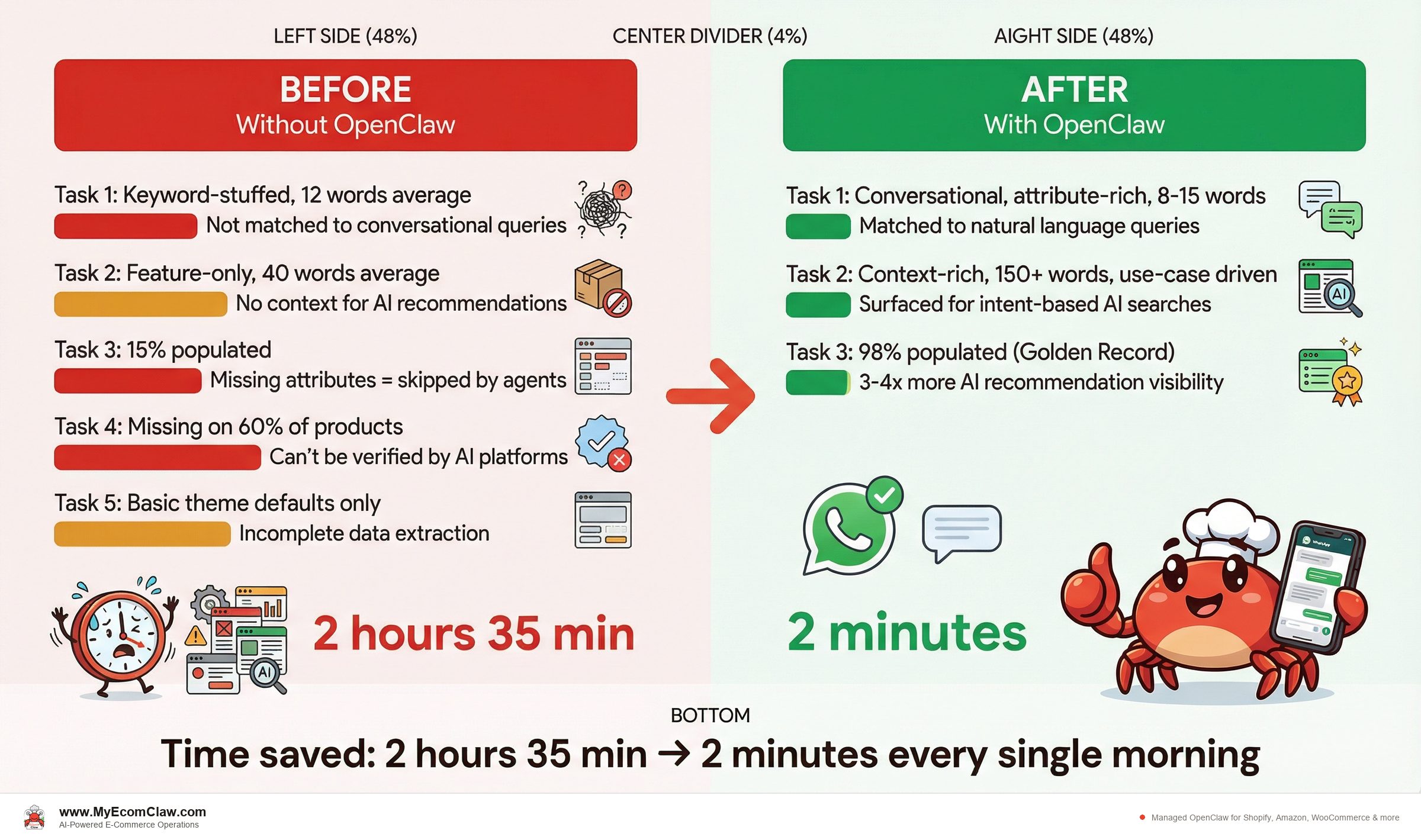
| Product titles | Keyword-stuffed, 12 words average | Not matched to conversational queries |
| Descriptions | Feature-only, 40 words average | No context for AI recommendations |
| Metafields | 15% populated | Missing attributes = skipped by agents |
| GTINs | Missing on 60% of products | Can’t be verified by AI platforms |
| Product schema | Basic theme defaults only | Incomplete data extraction |
| Inventory sync | Manual, updated every 48 hours | Stale stock = disapproved products |
| FAQ schema | None | Zero conversational discovery |
| Product feeds | 12% disapproval rate | Suppressed in AI recommendations |
After: | Signal | Status | AI Agent Impact |
| ——– | ——– | —————- |
|---|---|---|
| Product titles | Conversational, attribute-rich, 8-15 words | Matched to natural language queries |
| Descriptions | Context-rich, 150+ words, use-case driven | Surfaced for intent-based AI searches |
| Metafields | 98% populated (Golden Record) | 3-4x more AI recommendation visibility |
| GTINs | 100% coverage | Verified and trusted by all AI platforms |
| Product schema | Complete JSON-LD with all required fields | 30% more accurate AI data extraction |
| Inventory sync | Real-time via Shopify Admin API | Always accurate, zero disapprovals |
| FAQ schema | Every product page, from real support data | Products cited in AI answers |
| Product feeds | 0% disapproval, 24-hour refresh | Maximum AI platform visibility |
The difference between the two columns isn’t magic. It’s structured data, clean APIs, and an agent that monitors it all 24/7.
The multi-platform factor: Shopify + Amazon + beyond
This checklist focuses on Shopify, but AI agents don’t shop on one platform. ChatGPT Shopping, Google AI Mode, and Perplexity pull products from multiple sources — Shopify, Amazon, WooCommerce, Walmart, and direct feeds.
If your product data is clean on Shopify but messy on Amazon, AI agents see the inconsistency. Different prices, different titles, conflicting stock levels — that’s a trust signal failure.
Cost and time: manual optimization vs. MyEcomClaw
- *Manual AI-readiness optimization for a 1,000-SKU Shopify store:**
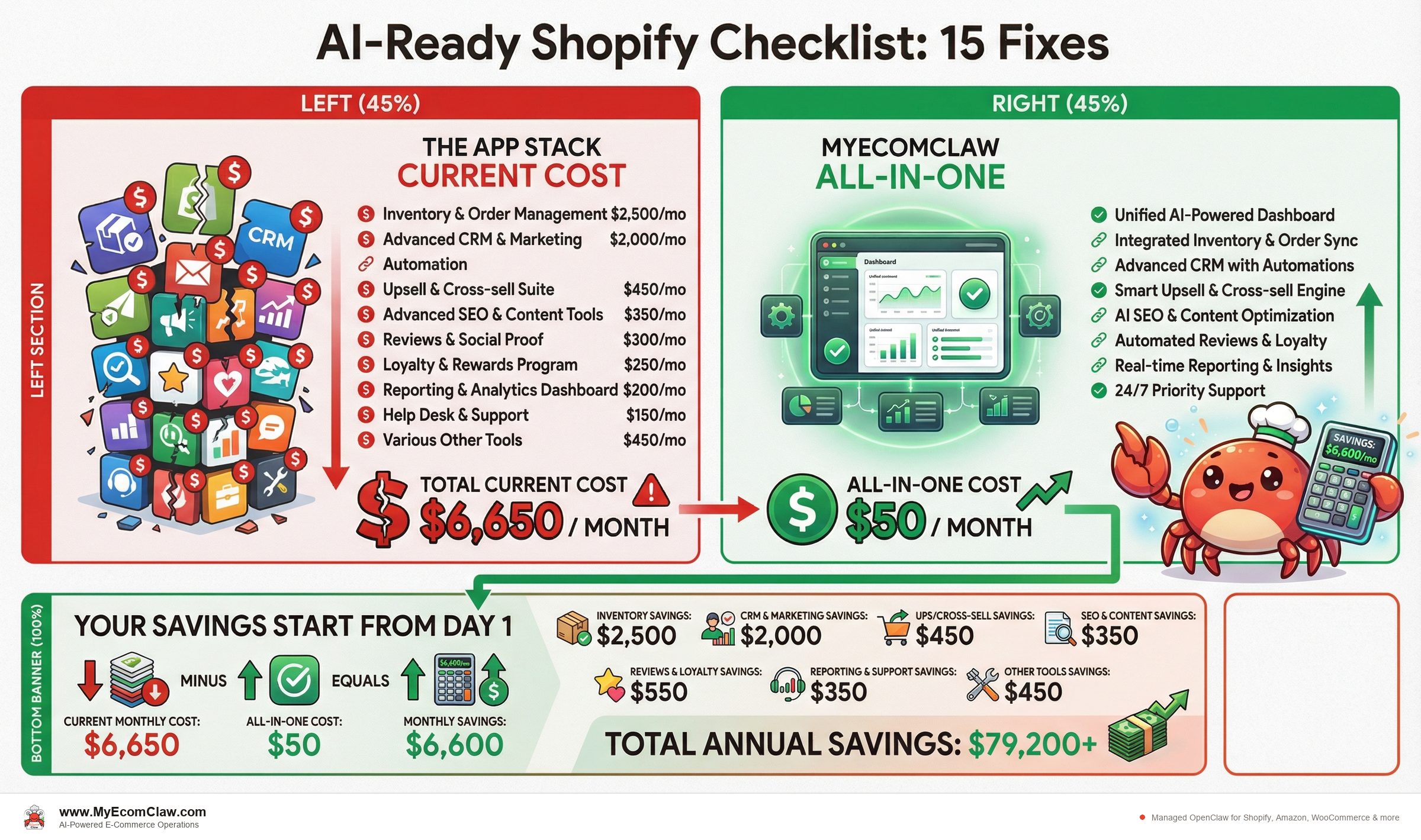
- Metafield population: ~133 hours ($6,650 at $50/hr freelancer rate)
- Schema markup audit + fixes: ~40 hours ($2,000)
- Product title rewrites: ~50 hours ($2,500)
- Description enrichment: ~80 hours ($4,000)
- Feed setup + ongoing management: ~10 hours/month ($500/mo)
- Total one-time: ~$15,150 | Ongoing: ~$500/mo
- *MyEcomClaw (Growth plan):**
- Setup: $999 one-time
- Monthly: $599/mo (includes all 5 agents, up to 5,000 orders/mo, ~10,000 AI actions/month)
- VPS hosting: $12/mo (Hetzner, we set it up)
- Total first month: $1,610 | Ongoing: $611/mo
- Your five OpenClaw agents handle continuous auditing, monitoring, and optimization across Shopify and Amazon. Not a one-time fix — ongoing AI readiness.
Why this matters
AI shopping agents are not a future trend — they’re buying products for customers right now. Google’s Universal Commerce Protocol, co-developed with Shopify, Walmart, and Target, is creating a standardized way for AI agents to discover, evaluate, and purchase products. ChatGPT Shopping is live. Perplexity has Buy buttons.
The stores that are structured for AI agents today will capture the traffic that shifts from traditional search to conversational commerce. The stores that aren’t will watch that traffic go to competitors — without ever knowing they lost it.
Our take: The 15 items on this checklist aren’t hard individually. They’re just tedious, technical, and easy to neglect. That’s why most stores skip them — and why the stores that don’t skip them get a massive AI visibility advantage. The smart move is to let agents handle the agent-readiness work. Your OpenClaw agent audits the same data that other AI agents use to evaluate your store. It knows exactly what they’re looking for because it speaks the same language.
FAQ
How do I know if AI agents are finding my products?
There’s no universal "AI impressions" dashboard yet. The best proxy is to ask ChatGPT, Perplexity, and Google AI Mode to recommend products in your category and see if yours appear. You can also monitor referral traffic from chatgpt.com, perplexity.ai, and Google AI Overviews in your analytics. Your OpenClaw Marketing Agent can automate this monitoring.
Do I need to optimize separately for ChatGPT, Google AI, and Perplexity?
The fundamentals are the same: clean structured data, complete schema, accurate inventory, and conversational content. Each platform has nuances — ChatGPT uses product feeds, Google uses Merchant Center and schema, Perplexity crawls web content — but the 15-item checklist covers the shared requirements. Your OpenClaw agents handle platform-specific differences automatically.
How long does it take to make my Shopify store AI-ready?
Depends on your catalog size. A 200-SKU store with decent existing data can be AI-ready in 1-2 weeks. A 2,000-SKU store with sparse metafields and no schema markup might take 4-6 weeks for manual optimization. With MyEcomClaw, setup takes days — we configure your agents, connect your APIs, and the agents start auditing and fixing issues immediately.
Does this checklist apply to WooCommerce, Amazon, and other platforms?
Yes. The principles — structured data, product identifiers, conversational content, real-time inventory, clean feeds — apply to every platform AI agents shop. The technical implementation differs (WooCommerce uses different schema plugins, Amazon has its own product data requirements), but MyEcomClaw’s OpenClaw agents are pre-configured with skills for Shopify, WooCommerce, Magento, Amazon, and Walmart.
What’s the difference between regular SEO and AI-readiness optimization?
Regular SEO optimizes for search engine crawlers and ranking algorithms. AI-readiness optimization structures your data for AI agents that reason, compare, and recommend. There’s significant overlap — schema markup helps both — but AI agents also need conversational content, real-time inventory accuracy, and complete product attributes that traditional SEO doesn’t prioritize. Think of it as SEO + structured data completeness + API readiness.
Can I do this myself without MyEcomClaw?
Absolutely. Everything on this checklist can be done manually or with existing Shopify apps. OpenClaw is open source — MIT licensed, 191,000+ GitHub stars. You can deploy it yourself if you have the DevOps expertise. MyEcomClaw exists for the stores that want it done right, done fast, and maintained ongoing — without hiring a DevOps engineer. We deploy OpenClaw on your own private server, configure the skills, and manage everything. Talk to us →
🚀 Your Shopify store, ready for AI agents. OpenClaw — 191,000+ GitHub stars, MIT licensed — deployed on your own server, configured for Shopify, WooCommerce, Amazon & more. Five agents. Real-time monitoring. Starting at $299/mo. See plans → | Talk to us →
More from Guides
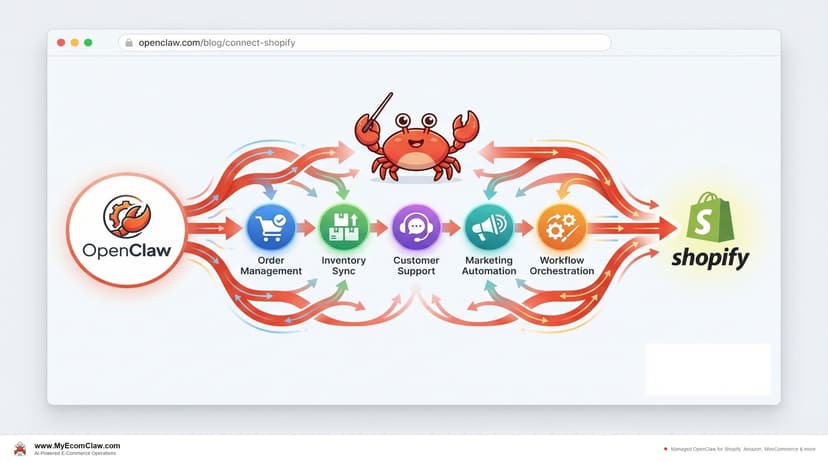
Connect OpenClaw to Shopify (2026 Guide)
OpenClaw has 191K+ GitHub stars — but connecting it to Shopify takes Admin API credentials, Composio OAuth, MCP configuration, and a week of DevOps.
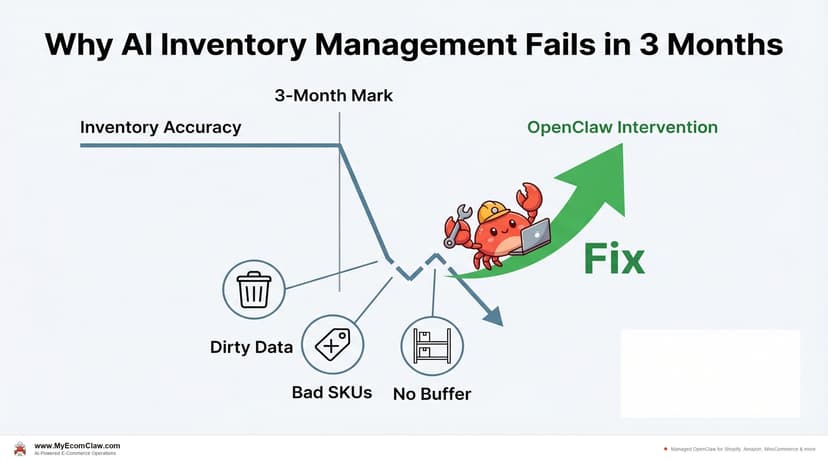
Why AI Inventory Fails in 3 Months
90% of merchants misunderstand AI for inventory. AI doesn’t fix bad data — it amplifies it. Here are the 5 most common failures and how.
White-Label AI for Shopify Agencies
Shopify agencies can offer AI agents as their own branded product — without building any technology. White-label OpenClaw on the Scale plan: your.