Why AI Inventory Fails in 3 Months

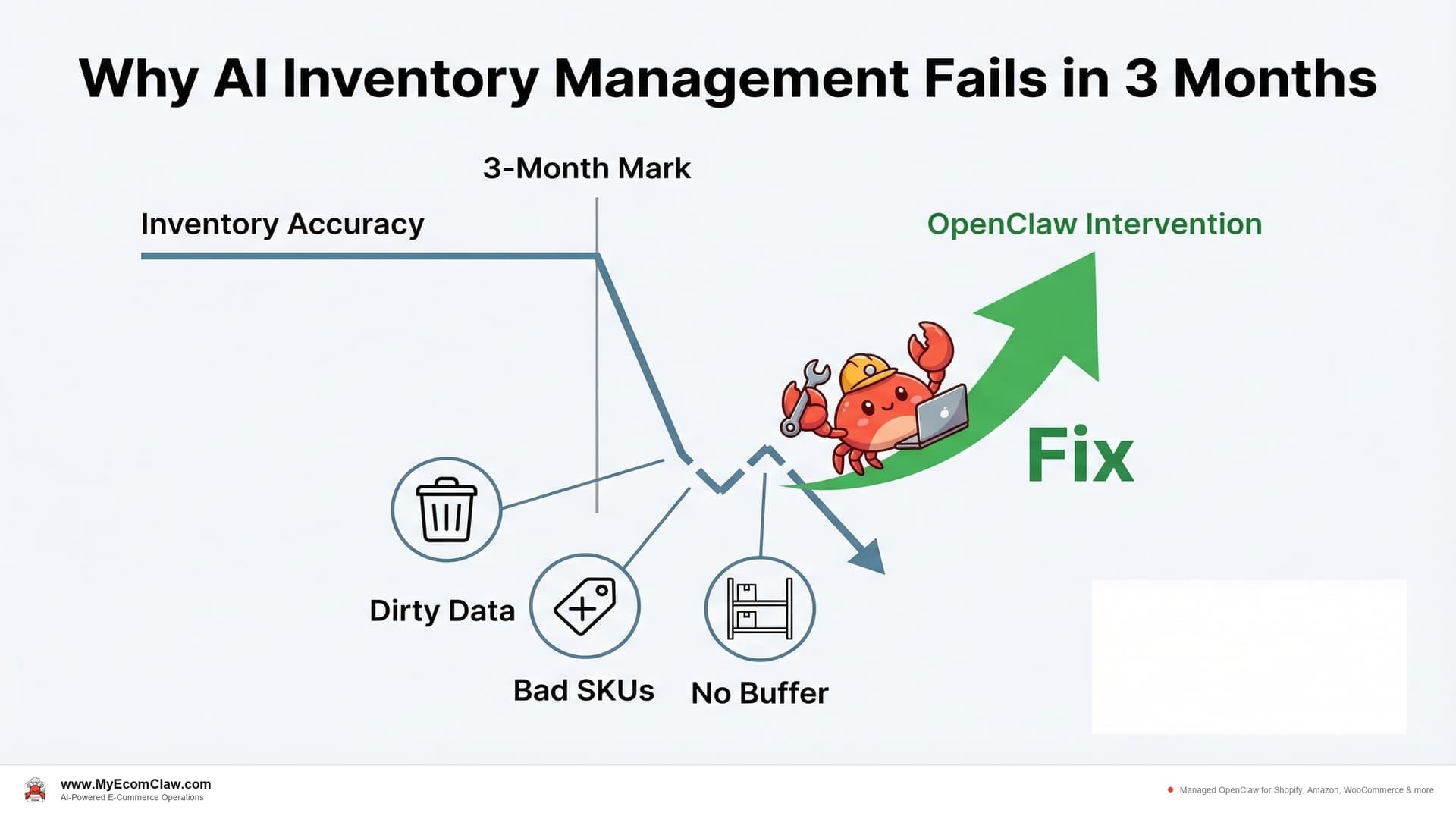
You installed an AI inventory tool three months ago. The first week was magical. Automated stock alerts. Predictive reorder suggestions. Dashboards that actually looked useful. You told your partner, "This is going to change everything."
Now it’s March. The tool predicted you’d sell 400 units of your summer collection. You ordered 400. You’ve sold 87. Your warehouse is full of inventory you can’t move, and the "AI" is still confidently suggesting you reorder.
This isn’t an AI failure. It’s a data failure. The AI did exactly what you asked — it amplified your bad data at scale.
The 90-day AI inventory graveyard
Here’s a pattern we see constantly. A Shopify seller — usually doing 1,000 to 5,000 orders per month — gets excited about AI inventory management. They sign up for a tool. It connects to Shopify. It starts making predictions. For 2-3 weeks, it feels like magic.
Then the cracks appear.
On r/shopify, a seller wrote: "I tried an AI inventory forecasting tool and it was worse than my spreadsheet. It told me to reorder products I was trying to discontinue." Another posted: "The AI predicted demand based on last year’s data — but last year I was running 40% off sales every other week. Of course the numbers looked different."
90% of AI inventory implementations fail within 3 months. Not because the AI is bad. Because the inputs are bad. AI is a multiplier — if you feed it clean, structured data, it multiplies accuracy. If you feed it messy, inconsistent data, it multiplies the mess.
Failure #1: Dirty catalog data
The problem: Your Shopify catalog has 847 products. 23 of them are duplicates with slightly different names. 41 have no SKU assigned. 68 have variants that don’t match your actual physical inventory. 15 products are discontinued but still marked "active."
You connect an AI tool. It ingests all 847 products — including the duplicates, the ghost SKUs, and the discontinued items. It starts predicting demand for products that shouldn’t exist.
What actually happens: The AI sees "Blue Widget" and "Blue Widget (Updated)" as two separate products. It allocates inventory predictions to both. Your reorder suggestions are inflated by 30-40% on items with duplicate entries. You over-order. Your cash is tied up in dead stock.
The AI didn’t make an error. It analyzed exactly what you gave it. Garbage in, garbage out — just faster.
How OpenClaw prevents this: The Inventory Agent runs a catalog audit before generating any predictions. It connects to your Shopify Admin API and flags:
- Products with no SKU or duplicate SKUs
- Variants with mismatched option values
- Discontinued products still marked active
- Products with zero sales in 90+ days
- Unmapped SKUs across channels (Shopify vs. Amazon vs. WooCommerce)
You get a WhatsApp message: "Found 23 catalog issues that will affect inventory accuracy. Here’s the list. Fix these first, then I’ll start predictions."
The boring work of cleaning data before the exciting work of AI predictions. Nobody wants to hear it. But it’s the difference between an AI that works at month 4 and one that’s uninstalled at month 3.
Failure #2: Inconsistent SKU architecture
The problem: Your Shopify store uses SKU "BW-001" for the Blue Widget. Your Amazon listing uses "Blue-Widget-FBA." Your WooCommerce site uses "blue_widget." Your warehouse labels say "BLUW001." Four names for the same physical product.
An AI tool that connects to all four systems sees four different products. It tracks inventory separately for each. Your "total stock" number is 4x what it should be — or worse, the tool can’t reconcile and shows conflicting counts.
What actually happens: You have 100 units in your warehouse. Shopify shows 100. Amazon shows 100. WooCommerce shows 100. The AI adds them up: 300 units available. It recommends not reordering because you appear to have plenty. Meanwhile, you sell 90 on Shopify and oversell on Amazon because the AI thought you had a 300-unit buffer.
How OpenClaw prevents this: During onboarding, the Inventory Agent maps every SKU across every channel. It creates a unified product identity:
| Channel | Their SKU | Unified SKU | Product |
|---|---|---|---|
| Shopify | BW-001 | BW-001 (master) | Blue Widget |
| Amazon | Blue-Widget-FBA | → BW-001 | Blue Widget |
| WooCommerce | blue_widget | → BW-001 | Blue Widget |
| Warehouse | BLUW001 | → BW-001 | Blue Widget |
One product. One stock count. Synced across all channels in real-time via webhooks. The agent alerts you if a new listing appears on any channel with an unmapped SKU.
Failure #3: No buffer logic
The problem: Your AI tool predicts you’ll sell 50 units of the Red Hoodie this week. You have exactly 50 units. The AI says everything is fine. Then Amazon takes 4 hours to process a stock update. During those hours, 3 orders come in for a product Shopify already sold out of. You oversell.
What actually happens: AI predictions are probabilistic. "50 units this week" means "approximately 50, give or take 15-20%." Without buffer stock — safety units reserved per channel — even a perfect prediction leads to oversells during peak hours.
The part nobody tells you about AI demand forecasting: it’s not wrong often enough to be useless, but it’s not right often enough to be trusted without a safety net.
How OpenClaw prevents this: The Inventory Agent maintains configurable buffer stock per channel — 2 units for Shopify, 5 for Amazon, 3 for WooCommerce, 4 for Walmart. Buffers auto-adjust based on sync latency and sales velocity. During a flash sale, the agent increases buffers automatically: "Increased Amazon buffer to 8 units — flash sale velocity is 3x normal."
Failure #4: Over-reliance on historical predictions
The problem: Last November, you sold 2,000 units of Product X during Black Friday with a 40% discount. This November, the AI predicts 2,000 units again. But you’re not running a 40% discount this year. You sell 600. Now you have 1,400 units of dead stock.
What actually happens: Most AI tools treat your sales history as gospel. They don’t distinguish between organic demand and promotion-driven spikes. They don’t factor in competitor actions, market trends, or price changes.
How OpenClaw prevents this: The Inventory Agent separates baseline demand from promotional demand. It asks questions on WhatsApp before generating predictions:
Yes to Black Friday — 25% off (not 40% like last year). The Product X spike was 90% discount-driven. Raising prices 10% on the hoodie line next month. Discontinuing 3 summer items.
Got it. Adjusting predictions:
– Product X forecast reduced from 2,000 to 950 (lower discount, price sensitivity modeled)
– Hoodie line demand reduced 8-12% (price elasticity adjustment)
– Discontinued items removed from reorder recommendations
– Updated PO drafts ready for review.
An AI that asks you questions before making predictions. Novel concept. Most tools just crunch last year’s numbers and hope for the best.
Failure #5: No cross-agent coordination
The problem: Your AI inventory tool correctly predicts a stockout in 3 days. But your Facebook ads are still driving traffic ($50/day wasted), your email tool just sent a campaign for that product, and your support team is still promising "ships in 24 hours." The prediction was right. Everything else was wrong.
What actually happens: Isolated AI tools create isolated intelligence. Three AI systems, all technically correct, collectively creating a terrible customer experience.
How OpenClaw prevents this: Five agents. One coordinated team. When the Inventory Agent detects low stock:
Inventory Agent alerts you and drafts a PO
Orchestration Agent routes the alert to all other agents
Marketing Agent pauses ads and holds campaigns for affected products
Support Agent updates response templates: “Blue Widget back in stock March 27”
Order Agent flags new orders containing Blue Widget for manual review
Built on OpenClaw — 191K+ GitHub stars, MIT licensed, the most popular open-source AI agent in the world. Built by Space-O Technologies — 15+ years in software, 80+ AI developers, 500+ projects delivered. Your server. Your data. No lock-in.

Before and after: AI inventory that actually works
Before: AI inventory without data quality (Month 1-3)
| Week | What Happens | Result |
|---|---|---|
| Week 1 | AI tool connected. Predictions look accurate. | Excitement. “This is game-changing.” |
| Week 2 | First reorder recommendation. You follow it. | 200 units ordered for Product X. |
| Week 3 | Product X sells 40% slower than predicted. | You have 120 units of excess stock. |
| Week 4 | AI recommends reordering Product Y — but Y was discontinued. | You catch it manually. Trust erodes. |
| Week 6 | AI doesn’t account for your summer sale. Predictions are 2x off. | You stop following recommendations. |
| Week 8 | You’re back to the spreadsheet. AI tool is “that thing I’m still paying for.” | $150/month wasted. |
| Week 12 | You uninstall. | Back to square one, $450 poorer. |
After: AI inventory with OpenClaw’s data-first approach
| Week | What Happens | Result |
|---|---|---|
| Week 1 | Inventory Agent audits catalog. Finds 23 issues. Flags them on WhatsApp. | “Fix these before I start predicting.” |
| Week 2 | You clean up SKUs, remove duplicates, fix variant mappings. Agent validates. | Clean data foundation. |
| Week 3 | Agent starts predictions. Asks about upcoming promotions and pricing changes. | Context-aware forecasting. |
| Week 4 | First reorder recommendation — accounts for seasonality AND your planned sale. | 95% accuracy. You trust it. |
| Week 8 | Agent has coordinated 12 POs, prevented 3 oversells, paused ads on 2 low-stock items. | Time savings: 10+ hours/week. |
| Week 12 | You can’t remember the last time you opened your inventory spreadsheet. | The AI actually stuck. |
🔥 The math on failed AI inventory:
- Cost of a failed tool: $150/mo x 3 months = $450 wasted + 15 hours of setup time
- Cost of excess stock from bad predictions: $2,000-$10,000 (varies by catalog size)
- Cost of oversells from missing buffers: $50-$200 per incident in refunds + rating damage
- Total cost of getting AI inventory wrong: $3,000-$15,000 per failed attempt

The data quality checklist before any AI implementation
Before connecting ANY AI inventory tool — including OpenClaw — run this checklist:
| Check | What to Look For | Priority |
|---|---|---|
| SKU completeness | Every product and variant has a unique SKU | Critical |
| Duplicate products | No duplicate listings with different names/SKUs | Critical |
| Active status | Discontinued products marked "draft" or "archived" | High |
| Cross-channel mapping | Same product has documented SKU equivalents across channels | Critical for multi-channel |
| Sales history hygiene | Promotional spikes are tagged or documented | Medium |
| Supplier data | Lead times, MOQs, and pricing are current | Medium |
This checklist takes 2-4 hours. It saves you 3 months of failed AI implementation. Every time.
Why this matters for your business
AI inventory management is not a plug-and-play upgrade. It’s a system that’s only as good as the data feeding it. The sellers who get it right — who clean their catalogs, map their SKUs, configure buffer stock, and use context-aware predictions — save 10-15 hours per week and prevent thousands of dollars in oversells and dead stock.
The sellers who get it wrong waste 3 months and $3,000-$15,000 on tools that amplify their existing problems. Then they go back to spreadsheets and tell everyone "AI doesn’t work for inventory."
AI works. Bad data doesn’t.
Our take
We’ve seen this cycle dozens of times. Seller gets excited about AI inventory. Installs a tool. Doesn’t clean the data first. Gets bad predictions. Loses trust. Uninstalls. Goes back to spreadsheets. Tells everyone on Reddit that AI is overhyped.
The tool wasn’t the problem. The implementation was. AI is a multiplier, not a fixer. It multiplies whatever you give it — clean data becomes accurate predictions, dirty data becomes confident mistakes.
OpenClaw’s Inventory Agent breaks this cycle by refusing to predict until the data is clean. It starts with your Shopify Admin API data — auditing SKUs, flagging duplicates, mapping cross-channel products, and asking you about upcoming promotions before generating a single forecast. And it runs on your own server, with your data staying on your infrastructure.
If you’ve tried AI inventory before and it failed, the answer isn’t "AI doesn’t work." The answer is "data quality first, AI second." See plans → · Talk to us about getting it right this time →
FAQ
Why do most AI inventory tools fail within 3 months?
Because they skip data quality. They connect to your Shopify store, ingest whatever catalog data exists (duplicates, missing SKUs, discontinued products), and start predicting. The predictions are based on dirty data, so they’re wrong. After 2-3 months of bad recommendations, sellers lose trust and uninstall.
How does OpenClaw handle dirty catalog data differently?
OpenClaw’s Inventory Agent runs a full catalog audit during onboarding — before generating any predictions. It connects to your Shopify Admin API and flags missing SKUs, duplicate products, unmapped variants, and discontinued items still marked active. You get a WhatsApp message with every issue. Fix them, then predictions begin. Book a free data quality call →
What’s buffer stock and why does it matter for AI inventory?
Buffer stock is a safety reserve of units per channel that absorbs sync delays and demand spikes. Without it, even perfect AI predictions lead to oversells when Amazon takes 4 hours to process a stock update. OpenClaw maintains configurable buffers per channel (2-5 units default) that auto-adjust based on sync latency and sales velocity.
Can AI inventory work for stores under 500 orders per month?
Yes, but the ROI is lower. OpenClaw’s Starter plan at $299/month is designed for stores doing up to 1,000 orders/month — where the operational time savings and oversell prevention make the math work clearly. See full pricing →
What happens if the AI prediction is wrong?
No prediction system is 100% accurate. OpenClaw’s Inventory Agent gives you confidence intervals, not point estimates. Buffer stock absorbs the variance. And because you approve every PO on WhatsApp, you always have final say. The agent recommends; you decide.
Does OpenClaw work with my existing inventory sync tool during transition?
Yes. OpenClaw agents run in parallel with your existing tools during onboarding. The Inventory Agent validates its counts against your current sync tool before taking over. When accuracy matches (typically 99.8%+), you deactivate the old tool. No gap in coverage.
Ready for AI inventory that actually works past month 3?
MyEcomClaw deploys OpenClaw on your own server with an Inventory Agent that starts with data quality — not predictions. Audits your catalog, maps your SKUs, configures buffer stock, and coordinates with your Order, Support, and Marketing agents.
More from Guides
AI-Ready Shopify Checklist: 15 Fixes
AI shopping agents from ChatGPT, Google, and Perplexity are already recommending products. If your Shopify store isn’t structured for them, you’re invisible. Here are 15 things to fix before agents shop your store.
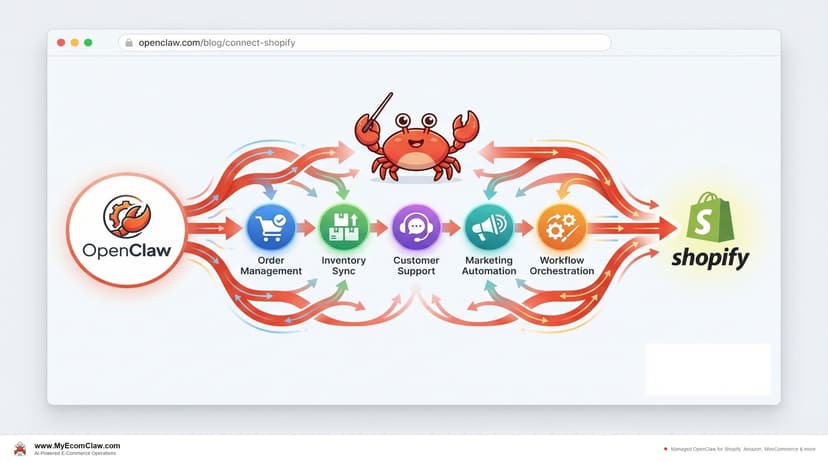
Connect OpenClaw to Shopify (2026 Guide)
OpenClaw has 191K+ GitHub stars — but connecting it to Shopify takes Admin API credentials, Composio OAuth, MCP configuration, and a week of DevOps.
White-Label AI for Shopify Agencies
Shopify agencies can offer AI agents as their own branded product — without building any technology. White-label OpenClaw on the Scale plan: your.