AI Agent Templates for Shopify

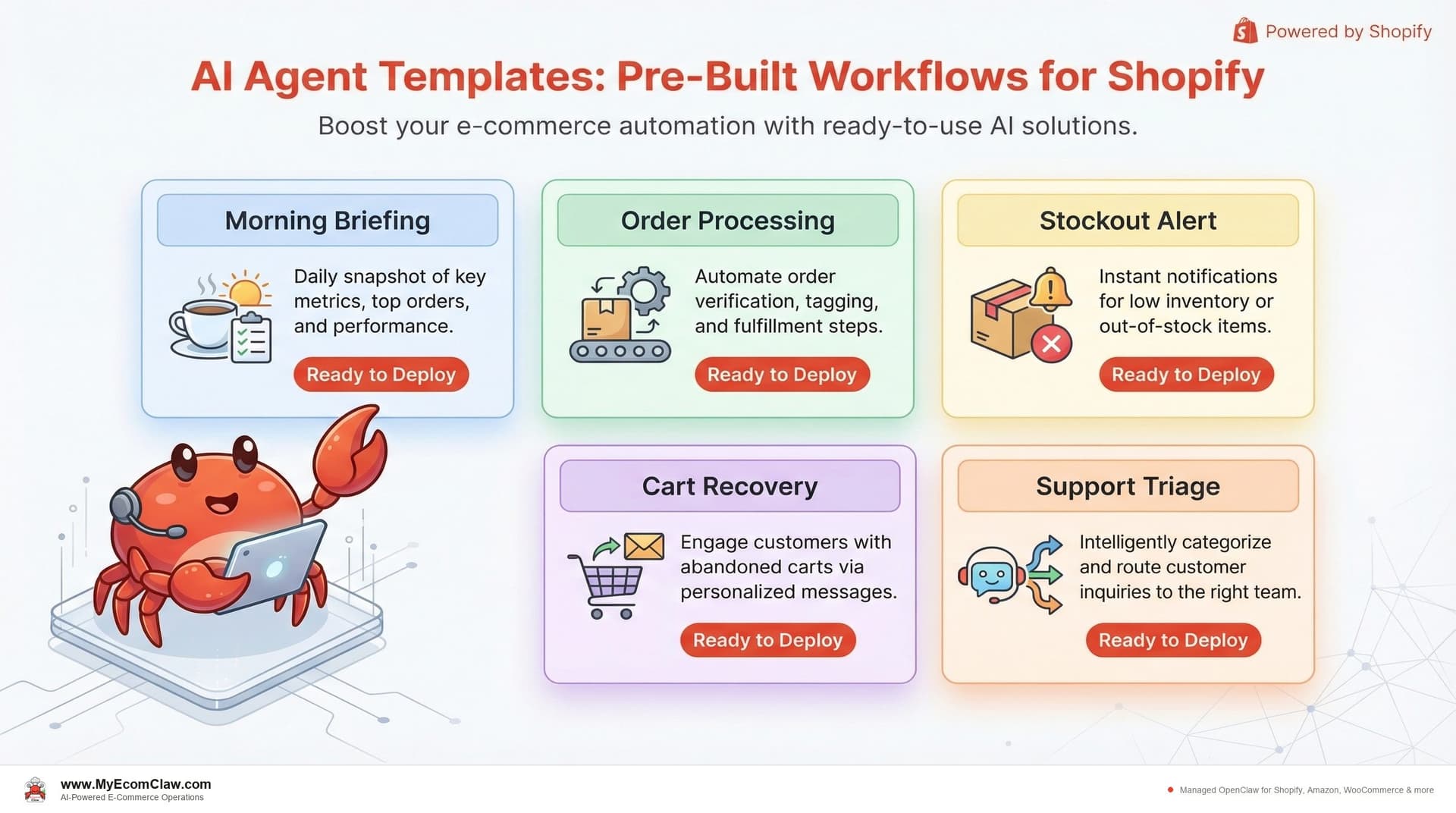
You’ve decided to use AI agents for your Shopify store. Great. Now you need to build the workflows. Order processing: payment validation, fraud detection, fulfillment routing, shipping labels, customer notifications. Inventory management: stock tracking, reorder alerts, purchase orders, multi-channel sync. Customer support: ticket triage, auto-responses, refund processing, escalation rules. Marketing: customer segmentation, discount codes, campaign scheduling, retention flows.
That’s 40+ individual workflows. Each one needs to be designed, built, tested, and connected to your Shopify Admin API. If you’re building from scratch, you’re looking at 4-8 weeks of development time — minimum.
Or you could start with templates that already work.
The template advantage: weeks vs. days
OpenClaw uses a concept called skills — pre-built workflow modules that give agents specific capabilities. Think of skills like apps for your AI agent. Instead of coding every workflow from scratch, you install a skill that already knows how to process orders, track inventory, or handle support tickets.
MyEcomClaw deploys OpenClaw with e-commerce-specific skills pre-configured for your Shopify store. You don’t build workflows. You activate templates.
The timeline difference is dramatic:
| Approach | Timeline | Cost | Risk |
|---|---|---|---|
| Build from scratch | 4-8 weeks of development | $10,000-$40,000 (developer rates) | High — untested workflows, integration bugs |
| Customize a generic framework | 2-4 weeks | $5,000-$15,000 | Medium — still needs e-commerce expertise |
| MyEcomClaw pre-built templates | 3-7 days | $299-$999/mo + setup fee | Low — battle-tested skills, Shopify-specific |
On r/shopify, a seller posted: "I spent 3 weeks trying to set up automated order processing with Zapier and custom scripts. It kind of works. When it doesn’t, I spend hours debugging." Another wrote: "We hired a developer to build AI automation for our store. $25K later, it handles 60% of what we wanted. The other 40% still needs manual intervention."
The build-from-scratch path is a trap for e-commerce sellers. You’re not a software company. You sell products. Let someone who’s deployed these workflows hundreds of times handle the automation.

The complete template library: what’s included
Every MyEcomClaw deployment comes with pre-configured skills organized by agent. Here’s the full library:
Order Agent templates
| Skill | What It Does | Trigger |
|---|---|---|
shopify-orders |
Monitors and processes new orders via Shopify Admin API | New order webhook |
order-validation |
Validates payment status, checks for fraud signals, verifies addresses | Every new order |
fulfillment-tracking |
Routes orders to fulfillment, generates labels, tracks shipments | After validation passes |
multi-channel-orders |
Syncs order processing across Shopify, Amazon, WooCommerce | Orders from any connected channel |
split-shipment |
Handles orders requiring items from multiple warehouses | Multi-warehouse inventory detected |
international-orders |
Generates customs docs, selects carriers, calculates duties | Shipping address outside home country |
return-processing |
Creates RMA, generates return labels, processes refunds | Return request received |
Inventory Agent templates
| Skill | What It Does | Trigger |
|---|---|---|
shopify-inventory |
Tracks stock levels across all locations and variants | Real-time via webhooks |
stockout-prediction |
Predicts stockouts based on sales velocity and trends | Daily analysis + on-demand |
reorder-alerts |
Generates alerts when stock hits reorder point | Stock level change |
purchase-order-gen |
Auto-generates POs with supplier details and quantities | Reorder point reached |
multi-channel-sync |
Syncs inventory across Shopify, Amazon, WooCommerce, Walmart | Sale on any channel |
bundle-tracking |
Tracks component inventory for product bundles | Bundle product sold |
seasonal-forecast |
Adjusts predictions based on historical seasonal patterns | Weekly analysis |
Support Agent templates
| Skill | What It Does | Trigger |
|---|---|---|
shopify-customers |
Accesses customer data, order history, lifetime value | Customer inquiry |
ticket-triage |
Categorizes tickets by type, urgency, and sentiment | New ticket received |
refund-processing |
Processes refunds within configured policy rules | Refund request matching auto-approve criteria |
order-lookup |
Provides order status, tracking info, delivery estimates | Customer asks about order |
auto-response |
Generates contextual responses for common inquiries | Ticket categorized as FAQ |
sentiment-detection |
Detects customer frustration and adjusts tone/escalation | Every customer interaction |
smart-escalation |
Routes complex issues to human with full context summary | Escalation criteria met |
Marketing Agent templates
| Skill | What It Does | Trigger |
|---|---|---|
shopify-discounts |
Creates and manages discount codes via Shopify API | Campaign launch or retention trigger |
email-campaigns |
Builds and sends targeted email campaigns | Scheduled or event-triggered |
customer-segmentation |
Groups customers by behavior, value, purchase patterns | Daily analysis |
retention-campaigns |
Sends win-back sequences to at-risk customers | Customer inactivity detected |
post-purchase-flow |
Sends follow-ups, review requests, cross-sell recommendations | Order delivered |
ad-inventory-sync |
Pauses/adjusts ad spend based on inventory levels | Low stock alert from Inventory Agent |
roi-tracking |
Monitors campaign performance and cost per acquisition | Campaign active |
Orchestration Agent templates
| Skill | What It Does | Trigger |
|---|---|---|
agent-coordinator |
Manages communication between all 4 agents | Cross-agent event detected |
workflow-routing |
Routes events to the appropriate agent based on type and priority | Any business event |
priority-management |
Handles conflicting priorities (e.g., low stock + active promotion) | Conflict detected |
daily-briefing |
Compiles morning summary from all agents | Scheduled (configurable time) |
exception-routing |
Routes exceptions to the right agent or escalates to human | Exception criteria met |
That’s 33 pre-built skills across 5 agents. Each one is tested, documented, and configured specifically for Shopify’s Admin API. You don’t build any of them. They come ready.
Talk to your agent on WhatsApp — templates in action
Here’s what template-powered workflows look like in daily operation. Every interaction below is powered by pre-built skills — no custom development.
Template in action — stockout prediction + ad coordination:
Approve. Increase the PO to 300 units — this product is trending.
✅ PO #4102 updated to 300 units ($5,100). Sent to RunSupply Inc.
✅ `seasonal-forecast` updated with trending signal — future predictions adjusted.
Template in action — customer support + retention:
For #1 — send replacement immediately, no return needed. Include a $25 gift card. For #2 — forward to me, I’ll handle wholesale personally.
✅ #1: Replacement order created via `fulfillment-tracking`. Gift card generated via `shopify-discounts`. Apology email sent. `retention-campaigns` will follow up in 7 days.
✅ #2: Forwarded to your email with full conversation history.
Every skill mentioned above — stockout-prediction, ad-inventory-sync, ticket-triage, sentiment-detection, auto-response, refund-processing — is a pre-built template. Zero custom code. Configured during onboarding. Running within days.
Before and after: building workflows from scratch vs. using templates
Before: Building AI automation for a Shopify store from scratch
| Phase | Activities | Duration | Cost |
|---|---|---|---|
| Research | Evaluate frameworks, learn APIs, design architecture | 1-2 weeks | $2,000-$5,000 (developer time) |
| Development | Build order processing, inventory tracking, support automation | 3-4 weeks | $6,000-$20,000 |
| Integration | Connect Shopify API, configure webhooks, test data flows | 1-2 weeks | $2,000-$5,000 |
| Testing | End-to-end testing, bug fixes, edge cases | 1-2 weeks | $2,000-$5,000 |
| Deployment | Server setup, Docker configuration, security hardening | 3-5 days | $1,000-$3,000 |
| Maintenance | Ongoing updates, API changes, bug fixes | Ongoing | $1,000-$3,000/month |
| Total | 6-10 weeks to first order processed | 6-10 weeks | $13,000-$38,000 + $1,000-$3,000/mo |
After: Deploying MyEcomClaw with pre-built templates
| Phase | Activities | Duration | Cost |
|---|---|---|---|
| Signup | Choose plan, share store details | 1 day | $299-$999/mo + setup |
| Deployment | We provision server, deploy OpenClaw, install skills | 2-3 days | Included in setup |
| Configuration | We connect APIs, configure skills, map SKUs | 1-2 days | Included in setup |
| Testing | We test all workflows end-to-end | 1 day | Included in setup |
| Live | First WhatsApp message from your agent | Day 3-7 | — |
| Maintenance | We handle updates, security, skill improvements | Ongoing | Included in monthly plan |
| Total | 3-7 days to first order processed | 3-7 days | $299-$999/mo |
- From scratch:6-10 weeks, $13,000-$38,000 upfront + $1,000-$3,000/month maintenance
- With MyEcomClaw templates:3-7 days, $299-$999/month all-inclusive
- First-year savings:$20,913-$60,013 by using pre-built templates instead of custom development
- Time to first automated order:42-70 days vs. 3-7 days
- Risk:High (untested, custom code) vs. Low (battle-tested templates)

How templates accelerate deployment
Templates don’t just save time — they eliminate entire categories of risk and effort:
1. No API integration debugging
The most time-consuming part of building e-commerce automation is getting API integrations right. Shopify’s Admin API has over 30 resources, each with different scopes, rate limits, and pagination rules. Amazon’s SP-API has OAuth complexity, role-based access, and marketplace-specific nuances. WooCommerce’s REST API has authentication quirks and webhook reliability issues.
Our skills handle all of this. shopify-orders already knows how to paginate order lists, handle rate limiting, and process webhooks. multi-channel-sync already handles the differences between Shopify, Amazon, and WooCommerce inventory APIs.
2. No edge case discovery
Building from scratch means discovering edge cases in production — when a customer orders a bundle with a backordered component, when an international order has restricted items, when a flash sale pushes 10x normal volume.
Our templates have already encountered these edge cases. They’re battle-tested across hundreds of deployments. The edge case handling is built in.
3. No maintenance burden
APIs change. Shopify releases new API versions quarterly. Amazon updates SP-API rules. WooCommerce pushes WordPress updates. Every change can break custom integrations.
We maintain all skills. When Shopify releases a new API version, we update the shopify-orders skill across all deployments. You don’t manage a codebase. You run a store.
4. No orchestration design
The hardest part of multi-agent automation is getting agents to coordinate — when should the Marketing Agent know about inventory levels? How should the Support Agent handle a question about an order that’s being processed by the Order Agent? What happens when two agents try to update the same record?
The Orchestration Agent skills handle coordination. agent-coordinator, workflow-routing, and priority-management are pre-built templates that manage multi-agent communication automatically.
Every hour you spend building custom automation is an hour you’re not spending on your actual business. Templates let you skip the engineering and go straight to operating.
Custom skills: when templates aren’t enough
Pre-built templates cover 80-90% of e-commerce operations. But every store has unique workflows. That’s where custom skills come in.
Growth plan: Up to 2 custom skills per month, included Scale plan: Unlimited custom skills, included
Examples of custom skills we’ve built:
| Custom Skill | What It Does | Store Type |
|---|---|---|
wholesale-pricing |
Applies tiered pricing based on customer tags and order volume | B2B Shopify store |
subscription-manage |
Handles recurring order modifications, skip/pause/cancel | Subscription box brand |
pre-order-flow |
Manages pre-order deposits, production tracking, fulfillment timing | Limited-edition product brand |
marketplace-arbitrage |
Monitors competitor pricing across Amazon, adjusts pricing dynamically | Multi-marketplace seller |
review-request |
Sends review requests with optimal timing based on delivery + product type | Consumer electronics |
loyalty-points |
Tracks and applies loyalty points across channels | Multi-channel fashion brand |
How custom skill development works:
- You describe the workflow you need — on WhatsApp, email, or a call
- We design the skill specification
- We build and test the skill on your server
- We deploy it and integrate it with your existing agents
- Timeline: 3-7 business days for most custom skills
Custom skill pricing: $499 per additional custom skill (beyond what’s included in your plan)
The cost math: templates vs. custom development
| Custom Development | MyEcomClaw Templates + Custom Skills | |
|---|---|---|
| Upfront cost | $13,000-$38,000 | $499-$1,999 (one-time setup) |
| Monthly cost | $1,000-$3,000 (maintenance) | $299-$999 (all-inclusive) |
| Time to deploy | 6-10 weeks | 3-7 days |
| Skills included | Whatever you build | 33 pre-built + custom skills per plan |
| Maintenance | You handle API updates, bug fixes, security patches | We handle everything |
| Multi-agent coordination | You architect it | Pre-built Orchestration Agent templates |
| Infrastructure | You provision and manage | We deploy on your server and manage |
| First-year total cost | $25,000-$74,000 | $4,087-$13,987 |
First-year savings: $20,913-$60,013 by using pre-built templates instead of custom development.
Built on OpenClaw — 191K+ GitHub stars, MIT licensed, the most popular open-source AI agent. Built by Space-O Technologies — 15+ years, 80+ developers, 500+ projects. Your server. Your data. No lock-in.

Common template deployment mistakes (and how to avoid them)
| Mistake | Why It Happens | How MyEcomClaw Prevents It |
|---|---|---|
| Over-customizing from day one | Trying to automate every edge case before launch | Start with default templates. Customize after you see real data. |
| Ignoring the Orchestration layer | Deploying agents without coordination | Orchestration Agent is included and configured from day one |
| Not testing with real orders | Deploying in sandbox and never switching to live | We test with real orders during onboarding (with your approval) |
| Mismatched plan to volume | Buying Scale when you need Starter, or vice versa | We recommend based on your actual order volume and complexity |
| Skipping SKU mapping | Assuming SKUs match across platforms | Inventory Agent validates SKU mappings during setup and flags mismatches |
| Not configuring escalation rules | Letting agents handle everything without human checkpoints | We configure approval thresholds and escalation rules during onboarding |
Why this matters for your business
The gap between "deciding to use AI agents" and "actually having AI agents running" is where most sellers get stuck. The build-from-scratch path takes too long, costs too much, and carries too much risk. Generic automation tools (Zapier, Make, custom scripts) handle simple workflows but break down at the multi-agent coordination that e-commerce requires.
Pre-built templates close that gap. You go from decision to operation in days, not months. And because the templates are built specifically for Shopify, WooCommerce, and marketplace platforms — not generic automation — they handle the nuances that matter: Shopify’s API rate limits, Amazon’s fulfillment requirements, WooCommerce’s webhook quirks.
The sellers who move fastest don’t build from scratch. They deploy what’s already built and customize from there. That’s the template advantage.
Our take
Every seller who tries to build custom AI automation for their store goes through the same arc: excitement (this is going to be amazing), reality (this is way more complex than I thought), frustration (it works 70% of the time), and acceptance (I need someone who does this every day).
We see it because we’ve deployed OpenClaw hundreds of times. The skills in the OpenClaw template library exist because we built them, tested them, broke them, fixed them, and refined them across real stores with real orders. They handle the edge cases because we’ve already encountered those edge cases.
The template library isn’t a shortcut. It’s the accumulated knowledge of hundreds of deployments, distilled into skills that work out of the box. 33 pre-built skills. Each one tested on real Shopify, Amazon, and WooCommerce stores. Configured for your store in days. Running on your own server. You don’t build AI automation. You deploy it.
If you’re still evaluating whether to build or buy, the math is clear: 3-7 days and $299-$999/month vs. 6-10 weeks and $25,000+ upfront. See plans → · Talk to us →
FAQ
What exactly is an OpenClaw “skill”?
A skill is a modular capability that gives an OpenClaw agent the ability to perform a specific task. Think of it like an app for your AI agent. The shopify-orders skill gives the Order Agent the ability to monitor, process, and manage orders via the Shopify Admin API. Skills include the API integration, business logic, error handling, and documentation. They’re installed on your server and can be customized.
Can I modify the pre-built templates?
Yes. All skills are deployed on your server and are fully configurable. You can adjust thresholds, rules, templates, and behaviors. For example, you can change the auto-approve threshold for returns, modify the stockout prediction window, or customize email templates. We help with configuration during onboarding and you can request changes anytime. Request a configuration change →.
How many templates come with each plan?
Starter includes all Order, Inventory, and Support Agent skills (21 skills across 3 agents). Growth includes all 33 skills across all 5 agents plus up to 2 custom skills per month. Scale includes everything in Growth plus unlimited custom skills.
Do templates work with Amazon and WooCommerce, or just Shopify?
Shopify has the deepest skill set — it’s the primary platform. Amazon SP-API and WooCommerce REST API skills are available and included in the multi-channel templates (multi-channel-orders, multi-channel-sync). Walmart Marketplace API skills are also available. Most sellers start with Shopify and add channels as they grow.
What happens if a template doesn’t cover my use case?
Custom skills fill the gap. Describe the workflow you need and we’ll build a custom skill for your agents. Growth plan includes 2 custom skills/month. Scale includes unlimited. Additional custom skills are $499 each. Most custom skills are built and deployed in 3-7 business days. Describe your use case →.
How often are templates updated?
We maintain all skills continuously. When Shopify, Amazon, or WooCommerce release API updates, we update the corresponding skills across all deployments. When we discover new edge cases or improvements from other deployments, those updates propagate to your skills. You don’t manage a codebase — we handle all maintenance as part of your monthly plan.
Ready to skip the build phase and go straight to operating?
MyEcomClaw deploys OpenClaw with 33 pre-built skills for Shopify, Amazon, and WooCommerce. Order processing, inventory sync, support automation, marketing campaigns — all configured for your store in 3-7 days.
More from Guides
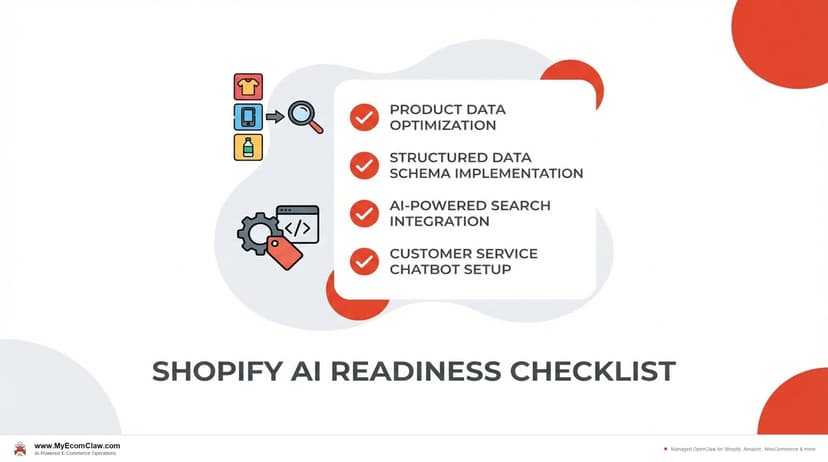
AI-Ready Shopify Checklist: 15 Fixes
AI shopping agents from ChatGPT, Google, and Perplexity are already recommending products. If your Shopify store isn’t structured for them, you’re invisible. Here are 15 things to fix before agents shop your store.
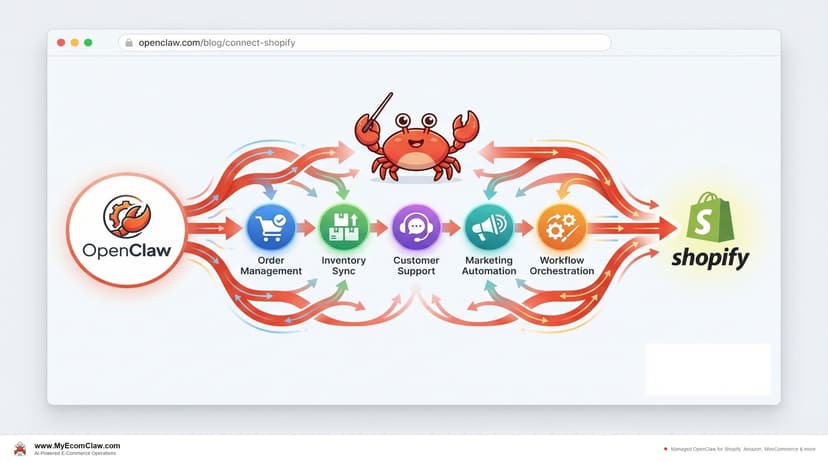
Connect OpenClaw to Shopify (2026 Guide)
OpenClaw has 191K+ GitHub stars — but connecting it to Shopify takes Admin API credentials, Composio OAuth, MCP configuration, and a week of DevOps.
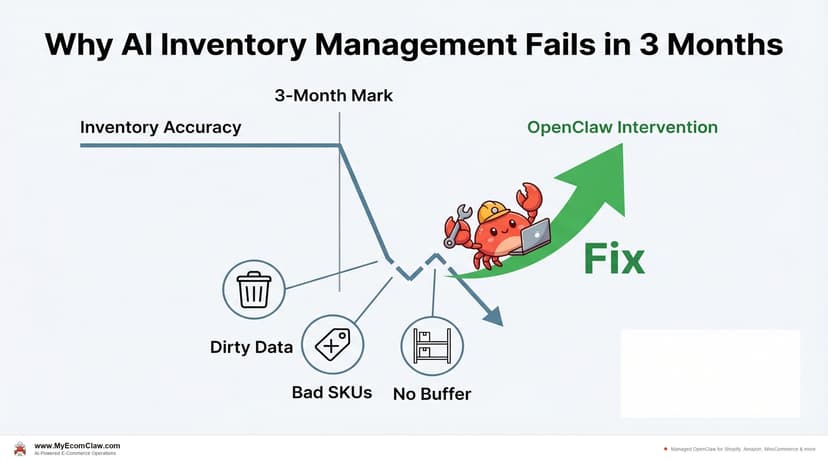
Why AI Inventory Fails in 3 Months
90% of merchants misunderstand AI for inventory. AI doesn’t fix bad data — it amplifies it. Here are the 5 most common failures and how.