AI Inventory: Predict Stockouts in Time

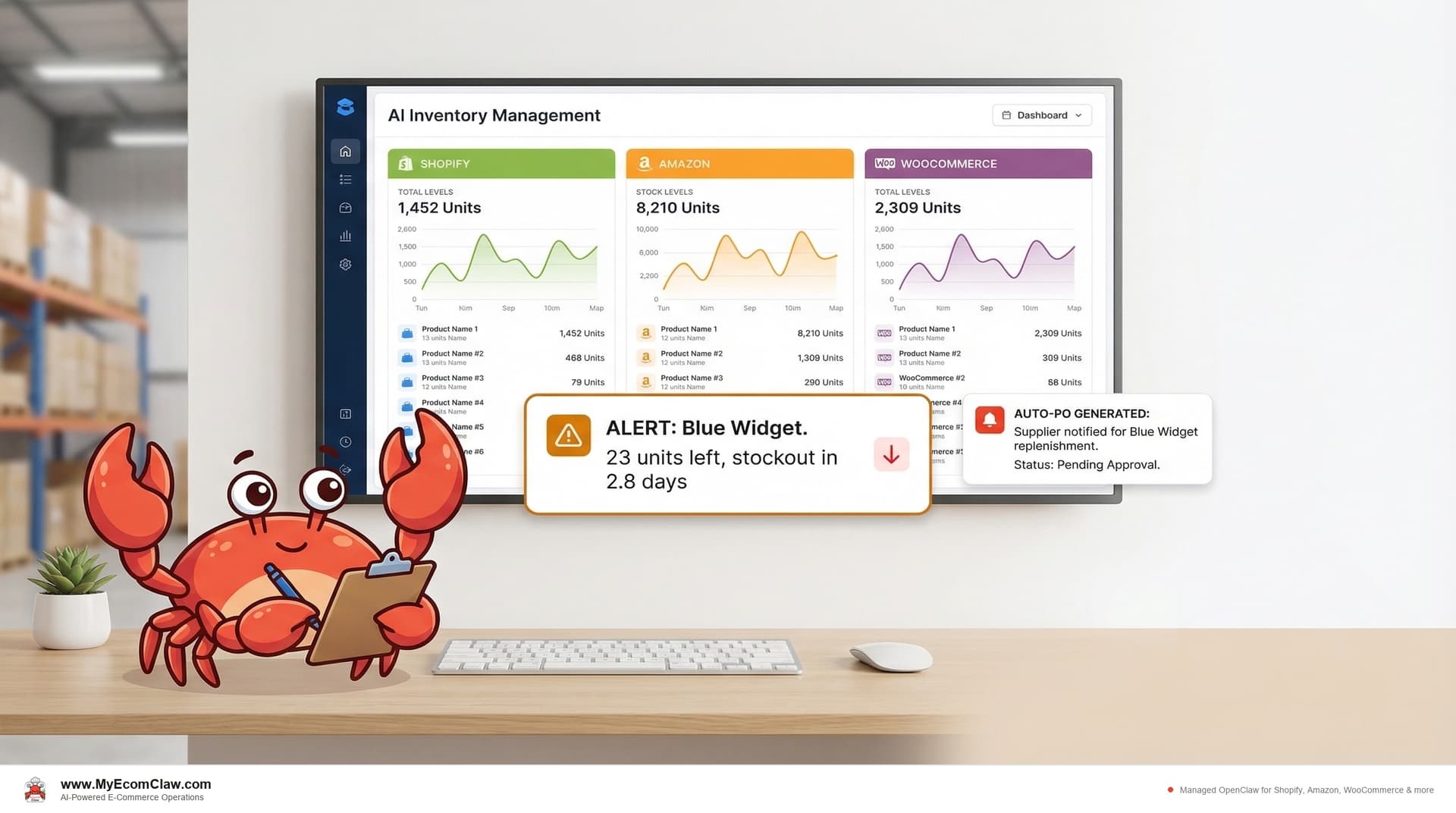
It’s 3 PM on a Thursday. You’re reviewing your Shopify dashboard and everything looks fine — 45 units of your best-selling wireless charger in stock. Comfortable, right? What you don’t know: Amazon sales spiked 60% this week because a micro-influencer posted a TikTok. At current velocity, you’ll hit zero in 2.4 days. Your supplier needs 5 days to ship.
By Saturday afternoon, you’re oversold on Amazon, refunding customers on Shopify, and watching your seller rating drop in real time.
This isn’t a planning failure. It’s a prediction failure. Your spreadsheet told you what happened yesterday. It didn’t tell you what’s about to happen tomorrow.
The stockout problem is a $1.7 trillion global crisis
Retailers worldwide lose an estimated $1.7 trillion annually to stockouts and overstock combined. For a Shopify + Amazon seller doing 2,000 orders per month, a single stockout event on a top-10 SKU can cost $3,000-$8,000 in lost revenue, refund fees, and seller rating damage.
On r/shopify, a seller posted about losing their Amazon Buy Box for 11 days after a single oversell incident. Another on r/FulfillmentByAmazon described building "a Google Sheets forecasting system" because no affordable tool could predict stockouts across channels.
Here’s what the data says:
- 53% of e-commerce sellers spend 1-10 hours per week on inventory management (Webgility, 800 sellers surveyed)
- 43% of small businesses don’t track inventory at all or use manual methods
- Amazon penalizes oversells with account health deductions — 3+ incidents in 30 days triggers a performance warning
- Shopify has no native stockout prediction — it tells you when stock hits zero, not when it’s going to
The irony? Every seller has the data needed to predict stockouts. Sales velocity, lead times, seasonal patterns — it’s all in your order history. You just need something to actually analyze it.

What the Inventory Agent actually does (the deep dive)
OpenClaw’s Inventory Agent isn’t a sync tool. It’s an autonomous AI agent that understands your inventory as a dynamic system — sales velocity, supplier lead times, seasonal trends, buffer requirements, and cross-channel dependencies.
Here’s exactly what it does, skill by skill.
1. Predictive stockout alerts
The agent analyzes your sales velocity across Shopify, Amazon, WooCommerce, and Walmart — not just today’s numbers, but rolling 7-day, 14-day, and 30-day trends. It factors in:
- Current stock levels across all channels
- Sales velocity per SKU per channel (rolling average + trend detection)
- Supplier lead times (configured per supplier, updated based on actual delivery performance)
- Seasonal patterns (Black Friday surge, post-holiday dip, back-to-school spikes)
- Promotional impact (if the Marketing Agent is running a campaign on a product, the Inventory Agent adjusts its forecast)
The output: You get a WhatsApp message 3-7 days before a stockout, not after.
2. Auto-generated purchase orders
When stock drops below your configured reorder point — or when the predictive model identifies an approaching stockout — the agent automatically drafts a purchase order.
What the PO includes:
- Supplier name and contact (from your configured supplier profiles)
- SKU, quantity (calculated from velocity + lead time + buffer)
- Recommended order quantity (not just "reorder minimum" but optimized for your storage capacity and cash flow)
- Estimated delivery date
- Cost per unit and total cost
What happens next: The PO lands in your WhatsApp as a one-tap approval. You reply "approve" and it’s sent to your supplier via email. No spreadsheets. No Google Docs. No logging into a procurement tool.
Shopify doesn’t have native purchase order support. Most Shopify sellers are creating POs in Google Docs, emailing them manually, and tracking delivery dates in yet another spreadsheet. The Inventory Agent eliminates the entire workflow.
3. Buffer stock management
Buffer stock (safety stock) is the margin between "in stock" and "oversold." Most sellers either don’t use it or set a flat number across all SKUs — which is like using the same tire pressure for a bicycle and a truck.
How the Inventory Agent handles buffers:
| Factor | How It Adjusts Buffer |
|---|---|
| Sales velocity | High-velocity SKUs get larger buffers (more units sold = more risk per hour of sync delay) |
| Channel | Amazon gets a higher buffer than Shopify (Amazon penalties for oversells are harsher) |
| Supplier reliability | Suppliers with inconsistent lead times trigger higher buffers |
| Promotional periods | Buffer increases automatically during active campaigns |
| Seasonal trends | Q4 buffers are different from Q1 buffers |
The agent recalculates buffers daily based on rolling data. You don’t set a static "safety stock = 5" and forget it. The buffer is a living number that adapts to your business.
4. Cross-channel SKU mapping
This is the problem nobody talks about until it breaks.
Your "Blue Wireless Charger" on Shopify has SKU BWC-001. On Amazon, the same product is listed as ASIN B0CK7X3NP2 with merchant SKU blue-charger-v2. On WooCommerce, it’s product ID 1847 with SKU blue-wireless-charger.
Three platforms. Three different identifiers. One product.
If your sync tool maps these incorrectly — or doesn’t map a new variant — stock counts drift. Within 48 hours, your Shopify inventory says 45, Amazon says 38, and WooCommerce says 50. None of them are right.
How the Inventory Agent handles this:
- Initial mapping: During setup, the agent maps every SKU across all your connected channels. It uses product names, barcodes, and SKU patterns to suggest mappings, then asks you to confirm.
- Ongoing validation: When you add a new product or variant on any channel, the agent detects the unmapped item and asks you to confirm the mapping via WhatsApp.
- Drift detection: The agent continuously compares stock counts across channels. If counts diverge beyond the expected buffer, it flags the discrepancy immediately.
One seller on r/shopify spent 6 hours debugging an oversell that turned out to be a variant mapping error — "Green Tee Small" on Shopify wasn’t linked to "green-tee-sm" on WooCommerce. The agent catches this in seconds, not hours.
5. Bundle and kit tracking
You sell a "Home Office Bundle" that includes a wireless charger, a phone stand, and a cable organizer. When someone buys the bundle, Shopify reduces the bundle SKU inventory by 1 — but it doesn’t reduce the individual component SKUs.
The result: You show 50 wireless chargers in stock, but 20 of them are committed to unsold bundles. A customer buys 35 individual wireless chargers, and now you can’t fulfill 5 bundle orders.
How the Inventory Agent handles this:
- Tracks bundle-to-component relationships explicitly
- When a bundle sells, the agent deducts component inventory across all channels
- When a component sells, the agent recalculates available bundle quantities
- Alerts you when component stock threatens bundle availability
This is one of the most requested features we see from Shopify sellers. Shopify doesn’t do component-level inventory for bundles natively. Most bundle apps don’t sync component counts across channels. The Inventory Agent does both.
Talk to your Inventory Agent on WhatsApp
Here’s what a predictive stockout conversation looks like in practice. No dashboards. No terminals. Just WhatsApp.
Predictive alert scenario:
All
Done.
✅ PO #3201 approved and sent to TechSupply Co. Delivery est. March 27.
✅ Amazon buffer reduced to 4 units. Shopify buffer unchanged at 3.
✅ Marketing Agent notified — Amazon PPC budget for WCP-200 reduced by 60% until restock.
✅ Support Agent briefed — if customers ask about WCP-200 availability, they’ll get: “Back in full stock March 27. Want me to notify you?”
I’ll update you when the PO ships.
Thanks. What’s the rest of my inventory looking like?
📊 Daily Inventory Health Report
– Total SKUs tracked: 312 across Shopify + Amazon + WooCommerce
– Stock health: 96% in-stock
– At-risk items: 2 (WCP-200 above + Phone Stand Mini — 8 days to stockout, PO already in transit)
– Oversells today: 0
– POs pending delivery: 3 ($11,400 total value)
– Unmapped variants: 0
All clear besides the charger. 👍
That entire interaction took 45 seconds. You prevented a stockout, adjusted buffers, coordinated with your marketing and support agents, and reviewed your full inventory health — from your phone, while waiting for coffee.
The same conversation works on Slack, Telegram, Discord, or any messaging platform your team uses. OpenClaw supports 10+ messaging integrations natively.
Before and after: daily inventory operations
Before: Running inventory on Shopify + Amazon without AI
| Time | Task | Duration |
|---|---|---|
| 7:00 AM | Open Shopify admin, check overnight orders and stock levels | 10 min |
| 7:10 AM | Open Amazon Seller Central, cross-reference stock with Shopify | 15 min |
| 7:25 AM | Open WooCommerce dashboard, check for sync discrepancies | 10 min |
| 7:35 AM | Open master spreadsheet, update stock counts manually | 25 min |
| 8:00 AM | Check which products are running low, estimate days-to-stockout manually | 20 min |
| 8:20 AM | Create purchase orders in Google Docs, email suppliers | 15 min |
| 8:35 AM | Handle 3 oversell refunds from yesterday’s sync delay | 20 min |
| 8:55 AM | Adjust bundle component counts after weekend sales | 15 min |
| 9:10 AM | Manually update Amazon listing quantities | 10 min |
| 9:20 AM | Finally start working on product sourcing / growth | — |
| Total | Reactive inventory management | 2 hrs 20 min |
After: Running inventory with OpenClaw’s Inventory Agent
| Time | Task | Duration |
|---|---|---|
| 7:00 AM | Open WhatsApp. Read agent’s overnight summary: “189 orders processed. 0 oversells. 1 PO needs approval. Stock health: 96%.” | 30 sec |
| 7:01 AM | Reply “Approve the PO” | 5 sec |
| 7:01 AM | Agent confirms: “PO #3201 sent to supplier. Delivery est. March 27.” | Done |
| 7:02 AM | Start working on product sourcing / growth | — |
| Total | Proactive, AI-managed inventory | 2 min |
🔥 The math on that time difference:
- Time saved: 2 hours 18 minutes per morning = 11.5+ hours per week
- At $50/hour (conservative founder rate) = $575/week saved
- Annual value of time recovered: $29,900/year
- Oversells prevented: At $150 avg cost per oversell (refund + fees + rating damage), preventing just 2 per week = $15,600/year saved
- Combined annual savings: $45,500+
And that’s before accounting for the revenue you keep by never stocking out on your best sellers during peak demand.

How the five agents coordinate on inventory events
The Inventory Agent doesn’t work alone. Here’s a real coordination scenario that shows why five agents beat five disconnected apps.
Scenario: Seasonal spike detected on your top product
Inventory Agent detects that sales velocity on your Wireless Charger Pro has increased 38% week-over-week across Shopify + Amazon. At current pace, stockout in 3 days. Supplier lead time is 5 days. The agent drafts PO #3201 for 300 units and sends you an approval request.
Orchestration Agent receives the low-stock signal and routes alerts to the Marketing Agent and Support Agent simultaneously.
Marketing Agent identifies $85/day in active Amazon PPC and Facebook ads driving traffic to the Wireless Charger Pro. It reduces PPC budget by 60% and pauses the Facebook campaign entirely. WhatsApp message to you: "Reduced ad spend on WCP-200 by $67/day. You’d have spent $335 on ads for a product that stocks out in 3 days. Saved."
Support Agent prepares proactive responses. Any customer inquiry about the Wireless Charger Pro gets: "This item is back in full stock March 27. Want me to add you to the restock notification list?" No support tickets escalated to you.
Order Agent monitors incoming orders containing WCP-200. If stock drops below the buffer threshold, new orders are flagged for manual review before fulfillment — preventing the oversell from happening.
Total time from detection to full response: 45 seconds. All five agents coordinated automatically.
No combination of Shopify apps does this. Your inventory sync app doesn’t know about your ad spend. Your support app doesn’t know about your stock levels. Your marketing automation doesn’t know about supplier lead times. Only a coordinated agent team connects these dots — and it runs on your server, not someone else’s cloud.
Built on OpenClaw — 191,000+ GitHub stars, MIT licensed, the most popular open-source AI agent in the world. Deployed by a team with 15+ years in software, 500+ projects delivered. Your server. Your data. No lock-in.

Cost comparison: reactive tools vs. AI Inventory Agent
| Traditional App Stack | MyEcomClaw (Growth Plan) | |
|---|---|---|
| Inventory sync tool | $49-$199/mo (Sellbrite, CedCommerce) | Included — Inventory Agent |
| Demand forecasting | $99-$299/mo (Inventory Planner, Flieber) | Included — predictive stockout alerts |
| Purchase order management | $49-$149/mo (Stocky, inFlow) | Included — auto-generated POs |
| Bundle tracking | $19-$49/mo (Bundle Builder, Simple Bundles) | Included — component-level tracking |
| Cross-channel analytics | $100-$400/mo (Triple Whale, Lifetimely) | Included — Orchestration Agent |
| Total monthly cost | $316-$1,096/mo | $599/mo |
| Annual cost | $3,792-$13,152/yr | $7,188/yr |
| Tools coordinate with each other? | No — you are the coordination layer | Yes — Orchestration Agent handles cross-agent workflows |
| Predictive alerts via WhatsApp? | No — dashboards only | Yes — all alerts and approvals via messaging |
| Data ownership | Spread across 5 vendor clouds | Your server. MIT licensed. Full SSH access. |
| Time spent on inventory ops | 10-15 hrs/week | 1-2 hrs/week reviewing agent reports |
Bottom line: At the Growth plan ($599/mo), you’re in the middle of the app-stack cost range — but getting five coordinated AI agents instead of five disconnected tools. Factor in the 11+ hours/week of recovered time ($29,900/year) and oversell prevention ($15,600/year), and the ROI is clear from month one.

Setting up the Inventory Agent: what happens on your end
Here’s the honest, step-by-step breakdown of what setup looks like:
You tell us which channels you sell on (Shopify, Amazon, WooCommerce, Walmart), your approximate SKU count, and your top inventory pain points. We provision your dedicated server — VPS or Mac Mini. Your data never touches our servers.
We connect your Shopify Admin API, Amazon SP-API, and WooCommerce REST API. We run the initial SKU mapping — matching products across channels by name, barcode, and SKU patterns. You get a WhatsApp message with the mapping summary: “312 SKUs mapped across 3 channels. 4 items need manual confirmation. Reply to confirm.”
We set reorder points, buffer stock levels, and supplier profiles based on your data. High-velocity SKUs get higher buffers. Amazon gets a higher buffer than Shopify (harsher oversell penalties). You review and adjust from WhatsApp.
The agent sends its first daily inventory health report. Stock levels, at-risk items, recommended POs, unmapped variants. From this point forward, your inventory is managed proactively.
Why this matters for your business
Every hour you spend reconciling stock counts across Shopify and Amazon is an hour you’re not spending on product development, marketing strategy, or supplier negotiations. The inventory problem isn’t about stock numbers — it’s about what those numbers cost you in time, revenue, and reputation.
A single oversell on Amazon costs $150+ in refund fees, rating damage, and customer trust. A stockout on your best seller during peak season costs thousands in lost revenue. A mismatched SKU mapping creates a silent data drift that compounds daily until you catch it — usually from a customer complaint.
🔥 The real cost of reactive inventory:
- Time: 10-15 hours/week on manual ops = $26,000-$39,000/year at $50/hr
- Oversells: 2-4 per week at $150 each = $15,600-$31,200/year
- Stockouts: 1-2 per month on top SKUs = $36,000-$96,000/year in lost revenue
- Total exposure: $77,600-$166,200/year for a seller doing 2,000+ orders/month
The shift is from reactive to predictive. An Inventory Agent that knows your sales velocity, your supplier lead times, your buffer requirements, your bundle compositions, and your promotional calendar — and acts on all of it before problems happen.
Our take
Inventory management is the foundation of multi-channel e-commerce. Get it wrong and every other problem compounds — oversells tank your seller ratings, stockouts kill your revenue, and manual spreadsheets eat your time.
The real breakthrough isn’t "better sync." Sync is table stakes. The breakthrough is prediction. Knowing you’ll stock out in 3 days, not finding out when you’re already at zero. Having a PO drafted and ready for one-tap approval, not spending 20 minutes in Google Docs. Having your marketing and support agents automatically adjust when inventory shifts, not finding out from an angry customer.
OpenClaw’s Inventory Agent doesn’t just track numbers. It understands the physics of your inventory — velocity, lead times, buffers, bundles, seasonal patterns — and coordinates with four other agents to act on it proactively. All from WhatsApp. All on your server. All open source.
If you’re running inventory across Shopify + Amazon with spreadsheets and sync apps, your OpenClaw Inventory Agent pays for itself in the first week. See plans starting at $299/mo → · Talk to our team →

FAQ
How far in advance can the Inventory Agent predict stockouts?
The agent typically provides 3-7 day advance warnings, depending on your sales velocity and supplier lead times. For high-velocity SKUs (20+ units/day), you’ll get alerts earlier because the runway is shorter. For slower-moving items, the agent may flag issues 7-14 days out. The prediction improves over time as the agent learns your seasonal patterns and supplier reliability. See it in action →
Does the agent work for both Shopify and Amazon simultaneously?
Yes. The Inventory Agent connects to Shopify Admin API, Amazon SP-API, WooCommerce REST API, and Walmart Marketplace API. Stock updates happen in real-time via webhooks across all connected channels. When a unit sells on Amazon, Shopify and WooCommerce counts update instantly — not in 15-minute batch cycles. Get started with multi-channel sync →
How does auto-PO generation work? Do I need to approve every order?
The agent drafts POs based on your configured reorder points, sales velocity, and supplier profiles. Every PO lands in WhatsApp as a one-tap approval. You can set rules for auto-approval (e.g., "auto-approve any PO under $1,000 from approved suppliers") or require manual approval for every PO. You’re always in control.
Can the agent track bundle components across channels?
Yes. You define bundle-to-component relationships during setup. When a bundle sells on any channel, the agent deducts component inventory across all channels. When a component sells individually, the agent recalculates available bundle quantities. This prevents the silent oversell that bundle sellers hit when Shopify doesn’t reduce component stock for bundle sales.
What happens if my supplier is late on a delivery?
The Orchestration Agent coordinates the response across all five agents. The Inventory Agent recalculates stockout timelines. The Marketing Agent pauses ads for affected products. The Support Agent prepares proactive customer responses. The Order Agent flags incoming orders for manual review. You get a WhatsApp summary with recommended actions. See how the agents coordinate →
Does my inventory data stay on my server?
Yes. Your OpenClaw agent runs on your own dedicated server — VPS or Mac Mini. All inventory data, API keys, sales patterns, supplier information, and purchase order history are stored on your infrastructure. Not on a shared cloud. Not on our servers. You have full SSH access. OpenClaw is MIT licensed. If you leave, you take everything. No lock-in. Learn about our infrastructure →
Can I start with just Shopify and add Amazon later?
Absolutely. Most sellers start with Shopify as their primary channel. You can add Amazon, WooCommerce, Walmart, or Magento connections at any time. The Inventory Agent handles SKU mapping, sync configuration, and buffer settings for each new channel. Starter plan supports 1 store; Growth and Scale support additional stores as add-ons ($149/mo per extra store). Start with Shopify, scale from there →
Ready to predict stockouts instead of reacting to them?
MyEcomClaw deploys OpenClaw on your own server with AI agents for inventory, orders, support, marketing, and orchestration. Predictive stockout alerts, auto-generated POs, buffer stock management, SKU mapping, and bundle tracking — all managed from WhatsApp. For Shopify, Amazon, WooCommerce, and Walmart sellers.
More from Guides
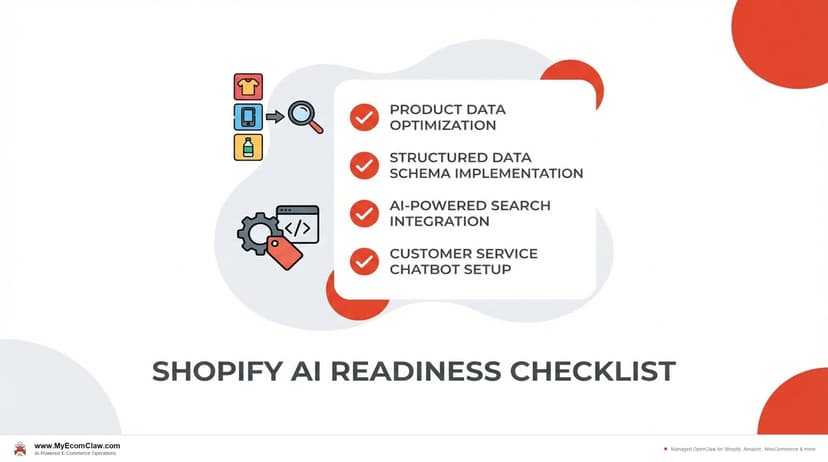
AI-Ready Shopify Checklist: 15 Fixes
AI shopping agents from ChatGPT, Google, and Perplexity are already recommending products. If your Shopify store isn’t structured for them, you’re invisible. Here are 15 things to fix before agents shop your store.
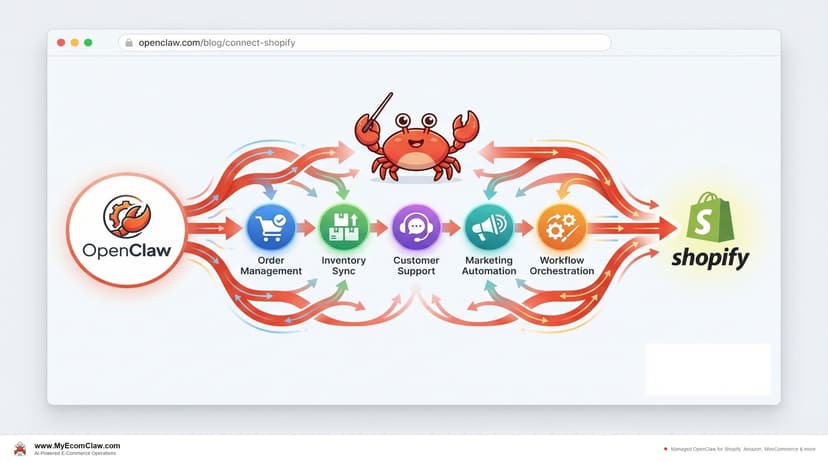
Connect OpenClaw to Shopify (2026 Guide)
OpenClaw has 191K+ GitHub stars — but connecting it to Shopify takes Admin API credentials, Composio OAuth, MCP configuration, and a week of DevOps.
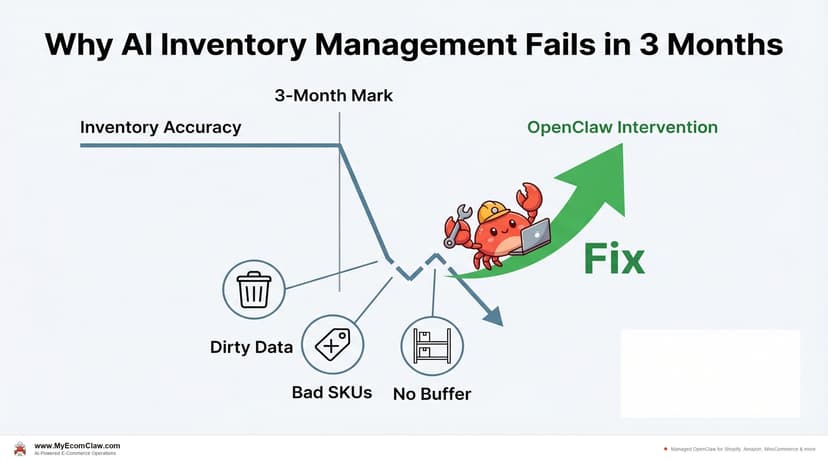
Why AI Inventory Fails in 3 Months
90% of merchants misunderstand AI for inventory. AI doesn’t fix bad data — it amplifies it. Here are the 5 most common failures and how.