OpenClaw for E-Commerce (2026 Guide)

191,000 GitHub stars. More than React. More than Next.js. More than any AI project in history. OpenClaw is the most popular open-source AI agent framework in the world — MIT licensed, free to deploy, and capable of running autonomous agents that handle real business operations.
And most e-commerce sellers have no idea what to do with it.
They’ve heard about it. They’ve read the Hacker News threads. Some have even cloned the repo and gotten it running on a laptop. But connecting it to a Shopify store, wiring up inventory sync across Amazon and WooCommerce, building skills for order processing and customer support — that’s where the weekend project dies.
The part nobody mentions: OpenClaw is free. Deploying it for your Shopify store is not. Server provisioning, API connections, skill configuration, security hardening, and ongoing maintenance — that’s weeks of DevOps work. Or you could let someone who does this every day handle it.
This is the complete guide to OpenClaw’s five AI agents for e-commerce. What each one does. How they coordinate. What it looks like in practice. And why managed deployment through MyEcomClaw is the fastest path from "interesting open-source project" to "my store runs itself."
What is OpenClaw? (The 60-second version)
OpenClaw is an open-source AI agent framework with 191,000+ GitHub stars and an MIT license. It lets you build autonomous agents that can use tools, access APIs, and take actions on your behalf — not just answer questions, but actually do things.
For e-commerce, "do things" means: process orders, sync inventory across channels, resolve support tickets, run marketing campaigns, and coordinate all of it automatically.
OpenClaw runs on your own server. Your data stays on your infrastructure. You bring your own LLM API key (OpenAI, Anthropic, or others). No vendor lock-in. No black boxes. Full SSH access to everything.
That’s the appeal. And the challenge. Because "runs on your own server" also means "you need to set up and maintain a server."
The five agents: what each one does
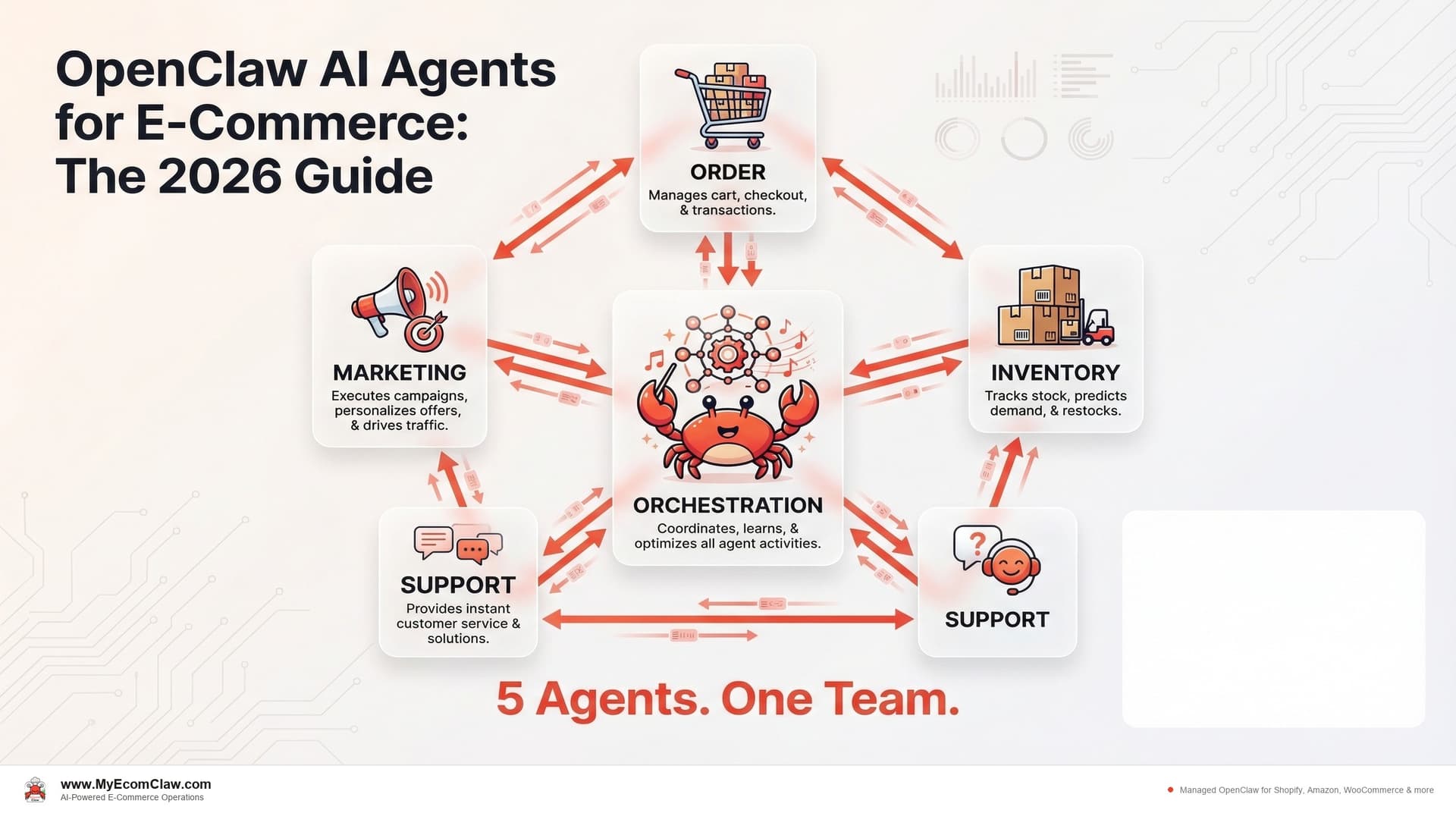
MyEcomClaw deploys OpenClaw with five pre-configured agents. Each one has a specific job. Together, they form an operations team that runs your store 24/7.
Agent 1: The Order Agent
Job: Monitor, validate, and track every order across all your sales channels.
The Order Agent connects to your Shopify Admin API, Amazon SP-API, and WooCommerce REST API. When a new order comes in on any channel, the agent validates the payment, checks for fraud signals, confirms inventory availability, sends an order confirmation, and tracks fulfillment through carrier APIs.
What it handles daily:
- New order monitoring across all channels
- Payment validation and fraud flagging
- Fulfillment tracking with carrier APIs (USPS, UPS, FedEx, DHL)
- Order confirmation messages to customers
- Exception flagging — address mismatches, high-value orders, repeat-return customers
Key skill: shopify-orders, order-validation, fulfillment-tracking
On r/shopify, a seller shared: "I spent my entire Saturday processing 200 orders. By the time I finished, 30 more had come in." The Order Agent processes orders the moment they arrive — whether that’s 2 AM on a Tuesday or noon on Black Friday.
Agent 2: The Inventory Agent
Job: Sync stock counts in real-time across every channel, predict stockouts, and generate purchase orders.
The Inventory Agent monitors stock levels across Shopify, Amazon, WooCommerce, Magento, and Walmart simultaneously. When a sale happens on ANY channel, it updates stock counts across ALL channels via webhooks — not in 15-minute batch cycles. It also tracks sales velocity to predict stockouts 3-7 days before they happen.
What it handles daily:
- Real-time inventory sync across all channels
- Stockout prediction based on sales velocity
- Auto-generated purchase orders with one-click approval
- Buffer stock management per channel
- Bundle component tracking (selling a bundle reduces individual SKU counts)
- Return processing — adjusting stock when items come back
Key skill: shopify-inventory, stockout-prediction, reorder-alerts
Retailers lose an estimated $1.7 trillion annually to stockouts and overselling. The Inventory Agent eliminates the root cause: batch sync delays and manual count management.
Agent 3: The Support Agent
Job: Handle customer inquiries, resolve tickets, process refunds, and escalate intelligently — across all platforms, in any language.
The Support Agent reads orders, tracking data, return policies, and customer history from every connected platform. It resolves WISMO tickets in seconds, generates return labels, processes qualifying refunds, and detects customer sentiment to escalate frustrated customers before they leave negative reviews.
What it handles daily:
- WISMO (where is my order) auto-resolution with carrier tracking
- Return request processing with policy verification
- Refund processing for qualifying orders
- Multilingual support in 50+ languages — natively, not translated
- Sentiment detection and smart escalation to humans
- VIP customer identification and priority routing
Key skill: shopify-customers, ticket-triage, refund-processing
Agent 4: The Marketing Agent
Job: Segment customers, generate discount codes, schedule campaigns, and track ROI — all from a WhatsApp conversation.
The Marketing Agent analyzes purchase history, order frequency, and spending patterns to segment your customers automatically. It generates Shopify discount codes, drafts campaigns for lapsed customers, and adjusts ad budgets based on inventory levels. You approve everything from WhatsApp.
What it handles daily:
- Customer segmentation based on purchase behavior
- Discount code generation for Shopify
- Winback campaigns for lapsed customers
- Ad budget recommendations based on stock levels
- Campaign ROI tracking
- Seasonal trend detection
Key skill: shopify-discounts, email-campaigns, customer-segmentation
The part nobody tells you: most sellers have a marketing strategy in their head. They just never find time to execute it. The Marketing Agent is the execution layer for the strategy you already know works.
Agent 5: The Orchestration Agent
Job: Coordinate the other four agents, resolve conflicts, manage priorities, and route decisions to you only when a human is needed.
The Orchestration Agent is the conductor. It watches all four agents, detects situations that require cross-agent coordination, and makes sure they act as a team — not as four independent tools.
What it handles daily:
- Cross-agent conflict resolution (inventory low + ads running = pause ads)
- Priority management during spikes and emergencies
- Decision routing — only escalates to you when human judgment is needed
- Workflow orchestration across all platforms
- Agent health monitoring and error recovery
Key skill: agent-coordinator, workflow-routing, priority-management
This is the agent that makes five individual agents feel like one operations team. Without it, you’d have five separate automations. With it, you have a coordinated system.
Talk to your agent on WhatsApp — see all five in action
Here’s what it looks like when all five agents are running on your server. One conversation. All your operations.
Morning report?
Good morning! Here’s your full operations report:
📊 Order Agent: 58 orders processed overnight (26 Shopify, 22 Amazon, 10 WooCommerce). 0 payment issues. 2 flagged for manual review — both address mismatches on high-value orders ($200+).
📦 Inventory Agent: 294 SKUs synced across 3 channels. All counts matched. 3 items approaching reorder point. Blue Widget at 31 units, 9/day velocity — stockout in 3.4 days. PO draft ready.
💬 Support Agent: 19 tickets overnight. 17 auto-resolved (11 WISMO, 4 returns, 2 modifications). 2 escalated — 1 VIP complaint, 1 negative-sentiment Amazon review response needed. Both flagged for your follow-up.
📈 Marketing Agent: Winback campaign to 63 lapsed customers — 27% open rate, 6 conversions ($478 revenue). Blue Widget Facebook ads paused per Inventory Agent flag (low stock). Saved $90 in wasted spend.
🔄 Orchestration Agent: Coordinated Blue Widget response — Marketing paused ads, Support updated product availability templates, Order Agent flagging new Blue Widget orders for stock verification before fulfillment.
⚠️ Actions needed:
1. Approve Blue Widget PO — 200 units from Acme Supplies
2. Review 2 flagged high-value orders
3. Handle VIP complaint (details attached)
Approve the PO. Ship both flagged orders — addresses look fine. I’ll call the VIP customer at 9.
✅ PO #2873 approved and sent to Acme Supplies. Est. delivery: March 27.
✅ Both orders released for fulfillment. Confirmations sent.
✅ VIP customer flagged for your 9 AM follow-up. Holding response sent: “Our team lead is reviewing your case this morning.”
That’s your entire operations team — orders, inventory, support, marketing, and coordination — in a 60-second WhatsApp conversation. Five agents. Three platforms. Zero dashboards opened.
The same conversation works on Telegram, Slack, Discord, or any messaging platform your team already uses.
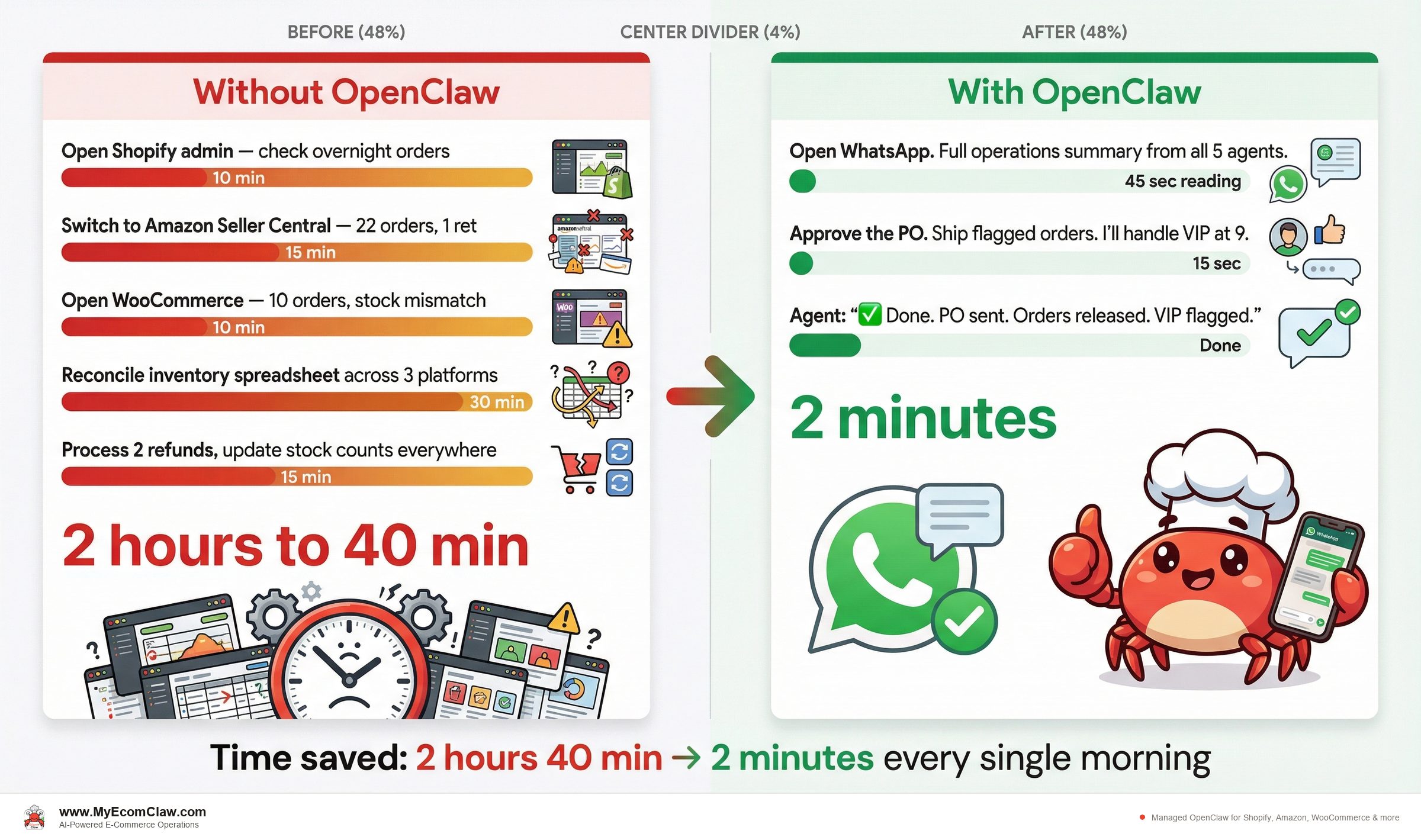
A day in the life: before and after five OpenClaw agents
Before: Managing a store without agents
| Time | What You’re Doing | Time Spent |
|---|---|---|
| 7:00 AM | Open Shopify admin — check overnight orders | 10 min |
| 7:10 AM | Switch to Amazon Seller Central — 22 orders, 1 return | 15 min |
| 7:25 AM | Open WooCommerce — 10 orders, stock mismatch | 10 min |
| 7:35 AM | Reconcile inventory spreadsheet across 3 platforms | 30 min |
| 8:05 AM | Process 2 refunds, update stock counts everywhere | 15 min |
| 8:20 AM | Answer 12 support tickets (8 WISMO, 3 returns, 1 complaint) | 35 min |
| 8:55 AM | Check ad performance, realize you’re advertising a low-stock product | 10 min |
| 9:05 AM | Manually pause ads, email supplier for restock | 10 min |
| 9:15 AM | Remember the email campaign you planned last week — still not sent | 5 min |
| 9:20 AM | Open to-do list. Realize it’s been the same list for 3 weeks. | — |
| Total | Operations busywork | 2 hours 40 min |
After: Five agents running on your server
| Time | What You’re Doing | Time Spent |
|---|---|---|
| 7:00 AM | Open WhatsApp. Full operations summary from all 5 agents. | 45 sec reading |
| 7:01 AM | “Approve the PO. Ship flagged orders. I’ll handle VIP at 9.” | 15 sec |
| 7:01 AM | Agent: “✅ Done. PO sent. Orders released. VIP flagged.” | Done |
| 7:02 AM | Start working on strategy, sourcing, or product development | — |
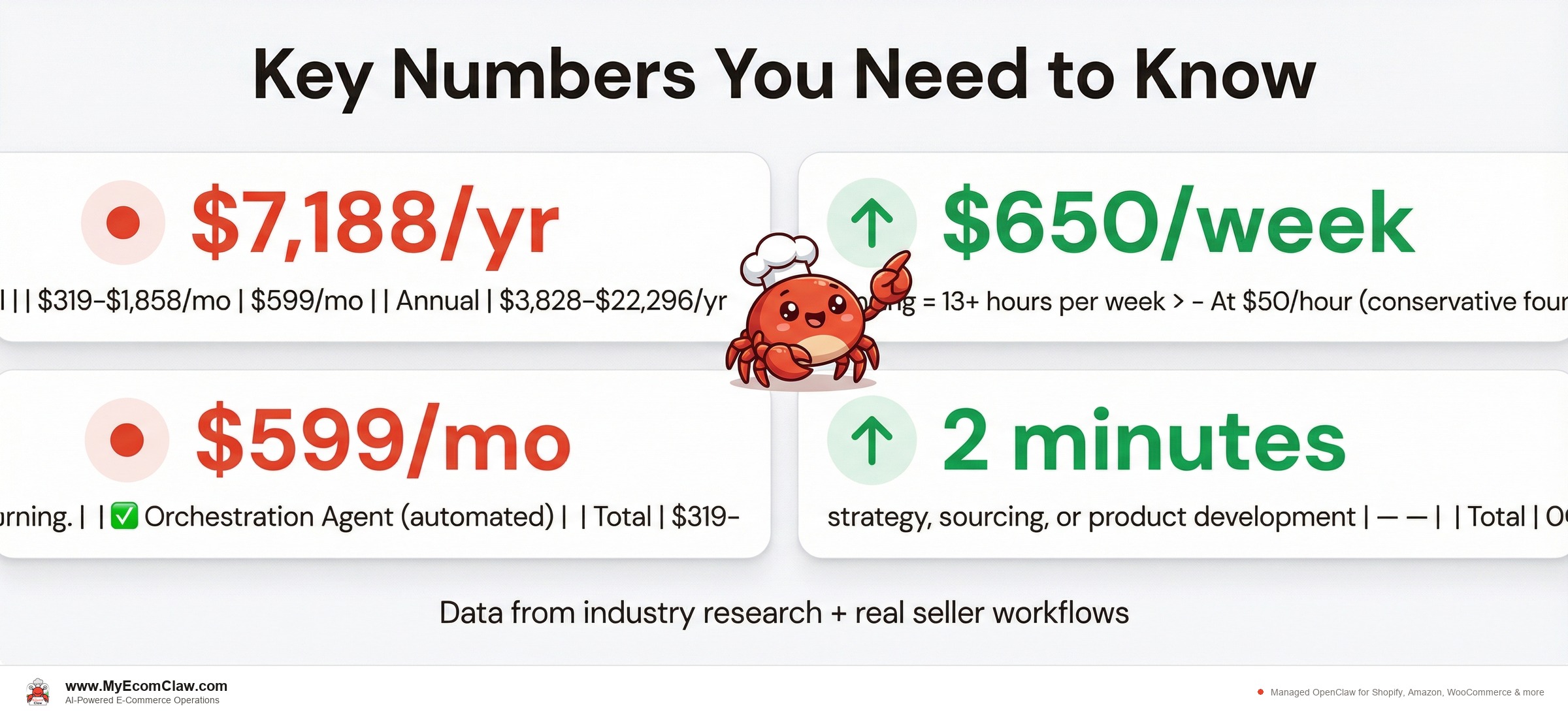
| Total | Operations | 2 minutes |
- Time saved:2 hours 38 minutes every morning = 13+ hours per week
- At $50/hour(conservative founder rate) = $650/week
- Annual value of recovered time: $33,800/year
- Oversells prevented:All of them. Real-time sync eliminates batch delays.
- Missed campaigns:Zero. Marketing Agent executes on schedule.
- Late support replies:Zero. Support Agent works 24/7 in 50+ languages.
How the agents coordinate: a real-world scenario
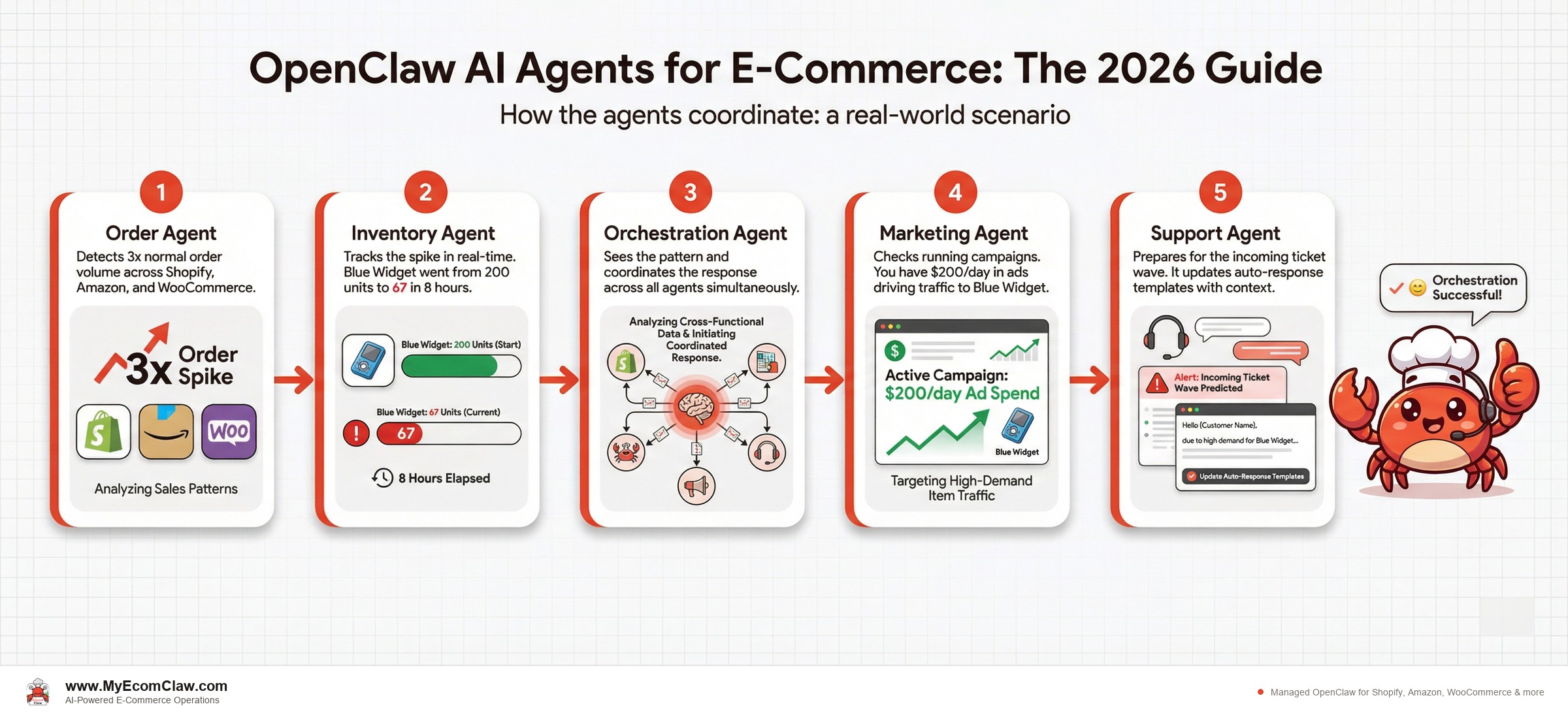
The individual agents are useful on their own. But the real power is coordination. Here’s what happens during a Black Friday spike:
Scenario: Orders triple overnight and your top product is selling faster than expected.
Order Agent detects 3x normal order volume across Shopify, Amazon, and WooCommerce. It processes all orders, validates payments, sends confirmations, and flags 4 for manual review (unusually large quantities — possible resellers).
Inventory Agent tracks the spike in real-time. Blue Widget went from 200 units to 67 in 8 hours. At current velocity, stockout in 14 hours. The agent creates an emergency PO and alerts you: "Black Friday surge — Blue Widget selling 3x normal. PO for 500 units drafted. Approve?"
Orchestration Agent sees the pattern and coordinates the response across all agents simultaneously.
Marketing Agent checks running campaigns. You have $200/day in ads driving traffic to Blue Widget. The agent reduces budget by 50% to slow sales until the restock arrives: "Reduced Blue Widget ad spend to $100/day. Redirected $100 to Green Tee (480 units in stock). Net ad spend unchanged."
Support Agent prepares for the incoming ticket wave. It updates auto-response templates with current shipping estimates (higher volume = longer fulfillment) and pre-drafts responses for stock availability questions: "Blue Widget may sell out this weekend. Order now to secure yours."
This entire coordination happened without you touching a dashboard. Five agents, three platforms, one unified response to a demand spike. Try doing that with Sellbrite + ShipStation + Gorgias + Klaviyo + Triple Whale.
Built on OpenClaw — 191K+ GitHub stars, MIT licensed, the most popular open-source AI agent in the world. Built by Space-O Technologies — 15+ years in software, 80+ AI developers, 500+ projects delivered. Deployed on your own private server. Your data never leaves your infrastructure. No lock-in.
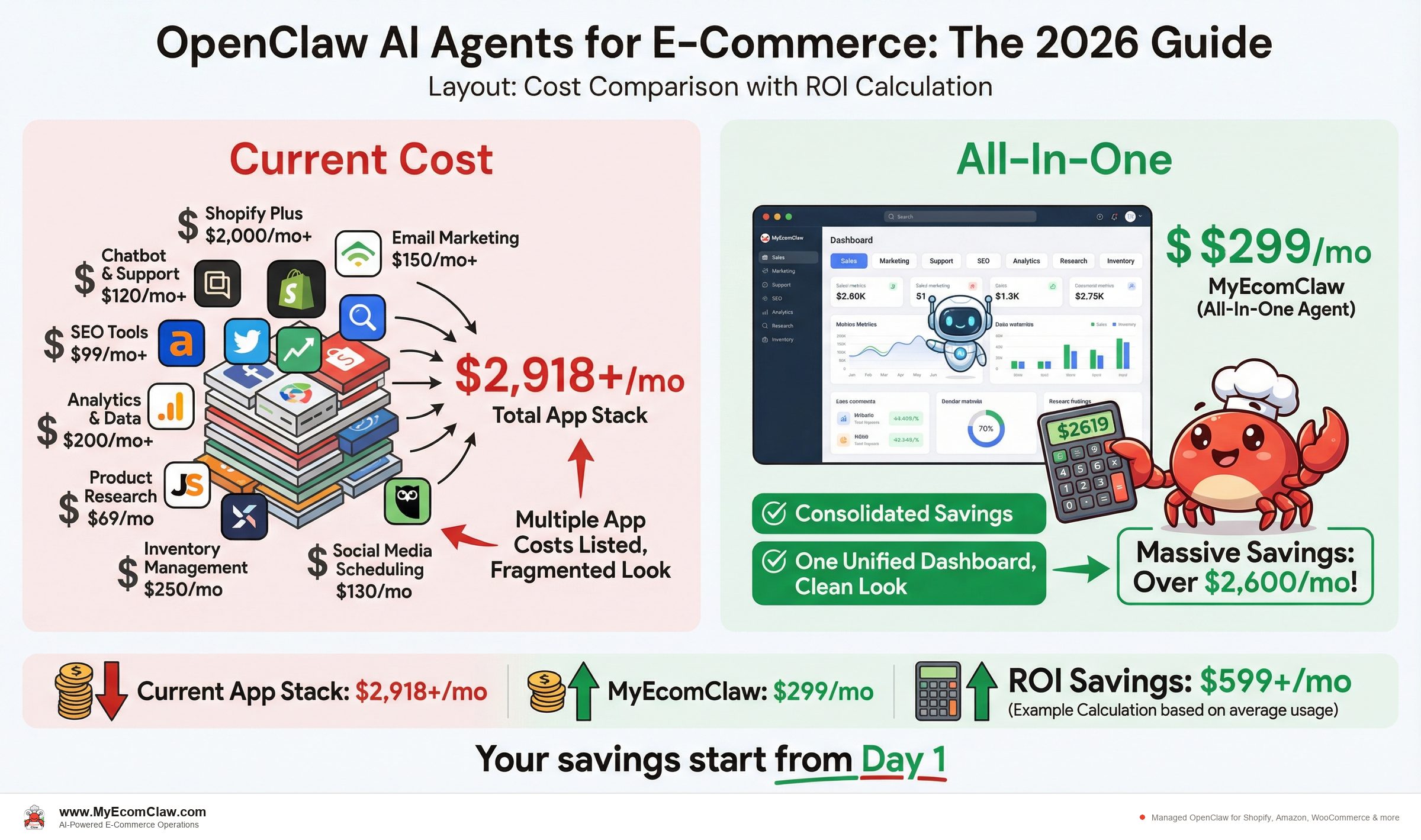
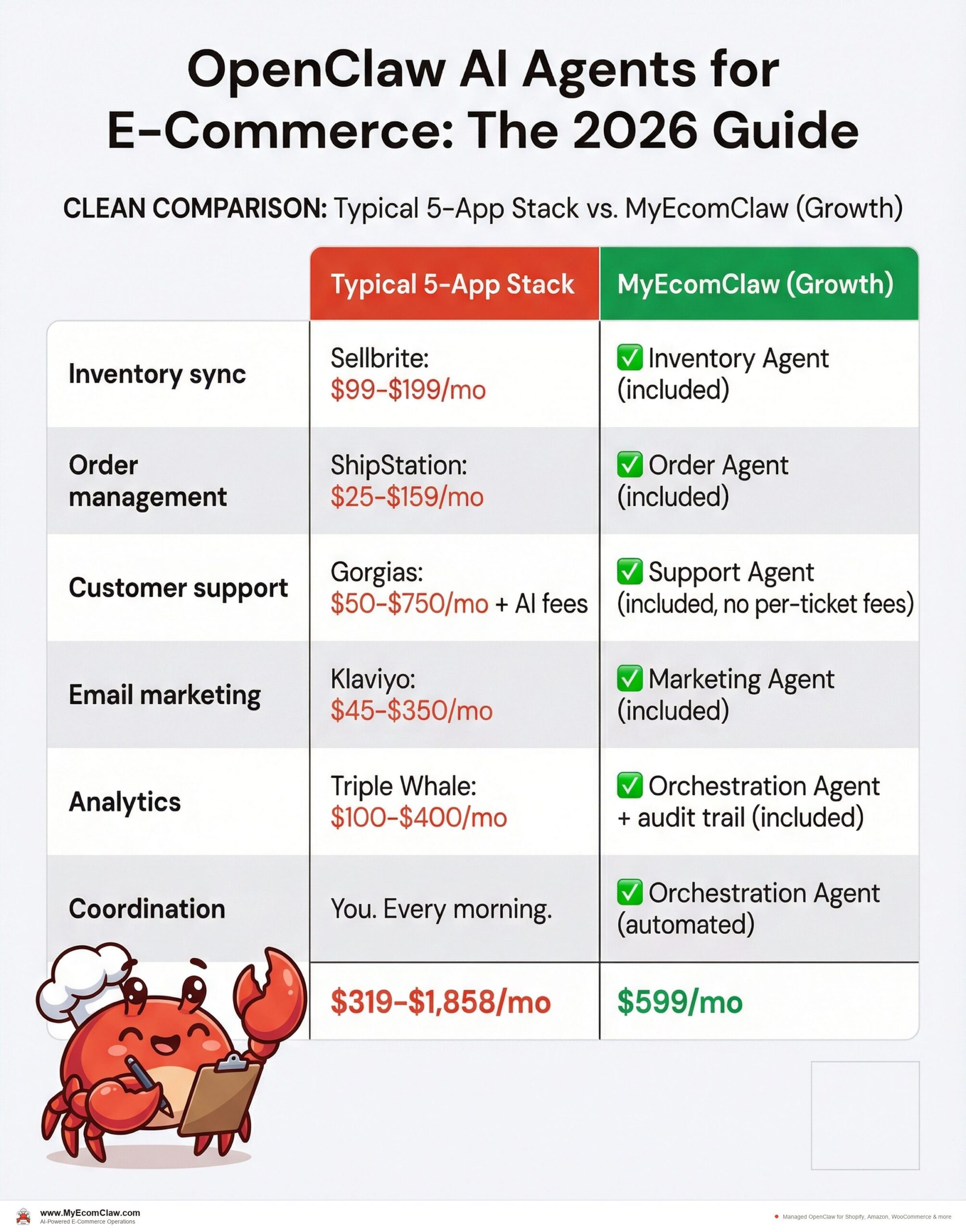
The cost comparison: app stack vs. five OpenClaw agents
| Typical 5-App Stack | MyEcomClaw (Growth) | |
|---|---|---|
| Inventory sync | Sellbrite: $99-$199/mo | ✅ Inventory Agent (included) |
| Order management | ShipStation: $25-$159/mo | ✅ Order Agent (included) |
| Customer support | Gorgias: $50-$750/mo + AI fees | ✅ Support Agent (included, no per-ticket fees) |
| Email marketing | Klaviyo: $45-$350/mo | ✅ Marketing Agent (included) |
| Analytics | Triple Whale: $100-$400/mo | ✅ Orchestration Agent + audit trail (included) |
| Coordination | You. Every morning. | ✅ Orchestration Agent (automated) |
| Total | $319-$1,858/mo | $599/mo |
| Annual | $3,828-$22,296/yr | $7,188/yr |
| Platforms | Mostly Shopify, partial others | Shopify + Amazon + WooCommerce + Magento + Walmart |
| Data | 5 vendor clouds | Your server. MIT licensed. |
What your first week looks like
Pick a plan — Starter ($299/mo, 3 agents) or Growth ($599/mo, all 5). Tell us your platforms, your order volume, your biggest pain points. We start provisioning your private server. Your data will never touch our servers.
We wire up your Shopify Admin API, Amazon SP-API, and WooCommerce REST API. We map SKUs across channels, configure reorder thresholds, set escalation rules, and define your support policies. You don’t touch a terminal.
First message from your agent: “Hi! Your OpenClaw agents are live. 294 SKUs synced across 3 channels. Stock health: 92%. 58 orders processed in the last 24 hours. 3 items approaching reorder point. Ready for your first morning report tomorrow.”
Full operations summary at 7 AM. Orders, inventory, support, marketing — all in one WhatsApp message. You approve two POs and move on with your day.
Agent alerts you: “Blue Widget ads paused — stock dropping faster than expected. Redirected budget to Green Tee. Support templates updated. PO sent to supplier. All coordinated.” Five agents. One decision. You approved it from your phone.
Why this matters for your business
The e-commerce operations landscape in 2026 has a fundamental problem: the tools are fragmented. Inventory sync is one app. Order management is another. Support is a third. Marketing is a fourth. Analytics is a fifth. None of them share data. None of them coordinate. And you’re the human glue between all of them.
OpenClaw’s five-agent architecture solves this at the root. Instead of five disconnected tools, you have five coordinated agents running on your own server, sharing data natively, and communicating through one WhatsApp conversation. The Inventory Agent tells the Marketing Agent to pause ads. The Support Agent knows about shipping delays before customers complain. The Orchestration Agent makes sure everyone acts as a team.
That’s the difference between automation and intelligence. Automation runs scripts. Intelligence coordinates responses.
Our take
Every Shopify seller in 2026 knows about OpenClaw. The 191K stars are impossible to ignore. The question isn’t "should I use AI agents?" — it’s "how do I actually get them running on my store?"
The DIY path takes weeks. Provisioning a server, configuring Docker, connecting the Shopify Admin API, writing custom skills, and maintaining everything yourself. It works — if you’re a developer with time. For everyone else, it’s a weekend project that stalls at the API connection step.
MyEcomClaw exists because we saw 500+ e-commerce sellers try to deploy OpenClaw themselves and hit the same wall. The technology is incredible. The deployment is hard. So we made the deployment easy. Your server, your data, your agents — configured for Shopify, WooCommerce, Amazon, Magento, and Walmart. Running in days, not weeks.
If you’re managing a store doing 100+ orders per month across any combination of platforms, your five OpenClaw agents will pay for themselves in the first week. See plans → · Talk to us →
FAQ
What exactly is OpenClaw?
OpenClaw is an open-source AI agent framework with 191,000+ GitHub stars and an MIT license. It lets you build autonomous agents that use tools, access APIs, and take real actions — not just chat. For e-commerce, that means agents that process orders, sync inventory, resolve support tickets, and run marketing campaigns. MyEcomClaw deploys and manages OpenClaw on your own server, pre-configured for Shopify, WooCommerce, Amazon, Magento, and Walmart.
Do I need all five agents? Can I start with fewer?
Yes. The Starter plan ($299/mo) includes 3 agents — Orders, Inventory, and Support — for up to 1,000 orders per month. These cover the highest-impact operations. When you’re ready for marketing automation and cross-agent orchestration, upgrade to Growth ($599/mo) for all 5 agents. Compare plans →
Where does my data live?
On your own server. Every MyEcomClaw deployment runs on a dedicated server — VPS or Mac Mini — that belongs to you. Your orders, inventory data, customer information, and API keys never leave your infrastructure. You have full SSH access. OpenClaw is MIT licensed. No lock-in. If you leave, you take everything with you.
How does the WhatsApp interface work?
OpenClaw natively integrates with WhatsApp, Telegram, Slack, Discord, and 10+ other messaging platforms. You talk to your agents in natural language. Ask for a morning report, approve a purchase order, check inventory, or handle an escalated ticket — all from the messaging app you already use. No terminal. No dashboard.
How is this different from installing 5 Shopify apps?
Shopify apps are individual tools. Sellbrite syncs inventory but doesn’t know about your ads. Gorgias handles support but doesn’t know about your stock levels. Klaviyo sends emails but doesn’t know about supplier lead times. OpenClaw’s five agents share data natively because they run on the same server. The Orchestration Agent coordinates them as a team. No app stack does this. See the cost comparison →
How long does setup take?
Starter plan: 3-5 business days. Growth plan: 5-7 business days. We handle everything — server provisioning, API connections, SKU mapping, agent configuration, support policy setup, and testing. Your first WhatsApp message from your agents arrives within days of signup. Get started →
Can OpenClaw handle Black Friday or seasonal spikes?
Yes. The agents handle spikes by coordinating automatically. Order Agent processes high volumes. Inventory Agent tracks depletion in real-time and sends emergency POs. Marketing Agent adjusts ad spend. Support Agent updates response templates for higher shipping times. Orchestration Agent makes sure nothing falls through the cracks. The system scales with your volume without you waking up to chaos.
Ready to deploy your five-agent operations team?
MyEcomClaw deploys OpenClaw on your own server with AI agents for orders, inventory, support, marketing, and orchestration. Works across Shopify, Amazon, WooCommerce, Magento, and Walmart. Managed 24/7.
More from Guides
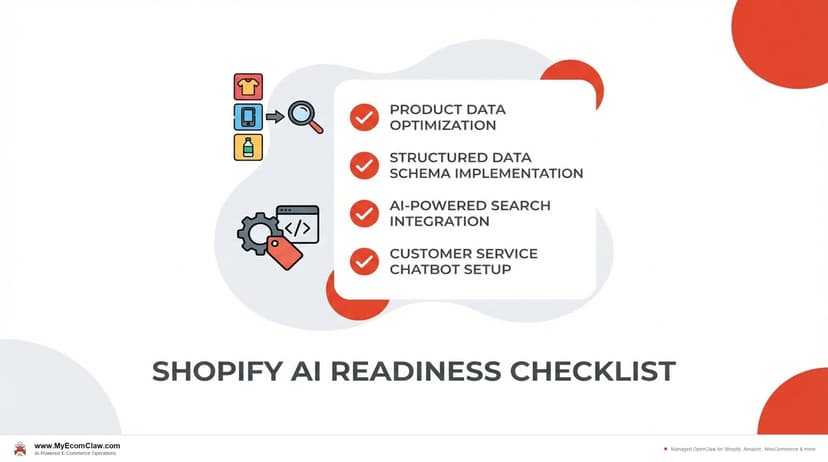
AI-Ready Shopify Checklist: 15 Fixes
AI shopping agents from ChatGPT, Google, and Perplexity are already recommending products. If your Shopify store isn’t structured for them, you’re invisible. Here are 15 things to fix before agents shop your store.
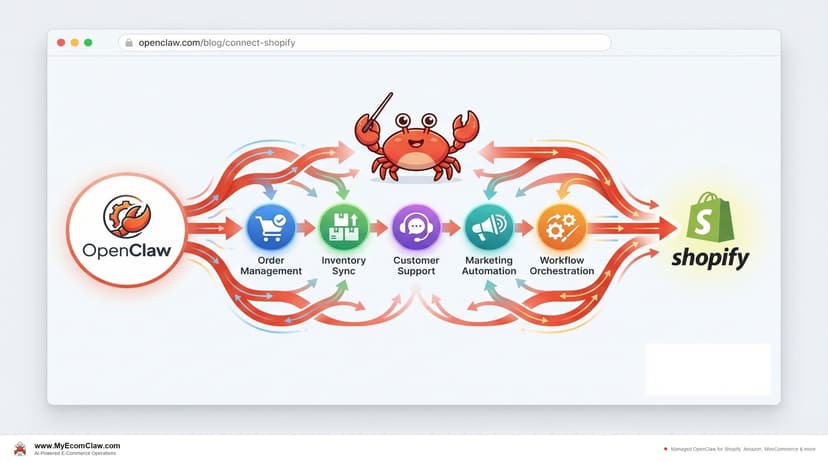
Connect OpenClaw to Shopify (2026 Guide)
OpenClaw has 191K+ GitHub stars — but connecting it to Shopify takes Admin API credentials, Composio OAuth, MCP configuration, and a week of DevOps.
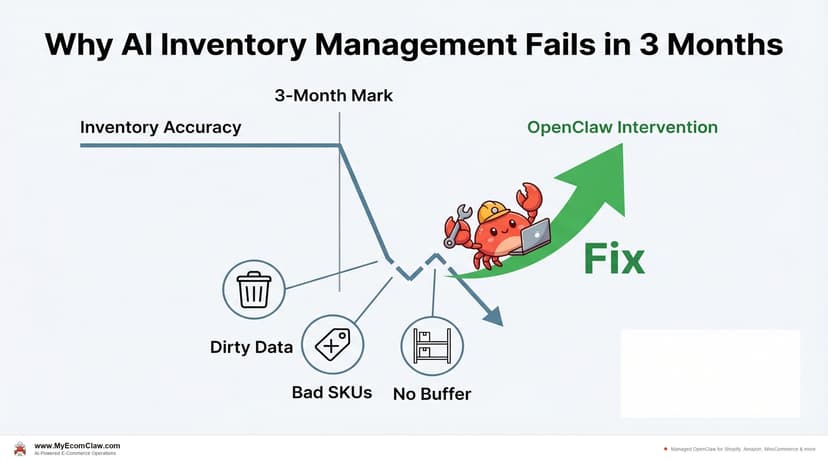
Why AI Inventory Fails in 3 Months
90% of merchants misunderstand AI for inventory. AI doesn’t fix bad data — it amplifies it. Here are the 5 most common failures and how.