Shopify-Amazon Inventory Sync: Why Apps Fail

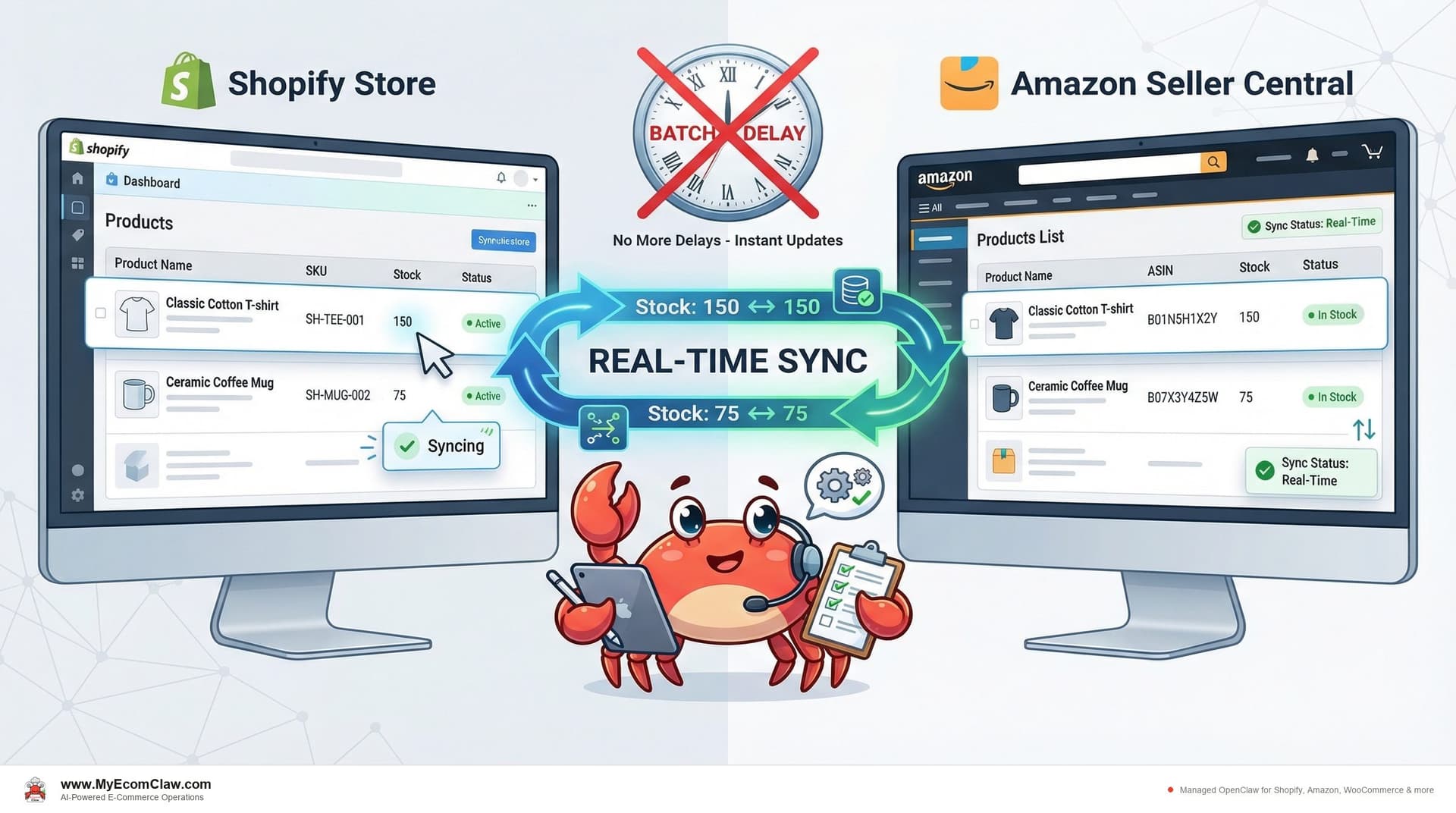
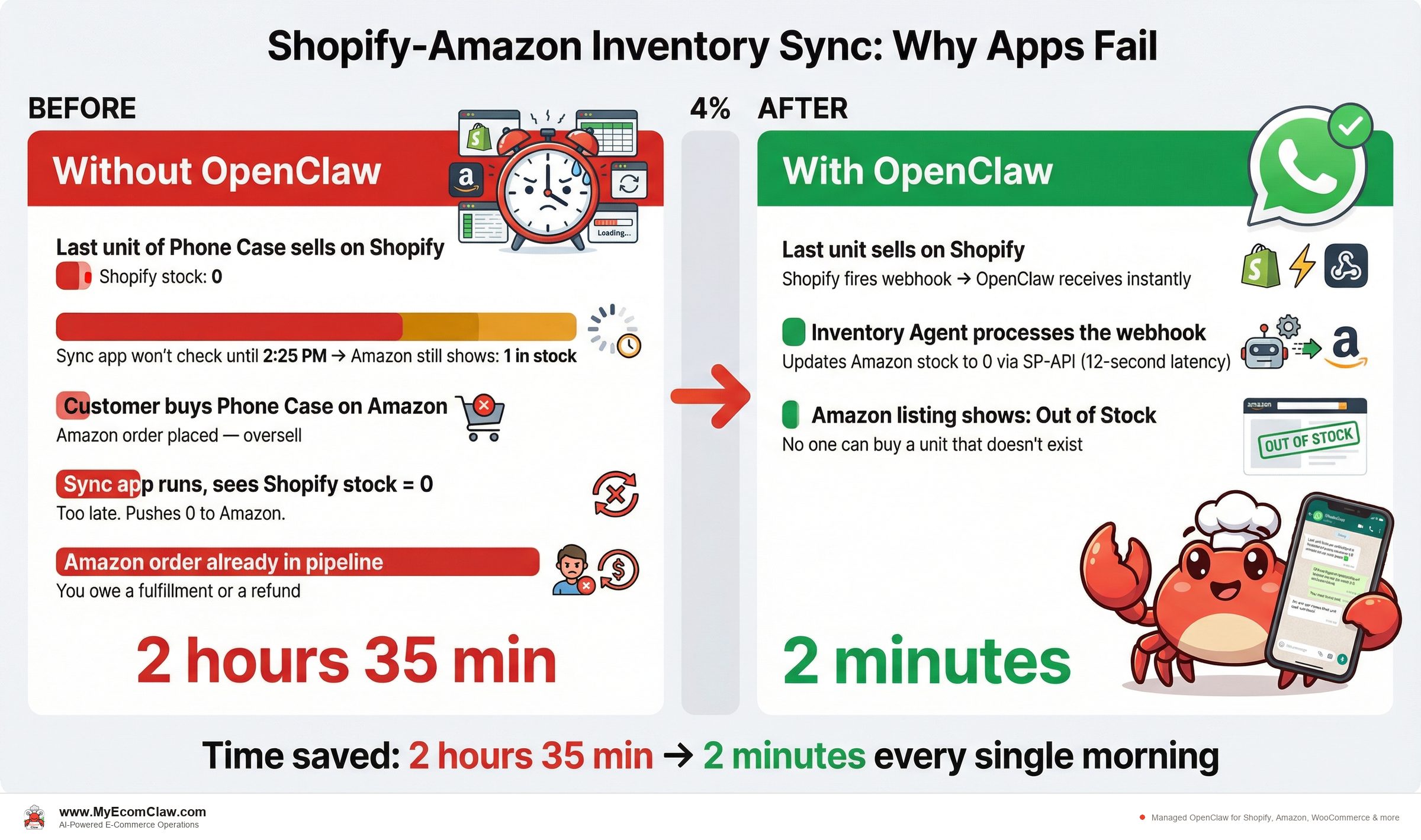
It’s 2:14 PM on a Thursday. A customer buys the last unit of your best-selling phone case on Shopify. At 2:17 PM — three minutes later — someone on Amazon buys the same phone case. Your sync app hasn’t updated yet. It runs on a 15-minute cycle. The next sync is at 2:25 PM.
You now have an order you can’t fulfill. An Amazon customer you’ll disappoint. A seller rating that just took a hit. And a refund to process.
This is not an edge case. This is the daily reality of selling on Shopify and Amazon simultaneously. Globally, retailers lose an estimated $1.73 trillion annually to a combination of stockouts and overselling. And the root cause is almost always the same: batch sync delays.
The cruelest part? You paid for an app specifically to prevent this. And it failed because "sync every 15 minutes" was the best it could do.
Shopify does NOT natively sync with Amazon
Let’s be clear about what Shopify does and does not do:
What Shopify syncs: Inventory across its own channels — your online store, Shopify POS, Shopify Markets. Within the Shopify ecosystem, stock counts stay consistent.
What Shopify does NOT sync: Anything outside its ecosystem. Amazon. WooCommerce. Walmart. Etsy. eBay. If you sell on Shopify and Amazon, there is zero native inventory sync between the two platforms.
On r/shopify, this comes up constantly. One seller posted: "How do you guys handle inventory between Shopify and Amazon? I’m manually updating both and it’s killing me." The replies were a mix of app recommendations and horror stories about overselling during flash sales.
And here’s the thing — Shopify isn’t going to build this. Amazon is a competitor. Shopify has no incentive to make selling on Amazon easier. You’re on your own.
How sync apps actually work (and why they fail)
Every Shopify-to-Amazon sync app uses the same basic architecture: batch polling.
Here’s the pattern:
- The app checks Shopify’s inventory levels on a schedule (every 5, 10, or 15 minutes)
- It compares the numbers to what’s on Amazon
- If there’s a difference, it sends an update to Amazon’s SP-API
- Amazon processes the update (which takes another 5-15 minutes on their end)
Total delay from Shopify sale to Amazon update: 10-30 minutes.
During that window, your Amazon listing still shows the old stock count. If someone buys during that window, you oversell.
The popular sync apps compared
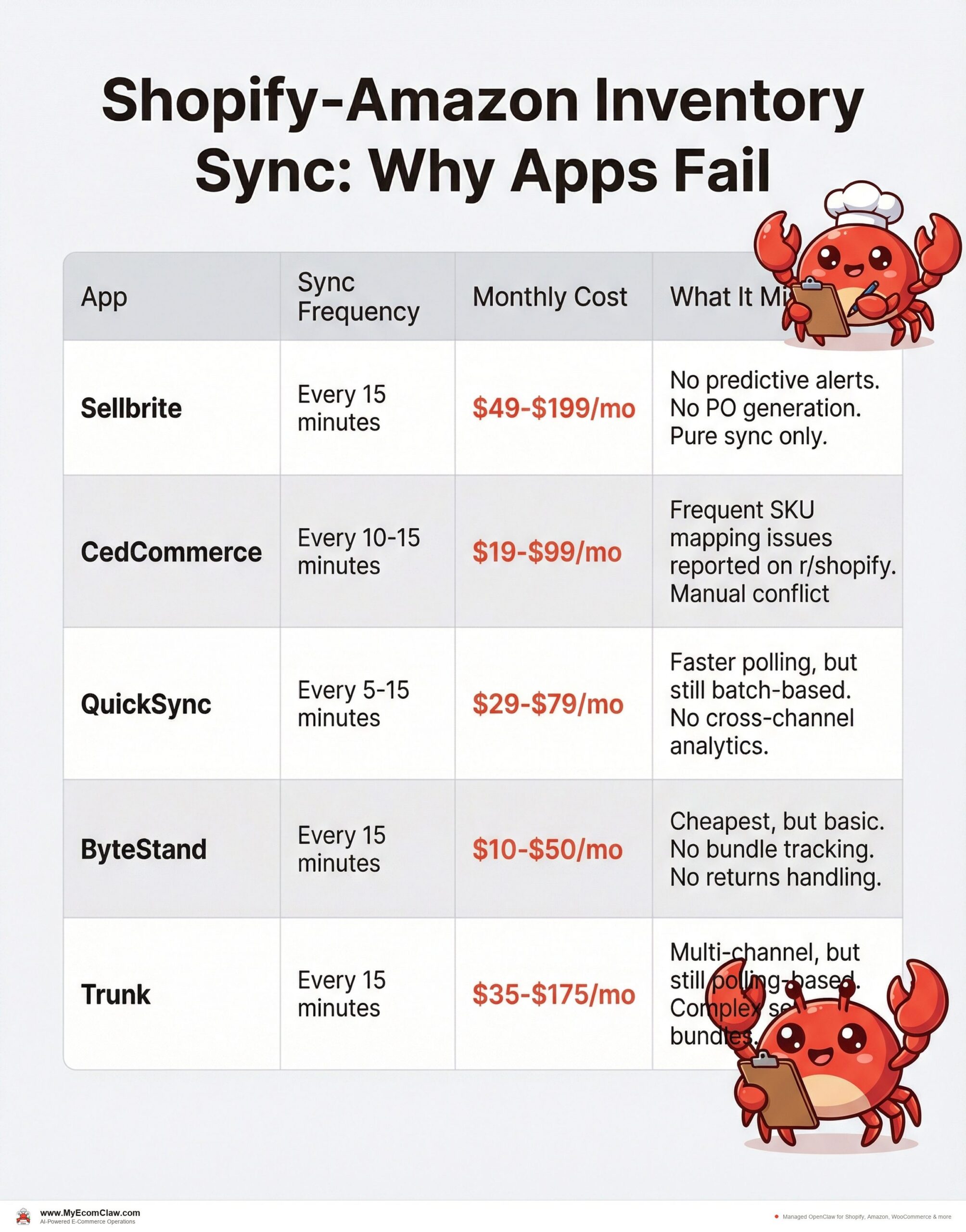
| App | Sync Frequency | Monthly Cost | What It Misses |
|---|---|---|---|
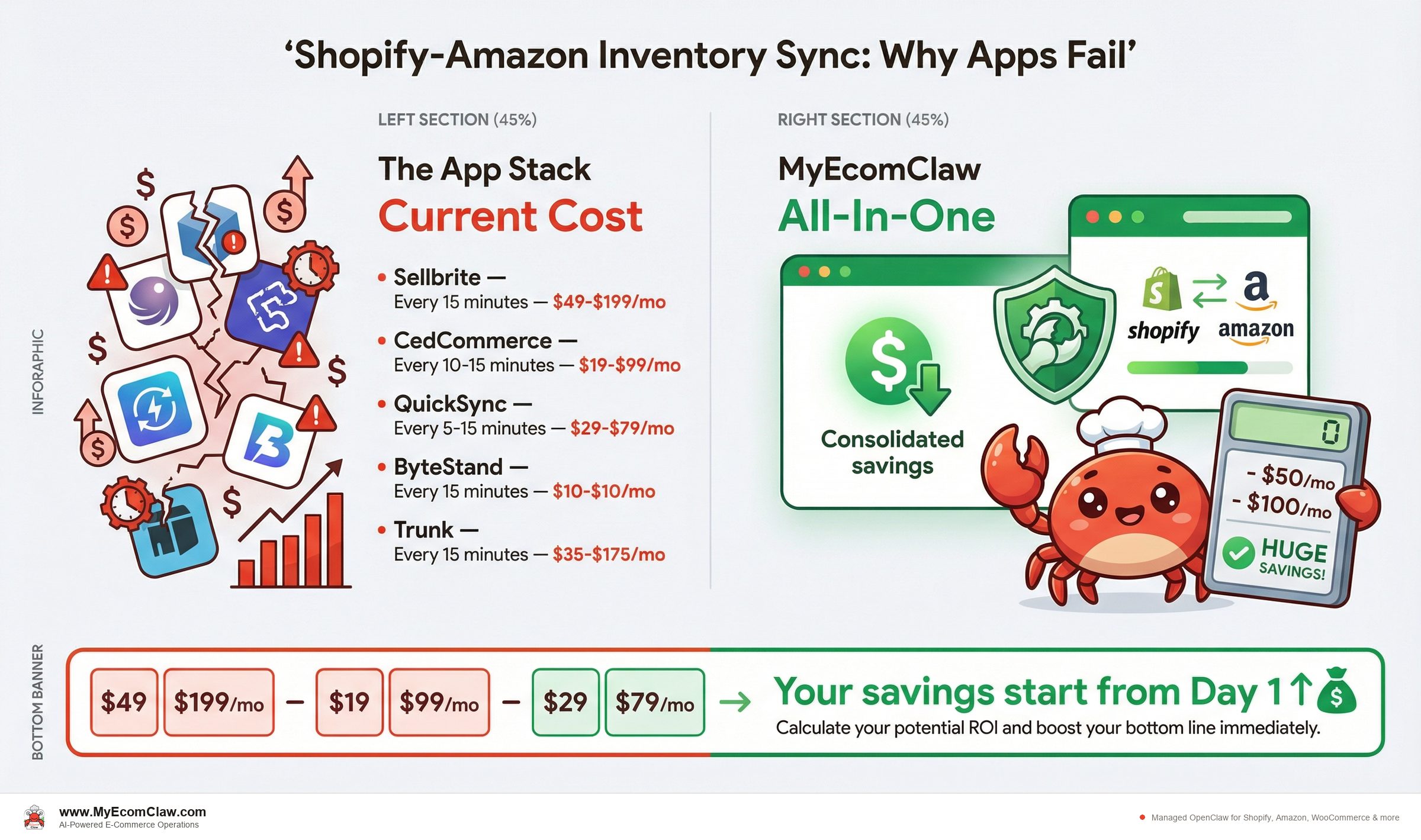
| Sellbrite | Every 15 minutes | $49-$199/mo | No predictive alerts. No PO generation. Pure sync only. |
| CedCommerce | Every 10-15 minutes | $19-$99/mo | Frequent SKU mapping issues reported on r/shopify. Manual conflict resolution. |
| QuickSync | Every 5-15 minutes | $29-$79/mo | Faster polling, but still batch-based. No cross-channel analytics. |
| ByteStand | Every 15 minutes | $10-$50/mo | Cheapest, but basic. No bundle tracking. No returns handling. |
| Trunk | Every 15 minutes | $35-$175/mo | Multi-channel, but still polling-based. Complex setup for bundles. |
Notice the pattern? Every single one is batch-based. Every single one has a window where your inventory is out of sync. The only difference is the size of that window.
The math on overselling
Let’s make this concrete. Say you sell 100 units per day across Shopify and Amazon. With a 15-minute sync window:
- Sales per minute across both channels: ~0.07 (100 orders ÷ 1,440 minutes)
- Sales during a 15-minute window: ~1.04 orders
- Probability of overlap (both channels sell the same item in 15 min): Depends on inventory depth, but for items with fewer than 10 units, it’s 15-25% per day
- Average overselling incidents per month for a mid-volume seller: 4-8 times
- Cost per incident (refund + Amazon penalty + customer loss): $50-$200
- Annual cost of overselling from batch sync: $2,400-$19,200
And that’s with the apps working correctly. When they glitch — and they do — the window gets longer and the numbers get worse.
- 4-8 overselling incidents per month
- $50-$200 per incident(refund + penalty + lost customer)
- $2,400-$19,200 per year— just from batch delays
- Plus: damaged Amazon seller rating, lost Buy Box eligibility, customer trust erosion
How OpenClaw’s webhook-based sync actually works
OpenClaw’s Inventory Agent doesn’t poll. It listens.
The difference:
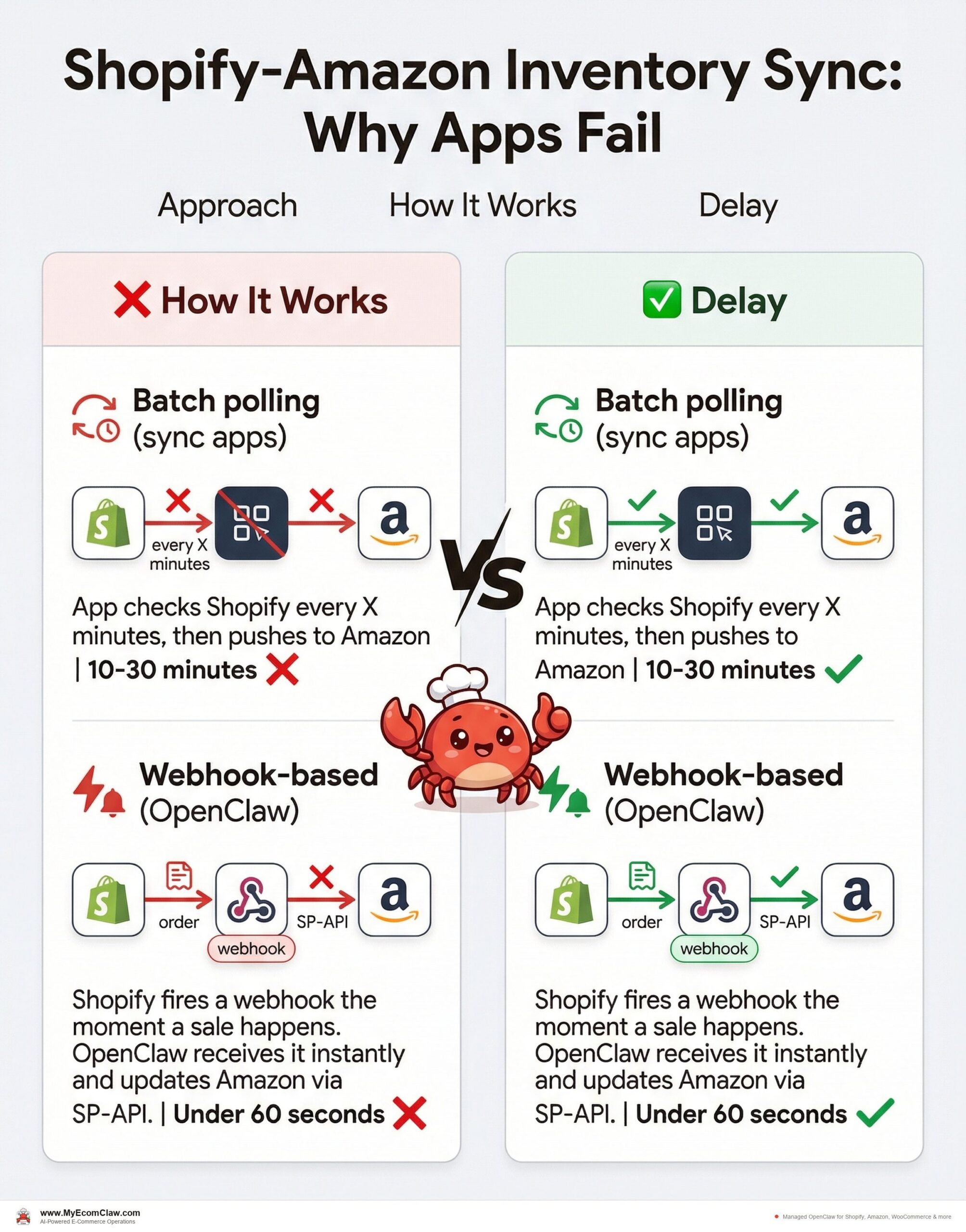
| Approach | How It Works | Delay |
|---|---|---|
| Batch polling (sync apps) | App checks Shopify every X minutes, then pushes to Amazon | 10-30 minutes |
| Webhook-based (OpenClaw) | Shopify fires a webhook the moment a sale happens. OpenClaw receives it instantly and updates Amazon via SP-API. | Under 60 seconds |
Here’s the technical flow:
Sale happens on Shopify → Shopify fires the `orders/create` webhook
OpenClaw receives the webhook → Inventory Agent parses the order, identifies the SKUs affected
Agent adjusts Amazon stock → Sends an `inventory_levels/adjust` call to Amazon SP-API
Agent confirms the sync → Logs the update and monitors for Amazon’s confirmation
The result: Stock counts across Shopify and Amazon are never more than 60 seconds out of sync. During high-volume periods, the Inventory Agent processes webhook events in parallel — handling multiple simultaneous sales without queuing delays.
This is the fundamental architectural difference. Polling is reactive — it asks "what changed?" on a schedule. Webhooks are proactive — the platform tells you the moment something changes. It’s the difference between checking your mailbox every 15 minutes and having mail delivered to your door.
Talk to your sync agent on WhatsApp
Here’s what Shopify-Amazon inventory sync looks like with OpenClaw. You don’t open Sellbrite. You don’t check a dashboard. You open WhatsApp.
Flash sale morning:
Increase Red Earbuds reorder to 500 units. Can you pause the Amazon listing for the Blue Phone Case when it hits 1 unit?
✅ PO #3912 updated to 500x Red Wireless Earbuds. Sent to supplier.
✅ Auto-pause rule set: Blue Phone Case Amazon listing will deactivate at 1 unit remaining. Shopify listing stays active for in-store pickup.
Perfect. Keep me posted.
Will do. Next update at 9 AM or if any item hits critical stock.
That conversation happened while you were making coffee. Your sync app would have shown you a dashboard with numbers that were already 15 minutes old.
A day in the life: batch sync vs. real-time sync
Before: Thursday with a sync app
| Time | What’s Happening | Result |
|---|---|---|
| 2:14 PM | Last unit of Phone Case sells on Shopify | Shopify stock: 0 |
| 2:14 PM | Sync app won’t check until 2:25 PM | Amazon still shows: 1 in stock |
| 2:17 PM | Customer buys Phone Case on Amazon | Amazon order placed — oversell |
| 2:25 PM | Sync app runs, sees Shopify stock = 0 | Too late. Pushes 0 to Amazon. |
| 2:25 PM | Amazon order already in pipeline | You owe a fulfillment or a refund |
| 2:30 PM | You discover the oversell | Manually cancel Amazon order, process refund |
| 2:45 PM | Customer leaves a 1-star review | “Ordered an item that wasn’t even in stock” |
| 3:00 PM | Amazon seller metrics take a hit | Cancellation rate increases, Buy Box at risk |
| Total damage | One $35 phone case | $35 refund + seller rating damage + lost Buy Box eligibility |
After: Thursday with OpenClaw
| Time | What’s Happening | Result |
|---|---|---|
| 2:14 PM | Last unit sells on Shopify | Shopify fires webhook → OpenClaw receives instantly |
| 2:14 PM | Inventory Agent processes the webhook | Updates Amazon stock to 0 via SP-API (12-second latency) |
| 2:15 PM | Amazon listing shows: Out of Stock | No one can buy a unit that doesn’t exist |
| 2:15 PM | Agent sends you a WhatsApp message | “Phone Case SKU-112 is now out of stock across all channels. PO draft ready — 200 units from CaseCo. Approve?” |
| 2:15 PM | You reply: “Approve” | PO sent. Restock in 3 days. |
| Total damage | Zero | No oversell. No refund. No angry customer. No rating hit. |
The difference between "sync every 15 minutes" and "sync in 12 seconds" is the difference between a refund and a restock. Between a 1-star review and a returning customer.
The cost comparison: sync apps vs. OpenClaw
| Sync App (Sellbrite) | Sync App (CedCommerce) | MyEcomClaw (Growth) | |
|---|---|---|---|
| Monthly cost | $99/mo (mid-tier) | $49/mo (mid-tier) | $599/mo |
| Annual cost | $1,188/yr | $588/yr | $7,188/yr |
| Sync method | Batch (15 min) | Batch (10-15 min) | Webhook (real-time) |
| Overselling prevention | Partial — gap during sync window | Partial | Complete — sub-60-second sync |
| Predictive stockouts | No | No | Yes — 3-7 day forecasting |
| Purchase orders | No | No | Auto-generated with one-click approval |
| Bundle tracking | No | Limited | Full component-level tracking |
| Return sync | Limited | Limited | Real-time return-to-stock across channels |
| WhatsApp management | No | No | Full conversational control |
| Data ownership | Their servers | Their servers | Your server. Your data. MIT licensed. |
| Other agents included | No — sync only | No — sync only | Orders + Support + Marketing + Orchestration |
The real comparison isn’t price — it’s total cost of ownership:
The cross-agent advantage sync apps can’t replicate
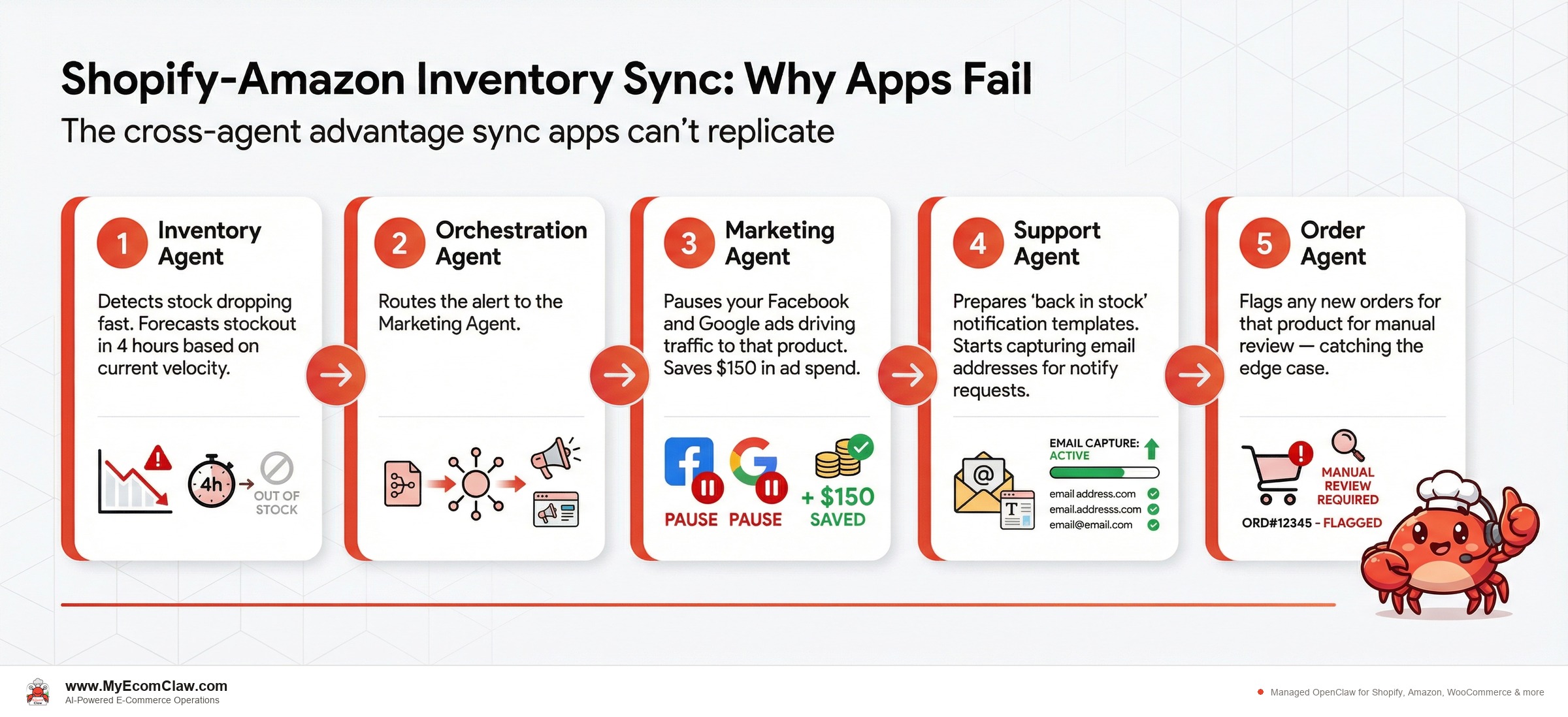
A sync app syncs numbers. OpenClaw’s agents coordinate actions.
Scenario: Your best seller is about to stock out during a sale.
Inventory Agent detects stock dropping fast. Forecasts stockout in 4 hours based on current velocity. Alerts you on WhatsApp.
Orchestration Agent routes the alert to the Marketing Agent.
Marketing Agent pauses your Facebook and Google ads driving traffic to that product. Saves $150 in wasted ad spend on a product you can’t fulfill.
Support Agent prepares “back in stock” notification templates. Starts capturing email addresses on the product page.
Order Agent flags any new orders for that product for manual review — catching the edge case where a sale sneaks through during the transition.
Built on OpenClaw — 191K+ GitHub stars, MIT licensed, the most popular open-source AI agent in the world. Built by Space-O Technologies — 15+ years, 80+ AI developers, 500+ projects delivered. Your server. Your data. No lock-in.
Why this matters for your business
If you sell on both Shopify and Amazon — and most serious e-commerce sellers do — inventory sync isn’t a nice-to-have. It’s the foundation your business runs on.
Every oversell costs you money directly (refund) and indirectly (Amazon seller rating, Buy Box eligibility, customer trust). The batch sync model that every app uses was built for a world where 15 minutes didn’t matter. In 2026, with flash sales, TikTok-driven traffic spikes, and customers who expect instant fulfillment, 15 minutes is an eternity.
The sellers who win on multi-channel aren’t using better sync apps. They’re using a fundamentally different architecture. Webhook-based, real-time, with AI agents that don’t just move numbers — they predict problems, coordinate responses, and act before the oversell happens.
Our take
The sync app market is a band-aid on a broken architecture. Every app on that comparison table is doing the same thing: polling Shopify on a timer and pushing numbers to Amazon. They’ve optimized the timer — 15 minutes became 10, then 5. But the architecture is still batch. And batch means gaps. And gaps mean overselling.
OpenClaw’s Inventory Agent doesn’t optimize the timer. It eliminates it. Webhook-based sync means stock updates propagate in seconds, not minutes. And because it’s part of a 5-agent system, the response to low stock isn’t just "update the number" — it’s "update the number, pause the ads, prepare the support team, and draft a PO."
If you’re losing even one sale per month to overselling between Shopify and Amazon, the math is simple. The refund, the rating hit, and the lost customer cost more than the agent that would have prevented it. And the agent runs on your own server, owned by you, MIT licensed, no lock-in.
Stop paying for 15-minute gaps. Get real-time sync → · Talk to us first →
FAQ
Why doesn’t Shopify sync inventory with Amazon natively?
Shopify and Amazon are competitors. Shopify wants you to sell on Shopify, not Amazon. There’s no business incentive for Shopify to build native Amazon integration. They sync within their own ecosystem (online store, POS, Markets) but anything external requires third-party apps or custom API integration.
Can OpenClaw really sync Shopify and Amazon in under 60 seconds?
Yes. The Inventory Agent uses Shopify’s orders/create webhook and Amazon’s SP-API event notifications. When a sale happens on either channel, OpenClaw receives the event in real-time and adjusts stock on the other channel immediately. Typical end-to-end latency is 12-30 seconds depending on Amazon’s API response time.
What about Amazon’s inventory processing delay?
Amazon’s SP-API has its own processing time — typically 5-15 minutes for inventory updates to reflect on the listing. OpenClaw can’t speed up Amazon’s internal processing. What it does do is submit the update within seconds of the Shopify sale (vs. 15+ minutes with batch apps), which reduces the total window from 20-30 minutes to 5-15 minutes. For critical items, the agent can also temporarily increase buffer stock on Amazon to absorb the processing gap. Learn more about buffer strategies →.
Do I need to replace my existing sync app to use OpenClaw?
Not immediately. Some sellers run both during a transition period. But once OpenClaw’s Inventory Agent is active, the sync app becomes redundant — and its batch polling can actually create conflicts with OpenClaw’s real-time updates. We recommend a clean cutover after a 1-week parallel testing period.
What if I sell on Shopify, Amazon, AND WooCommerce?
OpenClaw’s Inventory Agent supports Shopify Admin API, Amazon SP-API, WooCommerce REST API, and Walmart Marketplace API simultaneously. All channels sync in real-time through the same webhook architecture. Adding a channel is a configuration change, not a new app installation. See multi-channel plans →.
How does OpenClaw handle SKU mapping between Shopify and Amazon?
During setup, the Inventory Agent maps your Shopify SKUs to Amazon ASINs and FNSKUs. It handles variant mapping (size, color), bundle components, and multipacks. If a new product is added to one channel without a mapping, the agent flags it on WhatsApp and suggests the match based on product name and attributes.
What happens during Amazon Prime Day or a major flash sale?
The Inventory Agent scales with volume. During high-traffic events, it processes webhook events in parallel and prioritizes inventory-critical updates. The Orchestration Agent also activates "high-volume mode" — increasing alert frequency, tightening buffer stock, and coordinating with the Marketing and Order Agents to prevent overselling during traffic spikes. Talk to us about flash sale prep →.
Ready to stop losing sales to 15-minute sync gaps?
MyEcomClaw deploys OpenClaw on your own server with real-time webhook-based inventory sync across Shopify, Amazon, WooCommerce, and Walmart. No batch delays. No overselling. Managed 24/7.
More from Guides
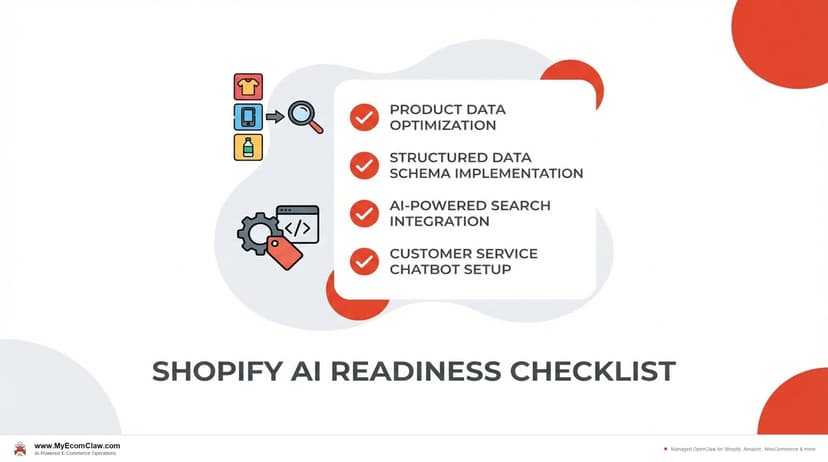
AI-Ready Shopify Checklist: 15 Fixes
AI shopping agents from ChatGPT, Google, and Perplexity are already recommending products. If your Shopify store isn’t structured for them, you’re invisible. Here are 15 things to fix before agents shop your store.
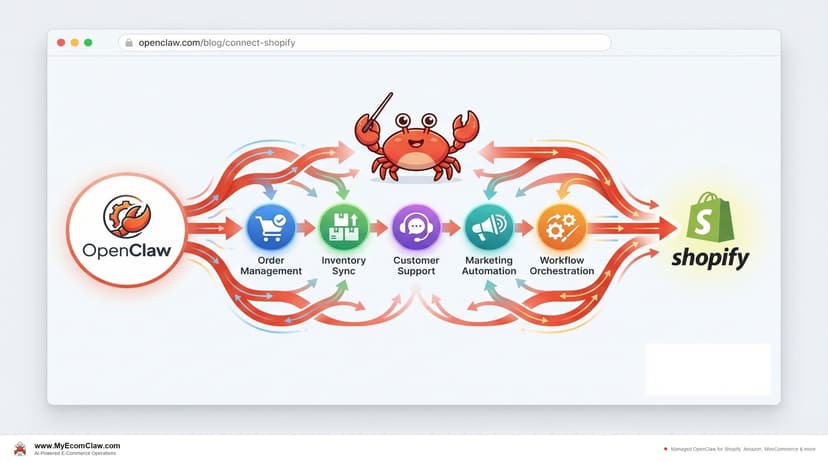
Connect OpenClaw to Shopify (2026 Guide)
OpenClaw has 191K+ GitHub stars — but connecting it to Shopify takes Admin API credentials, Composio OAuth, MCP configuration, and a week of DevOps.
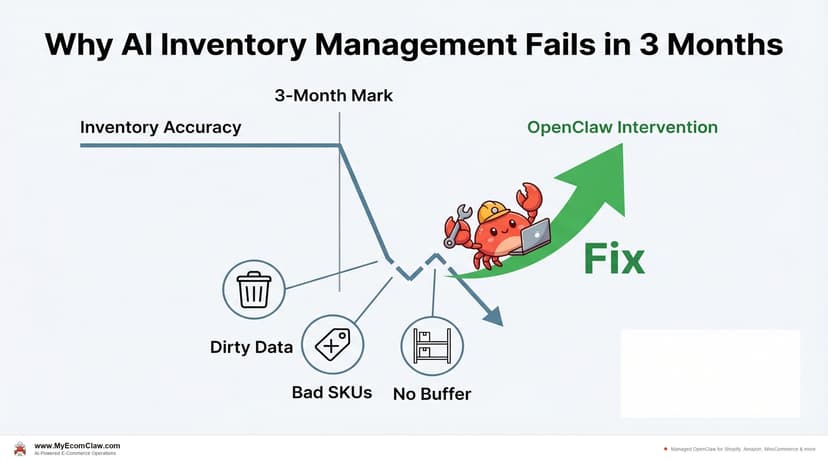
Why AI Inventory Fails in 3 Months
90% of merchants misunderstand AI for inventory. AI doesn’t fix bad data — it amplifies it. Here are the 5 most common failures and how.