Shopify Meta App Broken? AI Fix

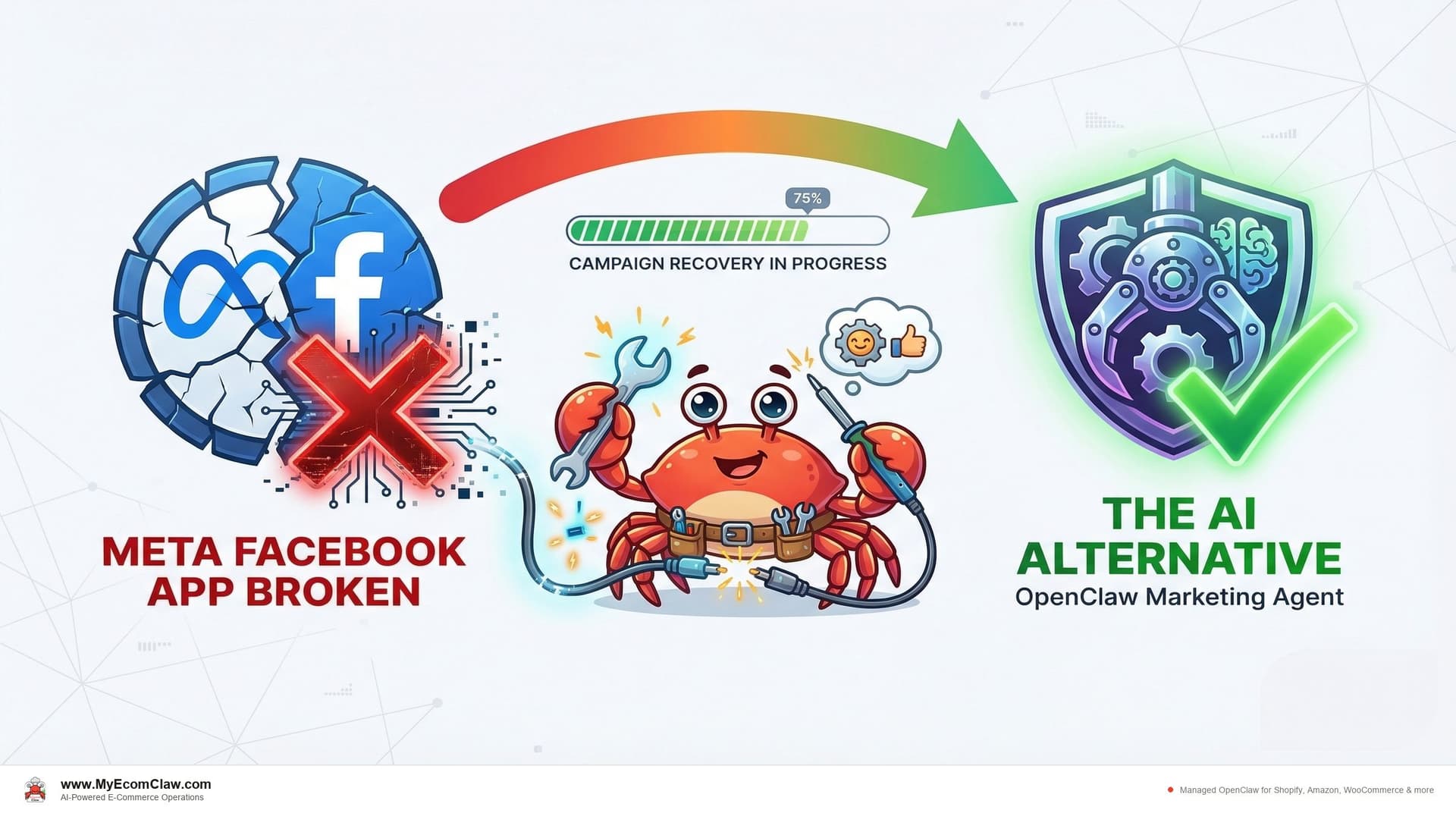
If you woke up this week and found your Shopify Facebook sales channel disconnected, your product catalog missing from Instagram, and your ad campaigns throwing errors — you’re not alone. And no, it’s not something you did.
In March 2026, widespread reports have flooded r/shopify, the Shopify Community forums, and X/Twitter: the "Facebook & Instagram by Meta" app is broken. Again. Sellers are losing active campaigns, product listings are disappearing from Facebook and Instagram shops, and the reconnection flow loops endlessly without actually reconnecting.
If you’re reading this because you just Googled "Shopify Facebook app not working" — take a breath. We’re going to cover exactly what’s happening, what you can do right now, and how to make sure a Meta app failure never takes down your marketing again.
What’s actually happening (March 2026)
The "Facebook & Instagram by Meta" app is the official connector between your Shopify store and Meta’s advertising and commerce ecosystem. When it works, it syncs your Shopify product catalog to Facebook and Instagram, lets you run dynamic product ads, and enables checkout through Facebook and Instagram shops.
When it doesn’t work — and right now, it doesn’t — here’s what breaks:
Reported issues this month:
- Product catalog sync failure. Products stop syncing from Shopify to Meta. New products don’t appear. Updated prices and stock levels don’t reflect. Some sellers report their entire catalog disappearing from Facebook Shop.
- Sales channel disconnection. The Facebook & Instagram sales channel in Shopify shows "disconnected" or "reconnection required." The reconnection flow loops back to the same error screen.
- Ad campaign disruption. Dynamic product ads that pull from the Shopify catalog stop showing products — or show outdated inventory. Some sellers report campaigns being paused by Meta automatically due to catalog errors.
- Pixel and conversion tracking broken. The Meta Pixel stops firing on some Shopify stores, breaking conversion tracking and making it impossible to measure ad ROI.
- Commerce Manager access issues. Sellers can’t access their Meta Commerce Manager from within Shopify, getting "permission denied" or blank screen errors.
Why this keeps happening
This isn’t the first time. The "Facebook & Instagram by Meta" app has had connection issues in 2023, 2024, 2025, and now 2026. The pattern is predictable:
Meta updates its API (they do major version changes roughly every year).
The Shopify app breaks because the connector hasn’t been updated to match.
Sellers lose campaigns — sometimes for days, sometimes for weeks.
Meta and Shopify point fingers. Meta says it’s Shopify’s app. Shopify says it’s Meta’s API changes. Sellers are stuck in the middle.
A fix eventually ships — but by then, sellers have lost revenue, wasted ad spend, and spent hours troubleshooting.
Here’s what a Reddit user posted this week on r/shopify:
"My Facebook catalog has been disconnected for 3 days. I’ve uninstalled and reinstalled the app twice. Support from both Shopify and Meta is useless — each one tells me it’s the other’s problem. I’m losing $500/day in ad-driven sales."
Sound familiar?
What you can do right now (emergency fixes)
Before we talk about the long-term fix, here are immediate steps if your Meta app is currently broken:
Step 1: Check Meta’s status page. Go to developers.facebook.com/status. If there’s a known outage, you’ll see it listed. In that case, the fix is on Meta’s side — all you can do is wait.
Step 2: Uninstall and reinstall the app. In Shopify Admin, go to Settings → Apps → Facebook & Instagram by Meta → Uninstall. Wait 5 minutes. Reinstall from the Shopify App Store. This sometimes forces a fresh OAuth connection.
Step 3: Check your Meta Business Suite permissions. Go to business.facebook.com → Settings → Business Assets. Verify your Shopify app still has permissions for your catalog, pixel, and ad account. Revoked permissions are a common silent failure.
Step 4: Re-authenticate your catalog. In Meta Commerce Manager, go to Catalog → Data Sources. Remove the Shopify data source and re-add it. This forces a fresh catalog sync.
Step 5: Contact support — both sides. Open a ticket with Shopify support AND Meta Business Help. Reference the specific error messages. Get ticket numbers from both.
These steps work about 60% of the time. For the other 40%, you’re waiting for a patch from Meta or Shopify — and that can take days to weeks.
The real cost of the Meta app breaking
Let’s do the math on what this outage costs a mid-size Shopify seller.
| Impact | Conservative Estimate | Aggressive Estimate |
|---|---|---|
| Lost ad-driven revenue (campaigns paused/broken) | $200/day | $1,000/day |
| Wasted ad spend (ads running with broken catalog) | $50/day | $300/day |
| Time spent troubleshooting | 2 hours/day at $50/hr | 4 hours/day at $75/hr |
| Lost product visibility (catalog missing from FB/IG shops) | $100/day in organic sales | $500/day |
| Customer confusion (out-of-stock shown as available) | 2-3 support tickets/day | 10+ tickets/day |
🔥 For a 3-day outage:
- Conservative: $1,350 in lost revenue + wasted spend + labor
- Aggressive: $6,600 in lost revenue + wasted spend + labor
- For a 7-day outage: $3,150 to $15,400
And this happens multiple times per year.
The math gets worse when you factor in the long-tail effects: broken conversion tracking means your future campaigns can’t optimize properly. A week of bad data corrupts your ad account’s learning phase. You’re not just losing this week’s sales — you’re degrading next month’s performance.

The alternative: OpenClaw Marketing Agent with direct API
Here’s the architectural difference. The Meta Shopify app is a middleware layer — it sits between Shopify and Meta, translating data between the two. When that middleware breaks, your entire connection breaks.
OpenClaw’s Marketing Agent doesn’t use the "Facebook & Instagram by Meta" app. It connects to the Meta Marketing API directly — the same API that major agencies and enterprise advertisers use. And it connects to your Shopify Admin API directly. No middleware. No Shopify app acting as a fragile bridge.
What the Marketing Agent does:
| Capability | Meta Shopify App | OpenClaw Marketing Agent |
|---|---|---|
| Product catalog sync | Through the Shopify app (breaks when app breaks) | Direct Shopify Admin API → Meta Catalog API (no app dependency) |
| Campaign management | Through Meta Commerce Manager (within Shopify) | Direct Meta Marketing API + WhatsApp commands |
| Dynamic product ads | Depends on app-synced catalog | Builds catalog directly from your Shopify product data |
| Conversion tracking | Meta Pixel via Shopify app | Server-side Conversions API (more reliable, privacy-compliant) |
| Campaign monitoring | Log into Facebook Ads Manager | WhatsApp: "How are my Facebook ads doing?" |
| Emergency response | Manually pause in Ads Manager | Agent auto-pauses campaigns when inventory is low |
| Resilience | Breaks when Meta or Shopify updates the app | Direct API — only breaks if Meta deprecates the API itself (announced 12+ months in advance) |
The key difference: APIs are versioned and deprecation is announced 12+ months ahead. App breakages happen without warning. One is plannable. The other is a fire drill.

Managing Facebook campaigns from WhatsApp
Here’s what campaign management looks like when your OpenClaw Marketing Agent is running — and the Meta Shopify app has no part in it.
How are my Facebook campaigns doing?
Here’s your Meta Ads summary for today:
📣 Active Campaigns: 3
1. Spring Sale — Broad — $45 spent, $312 revenue (6.9x ROAS), 8 purchases
2. Retargeting — Cart Abandoners — $22 spent, $189 revenue (8.6x ROAS), 4 purchases
3. Lookalike — Top Buyers — $33 spent, $156 revenue (4.7x ROAS), 3 purchases
📊 Total: $100 spent, $657 revenue, 7.6x blended ROAS
⚠️ Note: “Lookalike — Top Buyers” ROAS has dropped from 6.2x to 4.7x over 3 days. Recommend refreshing creative or pausing for audience reset.
Pause the lookalike campaign. Create a new one targeting repeat buyers with the new hoodie collection. $40/day budget.
✅ “Lookalike — Top Buyers” paused.
✅ New campaign created: “Repeat Buyers — Hoodie Collection”
– Audience: Customers with 2+ purchases in last 90 days
– Products: New hoodie collection (6 products synced from Shopify)
– Budget: $40/day
– Creative: Dynamic product ads using Shopify product images
– Status: In review (Meta typically approves in 1-2 hours)
I’ll notify you when it’s live and send a performance update at 6 PM.
That entire interaction happened without opening Facebook Ads Manager, without the Meta Shopify app, and without a browser. Your agent connected to the Meta Marketing API directly, using your own API credentials stored on your own server.
Before & after: Meta app dependency vs. direct API
Before: Your marketing depends on the Meta Shopify app
| Situation | What Happens |
|---|---|
| Meta app working | Campaigns run, catalog syncs, life is good |
| Meta app breaks (3-4x per year) | Catalog disconnects, ads break, revenue stops, you spend hours troubleshooting |
| Meta updates their API | App may break without warning, downtime until Shopify pushes a patch |
| You need to pause a campaign urgently | Log into Facebook Ads Manager, navigate to campaign, pause manually |
| You want to check ad performance | Open Facebook Ads Manager or Shopify marketing tab |
| Catalog sync delays | Products show old prices/stock on Facebook, causing customer complaints |
After: Your marketing runs through direct API via OpenClaw
| Situation | What Happens |
|---|---|
| Meta Shopify app status | Irrelevant — you’re not using it for campaigns |
| Meta API version update | Announced 12+ months ahead, your agent configuration is updated by MyEcomClaw during routine maintenance |
| You need to pause a campaign urgently | WhatsApp: “Pause the spring sale campaign” → done in 3 seconds |
| You want to check ad performance | WhatsApp: “How are my Facebook ads doing?” → full report in 5 seconds |
| Catalog sync | Direct Shopify API → Meta Catalog API, real-time, no middleware |
| Inventory drops on a product with active ads | Marketing Agent auto-pauses the campaign, notifies you on WhatsApp |
🔥 The difference in one sentence: With the Meta app, your marketing depends on a fragile connector that breaks multiple times per year. With OpenClaw, your marketing runs on the same direct API that enterprise brands use — and you manage it from WhatsApp.
The cost comparison
| Relying on Meta Shopify App | MyEcomClaw Marketing Agent | |
|---|---|---|
| Monthly cost | Free (the app) + ad spend | $599/mo (Growth plan) + ad spend |
| Annual app-related downtime | 7-21 days across 3-4 outages | 0 days (direct API, no app dependency) |
| Revenue lost during outages | $1,400-$21,000/year (based on store size) | $0 — campaigns keep running |
| Time spent troubleshooting | 20-40 hours/year at $50-$75/hr = $1,000-$3,000/year | 0 hours — agent handles API changes |
| Campaign management interface | Facebook Ads Manager (browser) | WhatsApp + auto-optimization |
| Cross-channel coordination | None — marketing isolated from inventory/support | Full — Marketing Agent coordinates with Inventory and Support agents |
| Data ownership | Meta stores your customer and campaign data | Your server. Your data. MIT licensed. |
| True annual cost | $2,400-$24,000 in losses + your ad spend | $7,188/year + your ad spend |
The "free" Meta app isn’t free when you count the outages. A Shopify seller losing $500/day in ad-driven revenue for 7 days across the year loses $3,500 — more than half the annual cost of the Growth plan. And that’s a conservative estimate.

Server-side tracking: the hidden advantage
Here’s a technical benefit most sellers don’t know about. The Meta Shopify app relies primarily on the Meta Pixel (browser-based tracking) for conversion data. Browser-based tracking is increasingly unreliable because of iOS privacy changes, ad blockers, and browser cookie restrictions.
OpenClaw’s Marketing Agent uses the Meta Conversions API (server-side tracking) as the primary data source. This means:
- Conversion data comes from your server, not the browser. It’s not affected by ad blockers, iOS App Tracking Transparency, or cookie restrictions.
- Better match rates. Server-side events typically achieve 20-40% higher match rates than pixel-only tracking.
- More accurate ROAS. When your conversion data is more complete, Meta’s algorithm optimizes better — leading to lower CPAs and higher ROAS over time.
- Privacy compliant. Server-side tracking is the direction regulators and platforms are moving. You’re ahead of the curve.
This isn’t just about surviving Meta app outages. It’s about running better campaigns because your data pipeline is more reliable.
Why this matters for your business
The "Facebook & Instagram by Meta" app breaking isn’t a one-time event. It’s a structural vulnerability in your marketing stack. Every Shopify seller who depends on it is one Meta API update away from losing campaigns, revenue, and days of productivity.
The direct API approach isn’t just a workaround — it’s how enterprise brands have always done it. They don’t install a Shopify app and hope it keeps working. They connect to Meta’s Marketing API directly, with their own infrastructure, under their own control.
OpenClaw makes that enterprise-grade approach accessible to SME Shopify sellers. Your Marketing Agent connects to Meta’s API directly, runs on your own server, and lets you manage everything from WhatsApp. No fragile middleware. No dependency on a Shopify app that breaks multiple times per year.
Your data stays on your server. OpenClaw is MIT licensed — 191,000+ GitHub stars, the most popular open-source AI agent in the world. No lock-in, no black boxes.
Our take
The Meta Shopify app breaking in March 2026 is frustrating, but it’s also clarifying. It shows exactly what you risk when your marketing depends on a single connector app that neither Shopify nor Meta seems to prioritize fixing quickly.
Every seller we’ve talked to this week has the same story: "I was running campaigns, they were working, and then everything just stopped." That’s not a bug report — that’s a business model risk.
The fix isn’t a better app. The fix is removing the app from the equation entirely. Direct API access. Server-side tracking. WhatsApp-based campaign management. And an AI agent that coordinates your marketing with your inventory and support — so when stock drops, ads pause automatically, before you even know there’s a problem.
If the Meta app breaking cost you even one day of revenue this month, the math is simple. See plans starting at $299/mo → · Talk to our team about migrating →
Built on OpenClaw — 191,000+ GitHub stars, MIT licensed. Your Marketing Agent runs on your server, connected directly to Meta’s API. No third-party app handling your ad data. Starting at $299/mo. See plans →

FAQ
Is the “Facebook & Instagram by Meta” Shopify app actually broken right now?
As of March 2026, yes — widespread reports on r/shopify, Shopify Community forums, and X/Twitter indicate connection failures, catalog sync issues, and campaign disruptions. The severity varies by account. Check Meta’s developer status page for official updates. If your app is broken, the emergency fixes in this article may help. For a permanent fix, consider direct API access through OpenClaw. Talk to our team →
Does OpenClaw completely replace the Meta Shopify app?
For advertising and campaign management, yes. OpenClaw’s Marketing Agent connects to Meta’s Marketing API and Shopify’s Admin API directly — no Shopify app needed. However, if you use Facebook Shop or Instagram Shop as checkout channels (where customers buy directly on Facebook/Instagram), those features are tied to the Meta app and can’t be fully replaced by API access alone. Most Shopify sellers primarily use Meta for advertising (not checkout), which is fully covered.
How does OpenClaw connect to Meta without the Shopify app?
The Marketing Agent uses your Meta Marketing API credentials (app ID, app secret, access token) to connect directly to Meta’s API infrastructure. These credentials are stored on your own server, not on a shared cloud. The connection is the same one used by major agencies and enterprise advertisers — it’s more stable than the Shopify app connector because it doesn’t have the middleware translation layer.
Will my existing Facebook campaigns keep running if I switch?
Yes. Your existing campaigns, ad sets, audiences, and creative assets live in your Meta ad account — not in the Shopify app. Switching to direct API management through OpenClaw doesn’t affect existing campaigns. The agent connects to your existing ad account and picks up where the Shopify app left off. Book a migration walkthrough →
Is server-side tracking really better than the Meta Pixel?
Yes, for most Shopify sellers. Server-side tracking via the Meta Conversions API is not affected by ad blockers, iOS privacy restrictions, or browser cookie limitations. It typically achieves 20-40% higher event match rates compared to pixel-only tracking. Meta’s own documentation recommends using the Conversions API alongside (or instead of) the pixel. OpenClaw implements this by default.
What does this cost?
MyEcomClaw’s Growth plan is $599/month with a $999 one-time setup fee. This includes all 5 AI agents (Orders, Inventory, Support, Marketing, Orchestration) deployed on your own private server. The Marketing Agent handles Meta campaign management, but you also get inventory sync, order processing, customer support automation, and cross-agent coordination. WhatsApp access is $49/month as an add-on. See all plans →
Can I keep using the Meta Shopify app AND use OpenClaw?
Yes. You can run both simultaneously during a transition period. The Marketing Agent won’t conflict with the Shopify app — they connect through different pathways. Most sellers start by running both in parallel, then phase out the Shopify app once they’re comfortable with WhatsApp-based campaign management.
Don’t let a broken Shopify app control your marketing.
MyEcomClaw deploys OpenClaw on your own server with direct Meta API access — no Shopify app dependency. Manage campaigns from WhatsApp. Server-side tracking by default. Your data stays on your server. MIT licensed. No lock-in.
More from Guides
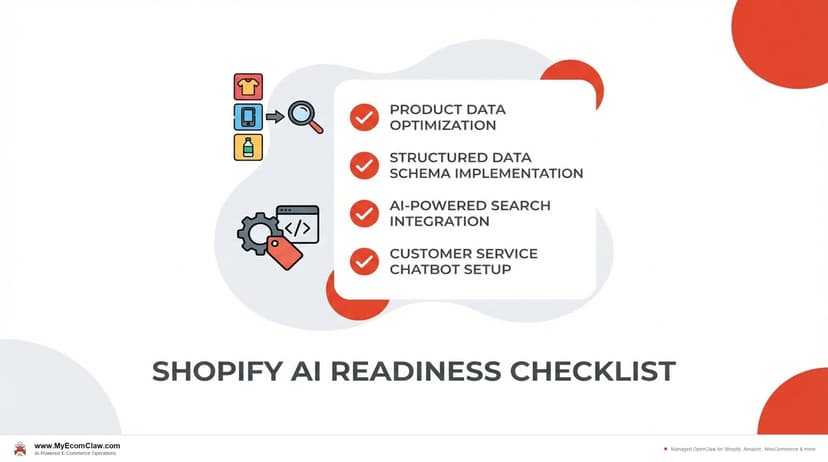
AI-Ready Shopify Checklist: 15 Fixes
AI shopping agents from ChatGPT, Google, and Perplexity are already recommending products. If your Shopify store isn’t structured for them, you’re invisible. Here are 15 things to fix before agents shop your store.
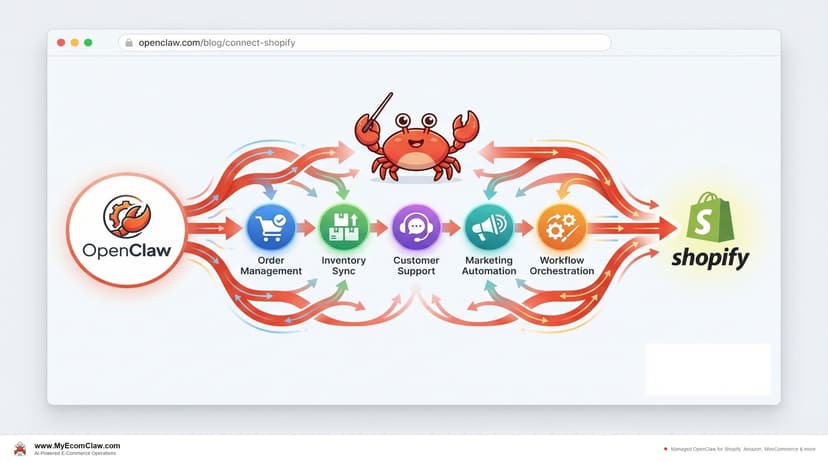
Connect OpenClaw to Shopify (2026 Guide)
OpenClaw has 191K+ GitHub stars — but connecting it to Shopify takes Admin API credentials, Composio OAuth, MCP configuration, and a week of DevOps.
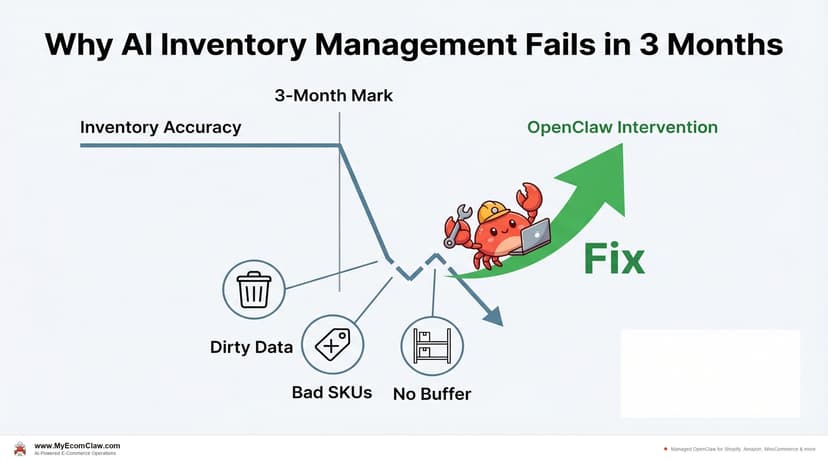
Why AI Inventory Fails in 3 Months
90% of merchants misunderstand AI for inventory. AI doesn’t fix bad data — it amplifies it. Here are the 5 most common failures and how.