Shopify Tax Changes 2026: Key Updates

A seller on the Shopify Community forum posted last month: "I just got a letter from the state of Colorado saying I owe $14,200 in back sales tax. I’ve been selling on Shopify for 3 years and didn’t know I had nexus there."
The replies were a mix of sympathy and panic. One response: "Same thing happened to me with Illinois. I thought I only had to collect in states where I had a warehouse." Another: "This is my nightmare. I sell to all 50 states and have no idea where I’m supposed to be collecting."
These aren’t careless sellers. They’re busy sellers who thought Shopify’s built-in tax settings were handling everything. In many cases, Shopify was calculating the tax correctly — but nobody told the seller they needed to register for a sales tax permit in those states first.
And 2026 is making the problem worse, not better. Enforcement is tightening. Thresholds are shifting. New product categories are becoming taxable. If you’re a Shopify seller and you haven’t reviewed your tax setup since last year, you’re exposed.
What’s changing in 2026: the four big shifts
Shift 1: Tighter enforcement everywhere
States are investing heavily in automated tax compliance auditing. The Streamlined Sales Tax Governing Board has expanded its data-sharing program, making it easier for states to identify out-of-state sellers who should be collecting tax but aren’t.
What this means for you: States that previously didn’t have the resources to chase small-to-mid-size e-commerce sellers now do. If you crossed a state’s economic nexus threshold in 2024 or 2025 and didn’t register, 2026 is when the letters start arriving.
🔥 The enforcement reality:
- 30+ states now use automated marketplace data to identify non-compliant sellers
- Average back-tax assessment: $8,000-$25,000 for a mid-volume Shopify seller
- Penalties: 10-25% of unpaid tax + interest (varies by state)
- Timeline: States are auditing 2-3 years back, not just the current year
Shift 2: Economic nexus thresholds are tightening
Since South Dakota v. Wayfair (2018), states can require out-of-state sellers to collect sales tax once they exceed certain thresholds. The standard was $100,000 in sales or 200 transactions in a state. But that’s changing.
2026 changes:
- Several states have eliminated the transaction count threshold — now it’s revenue-only
- Some states are lowering the revenue threshold below $100,000
- States like New York and California are enforcing more aggressively at existing thresholds
- Marketplace facilitator laws are expanding — if you sell on Amazon AND Shopify, your combined sales may trigger nexus even if neither channel alone crosses the threshold
Here’s the part that catches sellers off-guard: Amazon already remits tax on your behalf for marketplace sales. But your Shopify direct sales? That’s on you. And if the combination of both channels puts you over the threshold in a state, you’re on the hook for Shopify sales tax in that state.
Shift 3: Digital goods and SaaS taxability
More states are expanding their definitions of taxable goods to include digital products, SaaS subscriptions, and downloadable content. If you sell digital downloads, online courses, ebooks, or digital gift cards on Shopify, the taxability map just got more complex.
Newly taxable in some states (2025-2026):
- Digital audiobooks and ebooks
- Streaming service subscriptions
- Downloaded software and plugins
- Digital art and photography
- Online course access
Why this matters for Shopify sellers: Shopify’s built-in tax engine handles physical goods well. But digital goods taxability varies wildly by state — some states tax all digital goods, some tax only certain categories, and some exempt them entirely. If you sell both physical and digital products, your tax calculations need product-level granularity.
Shift 4: Supplement and bundle classification rules
States are cracking down on product classification. Dietary supplements, which were previously treated as food (often tax-exempt) in many states, are now being reclassified as taxable goods. Product bundles that include a mix of taxable and non-taxable items have new apportionment rules.
The bundle problem: If you sell a "Wellness Bundle" on Shopify that includes a taxable supplement, a non-taxable food item, and a taxable accessory, the tax calculation depends on the state, the proportion of taxable vs. non-taxable items, and whether the bundle is priced as a single unit or itemized.
Shopify’s native tax engine doesn’t handle this granularity. Neither do most tax apps — they calculate tax at the line-item level but don’t understand bundle apportionment rules.
What Shopify does (and doesn’t do) for tax compliance
Let’s be specific about Shopify’s tax capabilities in 2026:
What Shopify handles:
- Basic sales tax calculation using Shopify Tax (their built-in engine)
- Tax rates for US states based on shipping destination
- EU VAT calculation with basic digital goods support
- Tax-exempt customer tagging
- Tax report generation for filing
What Shopify does NOT handle:
| Gap | Impact | What You Need |
|---|---|---|
| Nexus determination | Shopify doesn’t tell you which states you have nexus in | Multi-state sales tracking + threshold monitoring |
| Registration filing | Shopify doesn’t register you for sales tax permits | Manual registration or tax service |
| Product classification | Basic categories only — doesn’t handle supplement/food/digital edge cases | Product-level tax code management |
| Bundle apportionment | No native support for mixed-taxability bundles | Custom tax rules per bundle |
| Multi-channel nexus | Doesn’t combine Shopify + Amazon sales for nexus calculation | Cross-channel revenue aggregation |
| Compliance monitoring | No alerts when thresholds change or new rules take effect | Ongoing regulatory monitoring |
| Filing and remittance | Generates reports but doesn’t file returns or send payments | Manual filing or tax service integration |
Shopify Tax is a calculator, not a compliance system. It answers "how much tax should I charge on this order?" It does not answer "am I supposed to be charging tax in this state at all?" Those are two very different questions.
How OpenClaw agents help with tax compliance
OpenClaw isn’t a tax calculation engine — Shopify Tax or third-party apps like TaxJar and Avalara handle rate calculation. What OpenClaw’s agents do is manage the operational complexity around tax compliance that no calculator addresses.
Auto-tax calculation monitoring
The Order Agent monitors every transaction for correct tax application. When an order is placed from a state where you haven’t configured tax collection, the agent flags it immediately.
WhatsApp alert example:
Yes, generate the report. And add Colorado to my nexus watchlist.
✅ Colorado sales report generated — 412 orders, $97,400 revenue. Report saved.
✅ Colorado added to nexus watchlist. I’ll alert you when you cross $100,000.
That conversation identified a $14,000+ exposure 2 weeks before it became a compliance problem. No tax app does this.
Multi-state nexus monitoring
The Inventory Agent and Order Agent work together to track your revenue by state across all channels — Shopify, Amazon, WooCommerce. The Orchestration Agent aggregates this data and compares it against each state’s economic nexus threshold.
Monthly nexus dashboard (delivered via WhatsApp):
Your Agent (WhatsApp, 1st of month): 📊 Monthly Nexus Report — March 2026:
States where you’re registered and collecting: 12 states ✅ States approaching threshold (action needed):
- Colorado: $97,400 / $100,000 threshold (97%) — register now
- Georgia: $82,000 / $100,000 threshold (82%) — monitor
- Michigan: $71,500 / $100,000 threshold (72%) — watch list
States where you crossed threshold without registering: 0 ✅
Want the full state-by-state breakdown?
Compliance change alerts
Tax rules change constantly. New states adopt new thresholds. Product classifications shift. Filing deadlines move. The Orchestration Agent monitors regulatory updates and alerts you when something affects your store.
Example alert:
🔔 Tax rule change affecting your store:
Effective April 1, 2026: Illinois is reclassifying dietary supplements as taxable (previously food-exempt). You sell 3 supplement SKUs on Shopify that ship to Illinois. Your Shopify tax settings need to be updated to charge tax on these products for Illinois orders.
Want me to flag the affected SKUs and generate a configuration checklist?

Before and after: tax compliance as a Shopify seller
Before: Tax season without OpenClaw
| Month | What Happens | Time Spent | Risk |
|---|---|---|---|
| January | Realize you need to check nexus thresholds for the past year | 4-6 hours | Missed thresholds from Q4 holiday sales |
| February | Discover you crossed nexus in 2 new states. Panic. Research registration process. | 6-8 hours | Back-tax liability accumulating |
| March | File late registrations. Calculate back-tax owed. Hire an accountant for $500. | $500 + 3 hours | Penalties for late registration |
| April | First quarterly filings due. Pull reports from Shopify, Amazon, WooCommerce separately. Reconcile manually. | 5-8 hours | Errors from manual data aggregation |
| Every month | Wonder if you’re compliant. Don’t have time to check. Push it to “next quarter.” | Ongoing anxiety | Exposure growing silently |
| Annual total | Reactive, stressful, error-prone | 20-30 hours + $500-$2,000 in fees | $8,000-$25,000 in potential back-tax |
After: Tax compliance with OpenClaw
| Month | What Happens | Time Spent | Risk |
|---|---|---|---|
| January | Agent sends annual nexus summary. Shows which states you crossed. Flags registration needs. | 5 min reading | Issues identified before they’re problems |
| February | Agent monitors daily. Alerts you 2 weeks before crossing any threshold. | 0 min (proactive alerts) | Zero surprise nexus crossings |
| March | Agent generates state-by-state tax reports for filing. All channels aggregated. | 10 min reviewing | Clean data, ready for your accountant |
| April | Filing reports pre-built. You or your accountant file in minutes, not hours. | 15 min | Accurate, complete, on time |
| Every month | Agent monitors thresholds, rule changes, and product classifications. Alerts only when action needed. | 1-2 min per alert | Continuous compliance |
| Annual total | Proactive, automated, calm | Under 5 hours | $0 in surprise back-tax |
🔥 The cost math:
- Without monitoring: $8,000-$25,000 in potential back-tax assessments + $500-$2,000 in reactive accounting
- With OpenClaw: $299-$599/mo ($3,588-$7,188/yr) — and zero surprise tax letters
- One prevented back-tax assessment pays for 1-3 years of the agent

The cost of getting tax wrong
| Consequence | Financial Impact | How Common |
|---|---|---|
| Back-tax assessment | $8,000-$25,000 per state (varies by revenue) | 1 in 5 multi-state sellers (and rising) |
| Late registration penalties | 10-25% of owed tax + interest | Automatic if you register after crossing nexus |
| Audit costs | $2,000-$10,000 in accounting/legal fees | Increasing as states expand automated auditing |
| Product misclassification | Under-collected tax = you owe the difference | Common with supplements, digital goods, bundles |
| Multi-channel nexus miss | Combined Shopify + Amazon revenue crosses threshold | Very common — Amazon remits its portion, Shopify doesn’t |
| Stress and distraction | Time not spent growing your business | Every seller who gets a letter |

The cross-agent advantage for tax compliance
Tax isn’t just the Order Agent’s job. Here’s how all 5 agents coordinate:
Order Agent: Tracks every transaction by state. Monitors tax collection status per order. Flags orders from states where tax isn’t being collected.
Inventory Agent: Tracks warehouse locations and fulfillment origins — critical for physical nexus determination. If you open a new warehouse or use a new 3PL, the agent factors it into nexus analysis.
Support Agent: When customers ask about tax charges (a common inquiry), the agent explains state-specific tax rates clearly. Reduces support tickets related to "why was I charged tax?"
Marketing Agent: When planning campaigns targeting specific states, the Marketing Agent cross-references with the tax compliance status. No point driving traffic from a state where you’re collecting tax incorrectly.
Orchestration Agent: Compiles all tax data into monthly nexus reports. Routes alerts to the right team members. Coordinates quarterly filing preparation across all channels.
No tax calculator does this. TaxJar tells you the rate. Avalara tells you the rate. Neither tells you that your Amazon + Shopify combined revenue just crossed the nexus threshold in Michigan and you need to register before the next filing deadline.
Built on OpenClaw — 191K+ GitHub stars, MIT licensed, the most popular open-source AI agent in the world. Built by Space-O Technologies — 15+ years, 80+ AI developers, 500+ projects delivered. Your server. Your data. No lock-in.

Why this matters for your business
Tax compliance isn’t exciting. Nobody started a Shopify store because they love sales tax. But it’s the kind of background operational risk that can turn a profitable year into a devastating one with a single letter from a state revenue department.
The sellers who navigate 2026 tax changes smoothly aren’t the ones with the best accountants. They’re the ones with systems that monitor compliance continuously — tracking nexus thresholds in real-time, flagging product classification changes, aggregating revenue across channels, and alerting before problems become penalties.
Most Shopify sellers check their tax compliance once a year. The states check it every day. That asymmetry is where the risk lives.
Our take
The tax landscape for e-commerce sellers gets more complex every year. 2026 is no exception — tighter enforcement, shifting thresholds, new product categories, bundle apportionment rules. And the response from the ecosystem is more tax apps, more SaaS subscriptions, more dashboards to check.
But the real problem isn’t calculating the tax. Shopify Tax and third-party calculators handle that well enough. The real problem is knowing where you need to be collecting, when thresholds change, which products are newly taxable, and how your multi-channel revenue affects nexus. That’s an operational intelligence problem, not a calculation problem.
OpenClaw’s agents don’t replace TaxJar or Avalara. They add the monitoring, alerting, and cross-channel intelligence layer that those tools don’t provide. Your Order Agent tracks revenue by state. Your Orchestration Agent compares it to nexus thresholds. Your agent messages you on WhatsApp two weeks before you cross a threshold — not two years after.
One prevented back-tax assessment of $14,000 pays for the agent for 2+ years. That’s not a theoretical ROI. That’s the math that seller on the Shopify Community forum wishes they had done last year.
Get ahead of 2026 tax changes. See plans starting at $299/mo → · Talk to us about tax compliance →
FAQ
Does OpenClaw replace TaxJar or Avalara?
No. OpenClaw’s agents handle the operational layer — nexus monitoring, threshold tracking, compliance alerting, cross-channel revenue aggregation, and product classification monitoring. TaxJar or Avalara handle the tax rate calculation and filing. They work together: the calculator determines the rate, the agent ensures you’re collecting in the right states and staying compliant.
How does OpenClaw know which states I have nexus in?
The Order Agent tracks every transaction by shipping destination and aggregates revenue by state across all your channels — Shopify, Amazon, WooCommerce. The Orchestration Agent compares your state-by-state revenue against each state’s economic nexus threshold (stored and updated in its configuration). When you approach or cross a threshold, you get a WhatsApp alert. Start monitoring your nexus exposure →.
What about marketplace facilitator laws? Amazon already collects tax.
Correct — Amazon remits sales tax on your behalf for marketplace sales. But your Shopify direct sales are your responsibility. And here’s the critical part: some states count your combined revenue (Amazon + Shopify) when determining if you’ve crossed the nexus threshold for direct sales. The agent tracks combined revenue to catch this scenario.
Can OpenClaw handle international tax (VAT, GST)?
The agent can monitor EU VAT thresholds and basic international tax rules. For complex international tax compliance (UK HMRC, EU One-Stop Shop, Australian GST), we recommend pairing OpenClaw with a dedicated international tax service. The agent provides the data aggregation and alerting; the tax service provides jurisdiction-specific rate calculation.
What if I’m already behind on tax compliance?
The agent can generate a historical revenue report by state across all channels, showing you exactly where you may have crossed nexus thresholds in previous years. This gives you and your accountant a clear picture of exposure so you can file voluntary disclosures or late registrations. Many states offer voluntary disclosure agreements (VDAs) that reduce penalties — your agent can flag which states offer them.
How much does a typical back-tax assessment cost?
For a mid-volume Shopify seller ($300K-$1M/yr in revenue), a back-tax assessment for a single state typically ranges from $8,000-$25,000, including unpaid tax, penalties (10-25%), and interest. Multi-state assessments can reach $50,000-$100,000+. These are real numbers from the Shopify Community forums and tax practitioner reports.
Does this work for sellers outside the US?
The nexus monitoring is US-focused (economic nexus is a US concept). For Canadian sellers (GST/HST/PST), the agent can track provincial sales thresholds. For EU sellers, it monitors One-Stop Shop registration thresholds. International tax compliance is an active area of skill development — reach out to discuss your specific needs. Contact us about international tax →.
Ready to stay ahead of 2026 tax changes — automatically?
MyEcomClaw deploys OpenClaw on your own server with agents that monitor nexus thresholds, track compliance changes, and alert you before problems become penalties. Across Shopify, Amazon, WooCommerce, and Walmart. Managed 24/7.
More from Guides
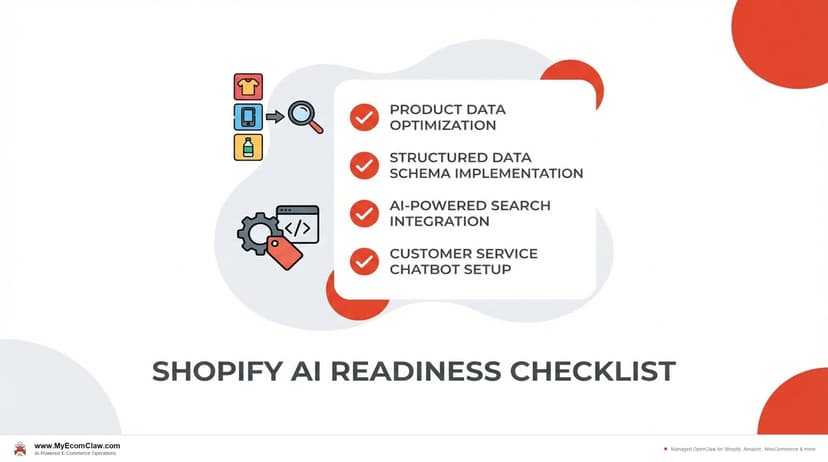
AI-Ready Shopify Checklist: 15 Fixes
AI shopping agents from ChatGPT, Google, and Perplexity are already recommending products. If your Shopify store isn’t structured for them, you’re invisible. Here are 15 things to fix before agents shop your store.
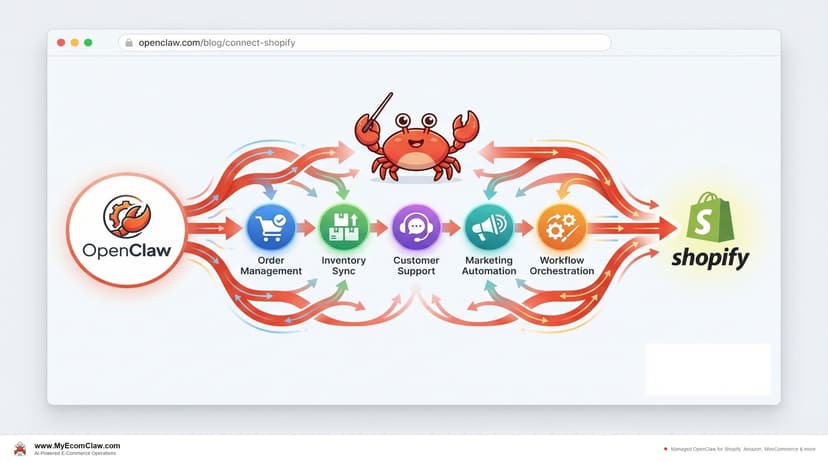
Connect OpenClaw to Shopify (2026 Guide)
OpenClaw has 191K+ GitHub stars — but connecting it to Shopify takes Admin API credentials, Composio OAuth, MCP configuration, and a week of DevOps.
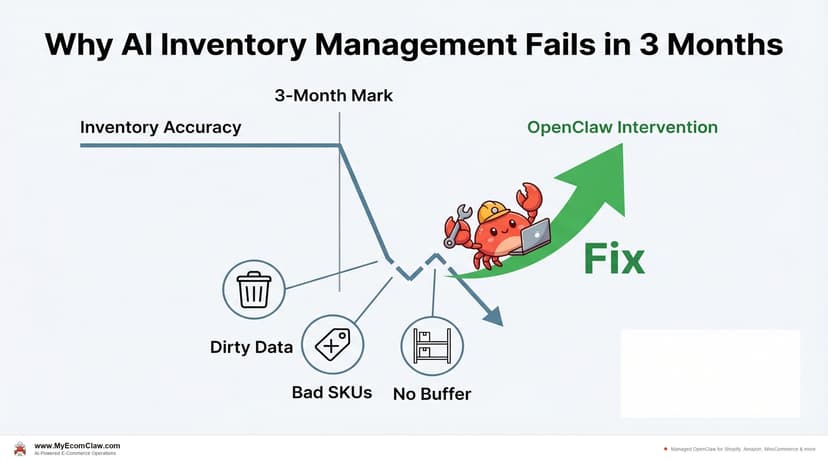
Why AI Inventory Fails in 3 Months
90% of merchants misunderstand AI for inventory. AI doesn’t fix bad data — it amplifies it. Here are the 5 most common failures and how.